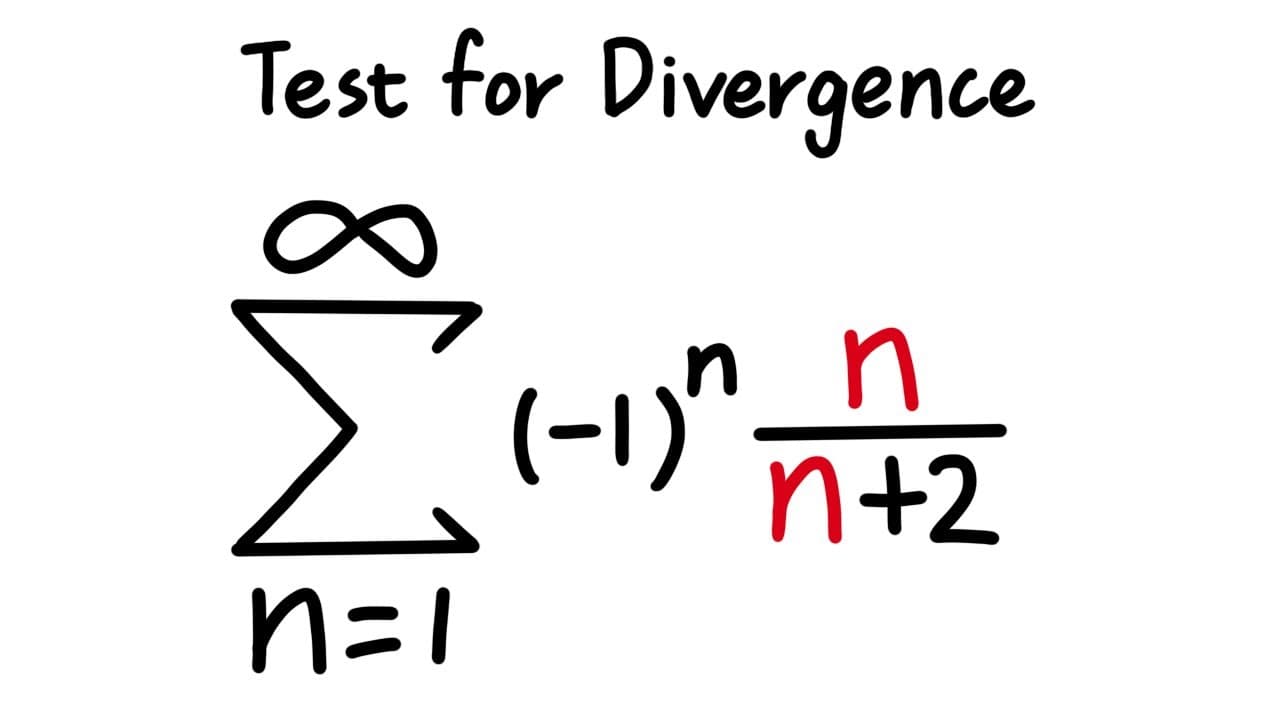
Alternating Series of (-1)^n*n/(n+2), calculus 2 tutorial
TL;DR
The provided content explains how to determine the divergence of an alternating series with sigma notation.
Transcript
converge or diverge Sigma as n goes from 1 to infinity parentheses negative 1 to the nth power times and over n plus 2 this is alternating because of this factor negative 1 in the parentheses to the nth power and then for this part we see that for this and over n plus 2 as n goes to infinity we know this part goes to 1 which is not 0 so we can show... Read More
Key Insights
- 💭 The series given is an alternating series, as indicated by the negative sign (-1) to the nth power.
- 😀 Testing for divergence is necessary, even for an L-tending series, to prove divergence.
- ⛔ The limit of the series is analyzed to determine its behavior as n approaches infinity.
- ⛔ The limit of the series is found to be non-existent, indicating that the series diverges.
- 👻 The test for divergence allows us to conclude that the series diverges if the limit does not approach zero.
- ⛔ The non-zero limit of the series indicates that it does not converge to a specific value.
- ⛔ The series cannot be classified as a convergent series due to the non-zero limit.
Install to Summarize YouTube Videos and Get Transcripts
Explore YouTube Video Summarizer or Get YouTube Transcript Extractor
Questions & Answers
Q: What is the significance of the negative sign in the series?
The negative sign (-1) in the series indicates that it is an alternating series, where the signs of the terms alternate between positive and negative.
Q: How do we determine if the series converges or diverges?
To determine if the series converges or diverges, we take the limit as n approaches infinity. If the limit is non-zero or does not exist, the series diverges.
Q: Why is the limit of the series analyzed using the test for divergence?
Although the series can be classified as an L-tending series, it is still necessary to use the test for divergence to prove that the series diverges.
Q: What happens when the limit of the series does not approach zero?
When the limit of the series does not approach zero, we can conclude that the series diverges, as per the test for divergence.
Summary & Key Takeaways
-
The content discusses the concept of convergence or divergence of the series as n goes from 1 to infinity.
-
The alternate sign (-1) in the series indicates that it is an alternating series.
-
By analyzing the limit of the series, it is concluded that the series diverges.
Read in Other Languages (beta)
Share This Summary 📚
Summarize YouTube Videos and Get Video Transcripts with 1-Click
Try YouTube Summary with ChatGPT & Claude or YouTube Transcript Generator
Explore More Summaries from blackpenredpen 📚
Summarize YouTube Videos and Get Video Transcripts with 1-Click
Try YouTube Summary with ChatGPT & Claude or YouTube Transcript Generator