What Are the Basic Properties of Probability Theory?
TL;DR
The basic properties of probability theory include non-negativity, that probabilities are less than or equal to one, and additivity. Probabilities of disjoint events can be calculated by summing their individual probabilities, and the probability of the empty set is always zero. These properties derive from the foundational probability axioms.
Transcript
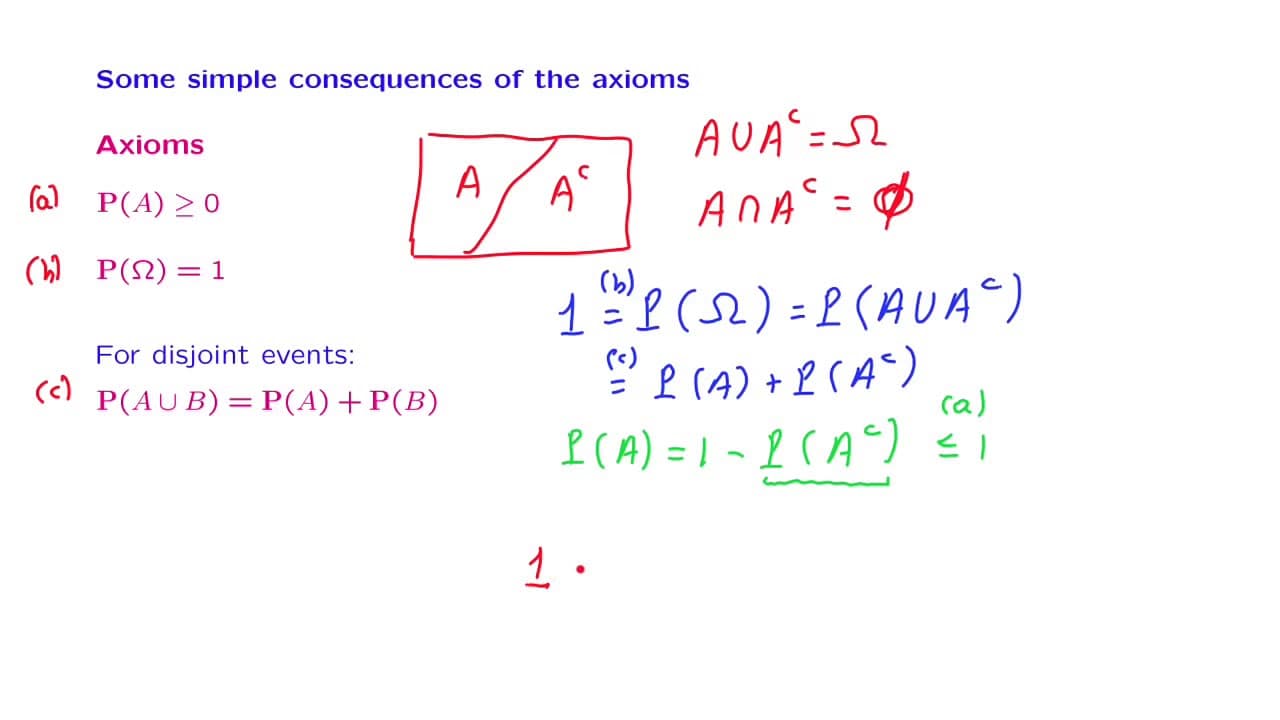
The probability axioms are the basic rules of probability theory. And they are surprisingly few. But they imply many interesting properties that we will now explore. First we will see that what you might think of as missing axioms are actually implied by the axioms already in place. For example, we have an axiom that probabilities are non-negative.... Read More
Key Insights
- 🛟 The probability axioms serve as the foundation of probability theory and imply various properties, including non-negativity, less than or equal to 1, and additivity.
- 🇪🇺 The proof of the additivity axiom for three disjoint events can be generalized to the union of finitely many disjoint events.
- 😫 The probability of the empty set is 0 because it is impossible for the outcome of an experiment to be in the empty set.
- 😫 Probability can be calculated by adding the probabilities of individual elements in a finite set.
Install to Summarize YouTube Videos and Get Transcripts
Explore YouTube Video Summarizer or Get YouTube Transcript Extractor
Questions & Answers
Q: What are the probability axioms?
The probability axioms are the basic rules of probability theory, including non-negativity, additivity, and a probability of 1 for the entire sample space.
Q: How does the additivity axiom generalize to the union of finitely many disjoint events?
The additivity axiom can be proven for the case of three disjoint events, and this proof can be extended to the union of any finite number of disjoint events by induction.
Q: What is the intuition behind probability being less than or equal to 1?
Probability being less than or equal to 1 means that the total probability of all possible outcomes in a sample space is never greater than 1, indicating that events cannot have a probability greater than certain.
Q: How can the probability of a finite set be calculated?
The probability of a finite set can be calculated by breaking it down into the union of single-element sets and applying the additivity property to find the sum of the probabilities of those individual elements.
Summary & Key Takeaways
-
The probability axioms are the basic rules of probability theory.
-
These axioms imply properties such as non-negativity, less than or equal to 1, and additivity.
-
The proof of the additivity axiom is demonstrated for the case of three disjoint events, but it can be generalized to the union of finitely many disjoint events.
Read in Other Languages (beta)
Share This Summary 📚
Summarize YouTube Videos and Get Video Transcripts with 1-Click
Try YouTube Summary with ChatGPT & Claude or YouTube Transcript Generator
Explore More Summaries from MIT OpenCourseWare 📚



Summarize YouTube Videos and Get Video Transcripts with 1-Click
Try YouTube Summary with ChatGPT & Claude or YouTube Transcript Generator