The Secret Plan Behind Artificial Intelligence
TL;DR
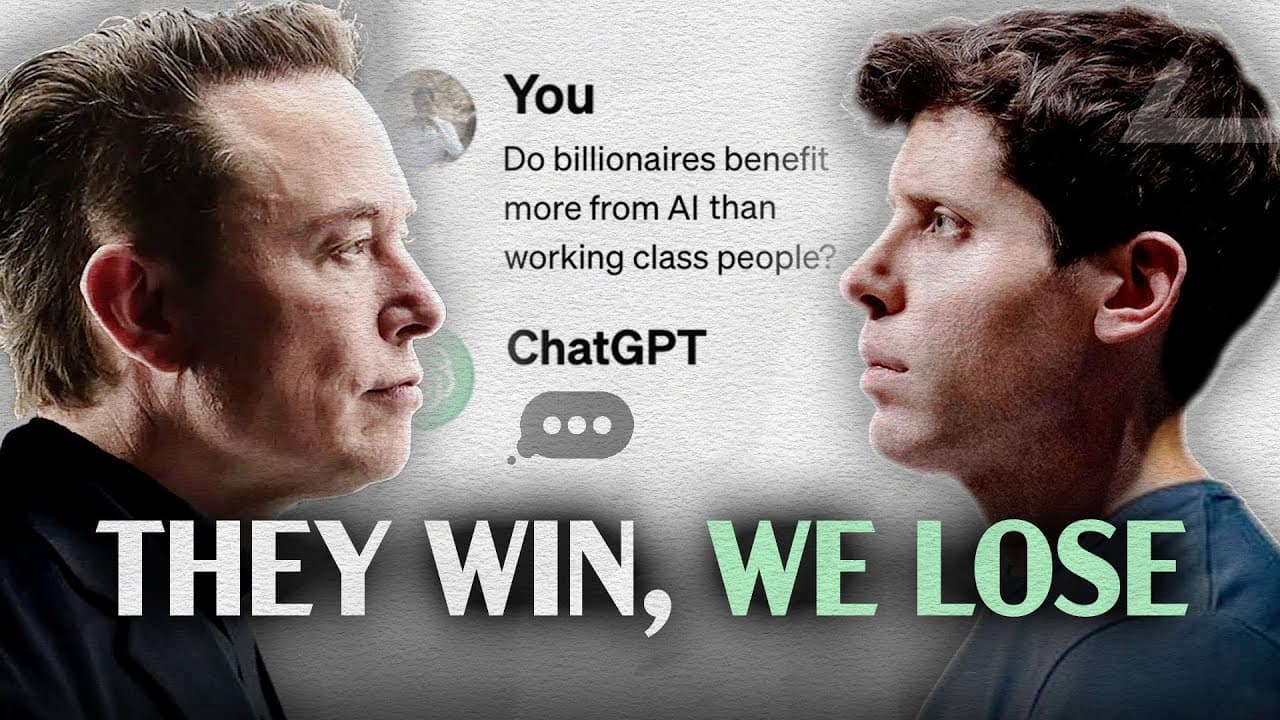
A few billionaires are fighting to control AI's future, impacting society.
Transcript
I want to say something that you would never expect to hear from More Perfect Union. Elon Musk is right about something. Elon Musk is suing the maker of ChatGPT... ...suing OpenAI... suing OpenAI for breach of contract... by putting profit ahead of benefiting humanity. Elon's lawsuit against OpenAI, the most recognized developer of artifici... Read More
Key Insights
- Elon Musk is suing OpenAI for prioritizing profit over humanity, highlighting a legal battle in the AI industry.
- AI is poised to revolutionize various sectors like biology, genomics, transportation, and retail, akin to past technological revolutions.
- A few billionaires are in a race to control AI, with companies like NVIDIA and Microsoft achieving significant valuations.
- Sam Altman, CEO of OpenAI, plays a crucial role in the AI industry's future, leveraging his experience from YCombinator.
- OpenAI, initially a nonprofit, transitioned to a mixed profit model, raising questions about its commitment to benefiting humanity.
- The narrative of AI's inevitability and danger benefits those developing it, as they push for monopolistic control.
- AI's rapid development is leading to job displacement, with plans to replace roles like nurses and media professionals.
- There's a call for collective action to ensure AI benefits all of humanity, drawing parallels to historical labor movements.
Install to Summarize YouTube Videos and Get Transcripts
Explore YouTube Video Summarizer or Get YouTube Transcript Extractor
Questions & Answers
Q: What is Elon Musk's lawsuit against OpenAI about?
Elon Musk's lawsuit against OpenAI accuses the organization of breaching its contract by prioritizing profit over the broader benefit of humanity. Musk's legal action highlights concerns about the direction in which AI development is heading, questioning the ethical implications of a profit-driven approach in an industry that holds the potential to significantly impact society.
Q: How is AI expected to impact various sectors?
AI is anticipated to revolutionize sectors such as digital biology, genomics, transportation, and retail. The technology is expected to bring about a transformation on par with the agricultural, industrial, and computer revolutions. This potential for broad application underscores the importance of ethical considerations in its development, as its influence could reshape industries and societal structures.
Q: Who is Sam Altman and what is his role in AI?
Sam Altman is the CEO of OpenAI and a key figure in the AI industry. He previously led YCombinator, a prominent venture capital firm and tech incubator, where he invested in well-known companies like Reddit and Airbnb. Altman's leadership at OpenAI, which transitioned from a nonprofit to a mixed profit model, positions him as a central player in the ongoing battle for control over AI's future.
Q: What concerns arise from OpenAI's transition to a mixed profit model?
OpenAI's shift from a nonprofit to a mixed profit model raises concerns about its commitment to benefiting humanity. Initially established to advance digital intelligence for the common good, its new structure suggests a potential alignment with profit-driven motives. This change prompts skepticism about whether OpenAI can balance its original mission with the demands of a capitalist framework, impacting its transparency and ethical stance.
Q: How does the narrative of AI's inevitability benefit its developers?
The narrative of AI's inevitability and potential danger benefits its developers by justifying their monopolistic pursuits. By framing AI as an unstoppable force, developers can argue for rapid advancement and control, positioning themselves as essential players in managing its risks. This narrative deflects attention from immediate ethical concerns and regulatory needs, enabling developers to prioritize profit and market dominance.
Q: What are the implications of AI on job security?
AI's rapid development poses significant threats to job security, with plans to replace human roles such as nurses and media professionals. The technology's ability to enhance productivity and efficiency could lead to widespread job displacement. This potential for disruption necessitates discussions on how to safeguard workers' interests and ensure that AI's benefits are equitably distributed, preventing exacerbation of existing inequalities.
Q: What historical parallels are drawn regarding AI's development?
The development of AI is paralleled with historical labor movements, such as the formation of the International Brotherhood of Electrical Workers, which advocated for safer jobs and better wages during the electrification era. This comparison highlights the potential for collective action to ensure that AI's transformative changes benefit working people. It suggests that, like past technological advancements, AI should be harnessed to improve societal welfare rather than solely serving corporate interests.
Q: What is the call to action regarding AI's impact on society?
There is a call for collective action to ensure that AI benefits all of humanity, rather than a select few. This involves advocating for regulations that address both immediate and long-term ethical concerns, drawing inspiration from historical labor movements that successfully balanced technological progress with workers' rights. By organizing and demanding equitable distribution of AI's benefits, society can prevent monopolistic control and ensure that technological advancements contribute positively to the common good.
Summary & Key Takeaways
-
Elon Musk's lawsuit against OpenAI raises concerns about the prioritization of profit over humanity's benefit in the AI industry. The rise of AI is compared to past technological revolutions, with significant impacts expected across various sectors.
-
A handful of billionaires are vying for control over AI, with companies like NVIDIA and Microsoft achieving high valuations. OpenAI, led by Sam Altman, plays a pivotal role, transitioning from a nonprofit to a mixed profit model.
-
The narrative of AI's inevitability and potential danger is used to justify monopolistic control by a few. This development threatens job security, prompting calls for collective action to ensure AI benefits all, akin to historical labor movements.
Read in Other Languages (beta)
Share This Summary 📚
Summarize YouTube Videos and Get Video Transcripts with 1-Click
Try YouTube Summary with ChatGPT & Claude or YouTube Transcript Generator
Explore More Summaries from More Perfect Union 📚






Summarize YouTube Videos and Get Video Transcripts with 1-Click
Try YouTube Summary with ChatGPT & Claude or YouTube Transcript Generator