String Theory Explained | Peter Woit and Lex Fridman
TL;DR
String theory is a highly complex and controversial theory that attempts to unify gravity and particle interactions, but it has faced difficulties in producing falsifiable predictions and finding consistency.
Transcript
you've been uh a bit of an outspoken critic of strength theory maybe one question first to ask is what is string theory and uh beyond that why is it wrong or rather the title of your blog says not even wrong okay well one interesting thing about the current state of strength theory is that i i think it i'd argue it's actually very very difficult to... Read More
Key Insights
- 👾 String theory aims to unify the standard model of particle interactions with gravity by using one-dimensional loops called strings moving in 10-dimensional space-time.
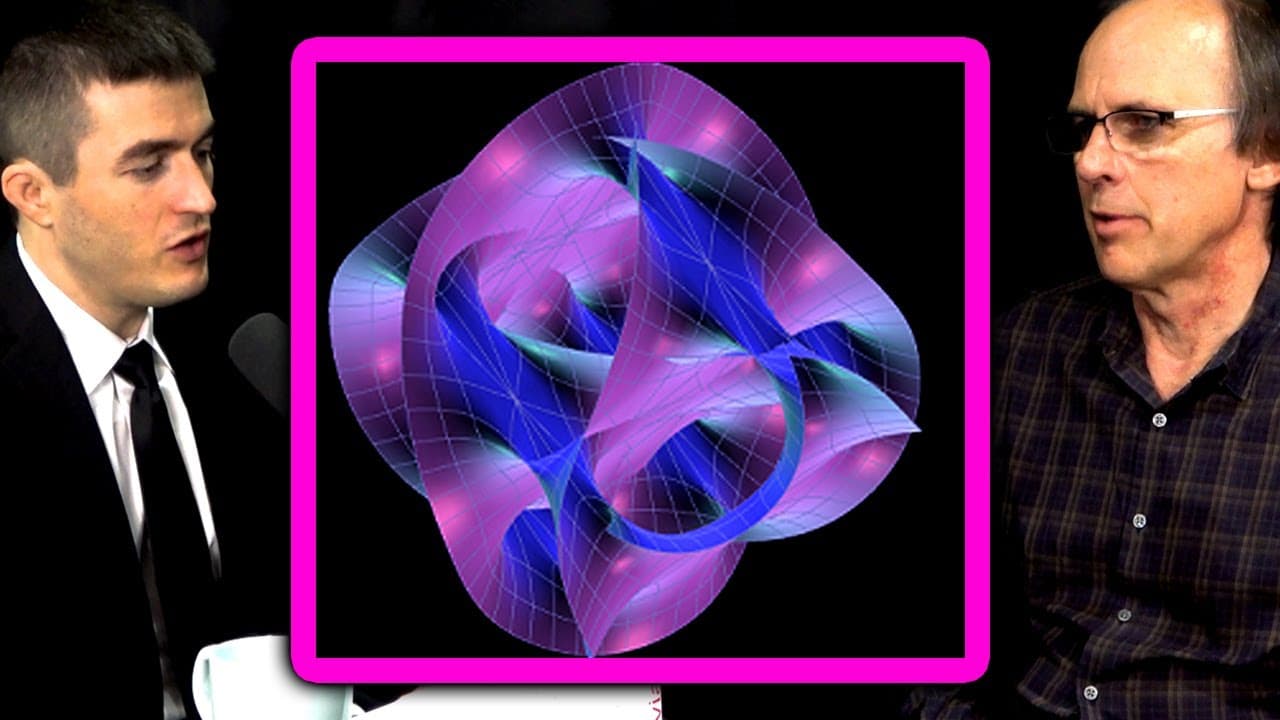
- 👍 The need to compactify six dimensions into tiny sizes has proven challenging, and finding consistent solutions, known as Calabi-Yau manifolds, remains difficult.
- 🥺 String theory has led researchers to explore fascinating mathematics and theories, such as two-dimensional conformal field theory.
Install to Summarize YouTube Videos and Get Transcripts
Explore YouTube Video Summarizer or Get YouTube Transcript Extractor
Questions & Answers
Q: What is the initial meaning of string theory?
The initial meaning of string theory dates back to developments in 1984 when researchers believed they had found a unified theory that combines the standard model of particle interactions and gravity. This theory involves one-dimensional loops (strings) moving in 10-dimensional space-time.
Q: Why has string theory faced challenges and criticism?
String theory's difficulties stem from the need to compactify six dimensions into small sizes while maintaining consistency. This requirement, known as Calabi-Yau manifolds, has limited available solutions and caused skepticism regarding the theory's ability to make falsifiable predictions.
Q: What are some positive outcomes of string theory research?
While string theory has not achieved its original goal of providing a unified theory of the universe, it has led to significant advancements in mathematics and other areas of physics. For example, two-dimensional conformal field theory, a branch of string theory, has revealed fascinating mathematical structures.
Q: How does the concept of "not even wrong" apply to string theory?
The phrase "not even wrong" encapsulates the idea that string theory did not provide enough concrete predictions or consistency to be proven wrong. Despite its initial promise, the theory has faced numerous challenges in achieving its original vision.
Summary & Key Takeaways
-
String theory proposes a quantum theory of one-dimensional loops (strings) moving in 10-dimensional space-time, aiming to unify the standard model of particle interactions and gravity.
-
The theory suggests that six dimensions must be compactified into tiny sizes, but finding consistent solutions, called Calabi-Yau manifolds, has proven challenging.
-
String theory has led to discoveries in other areas of physics and mathematics, such as two-dimensional conformal field theory, but has struggled to provide a framework that accurately describes the real world.
Read in Other Languages (beta)
Share This Summary 📚
Summarize YouTube Videos and Get Video Transcripts with 1-Click
Try YouTube Summary with ChatGPT & Claude or YouTube Transcript Generator
Explore More Summaries from Lex Clips 📚



Summarize YouTube Videos and Get Video Transcripts with 1-Click
Try YouTube Summary with ChatGPT & Claude or YouTube Transcript Generator