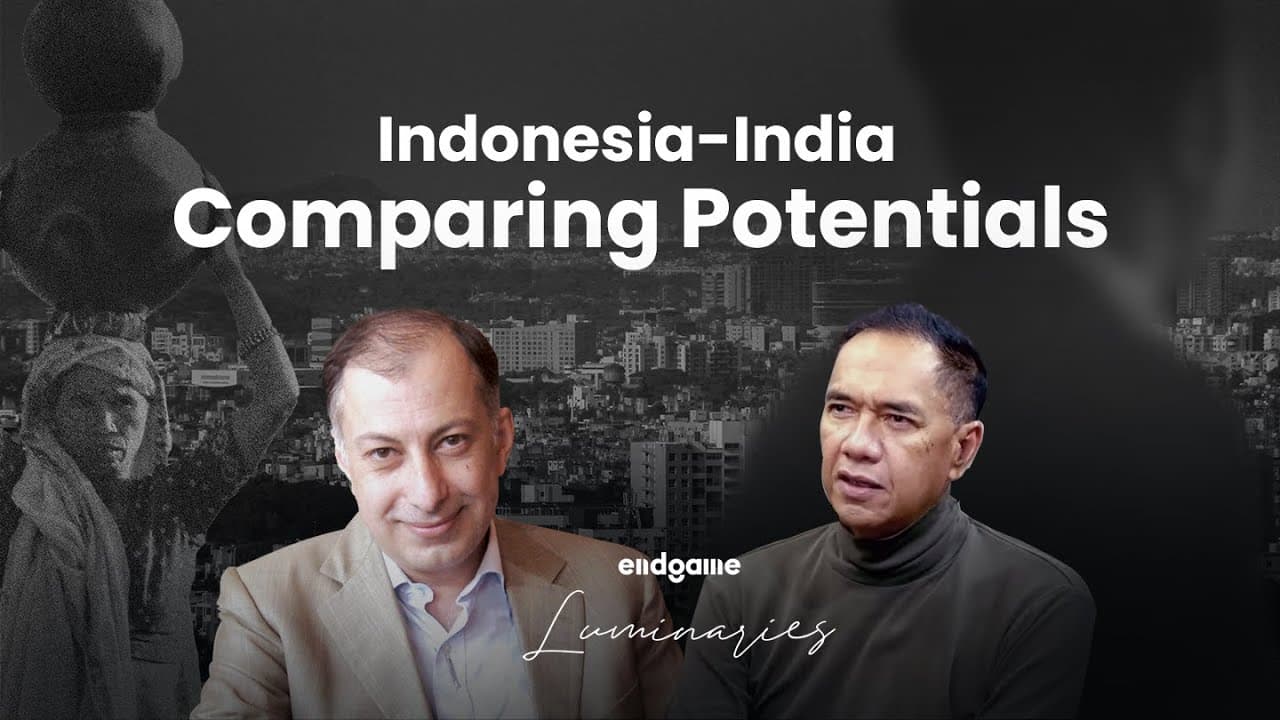
Belajar dari Tuan Rumah G20 Berikutnya - Naushad Forbes | Endgame #106 (Luminaries)
TL;DR
Naushad Forbes discusses India's growth potential and global economic dynamics.
Transcript
GITA WIRJAWAN: Hello friends, today we have Naushad Forbes. He is the Co-Chairman of Forbes Marshall, and was President of CII or Confederation of Indian Industry. Naushad, it's a pleasure to have you on our show. Thank you so much. NAUSHAD FORBES: Thank you very much for having me. Thanks. - You've accomplished so many things. But as I do with all... Read More
Key Insights
- Naushad Forbes emphasizes the importance of democratizing talent in India and compares it to China's approach, highlighting the role of institutions and education in fostering growth.
- The conversation explores the differences in economic development between India and China, attributing China's rapid growth to state-led initiatives and export-oriented manufacturing.
- Forbes discusses the challenges and opportunities in India's education system, emphasizing the need for improved primary education outcomes to enhance long-term economic potential.
- The discussion touches on the importance of openness and diversity, with Forbes advocating for policies that welcome talent and investment from around the world.
- Forbes expresses concern about the trend of populism globally, noting its potential to hinder openness and international cooperation.
- The interview highlights the significance of institutional development and contract enforcement in attracting foreign direct investment to India.
- Forbes underscores the need for humility and confidence in learning from global best practices while adapting them to local contexts.
- The conversation concludes with a vision for 2045, emphasizing the role of inclusive growth, institutional independence, and private sector engagement in realizing India's potential.
Install to Summarize YouTube Videos and Get Transcripts
Explore YouTube Video Summarizer or Get YouTube Transcript Extractor
Questions & Answers
Q: What are the key differences between India's and China's economic growth strategies?
India and China started at similar economic levels in 1980, but China's rapid growth has been driven by a state-led model focusing on export-oriented manufacturing and agricultural reforms. In contrast, India has experienced slower growth, partly due to its reliance on a more decentralized, private-sector-driven approach. Forbes highlights the importance of institutional development and education in bridging this gap.
Q: How does Naushad Forbes view the role of education in India's development?
Forbes emphasizes the critical role of education in India's development, particularly the need to improve primary education outcomes. He points out that ensuring children achieve basic literacy and numeracy by the second grade is essential for their future learning and economic participation. He advocates for targeted interventions and private sector involvement in enhancing educational quality.
Q: What concerns does Forbes have about global populism?
Forbes expresses concern about the rise of populism globally, noting its potential to hinder openness and international cooperation. He cites examples like Brexit and the Trump presidency as instances where populism led to more inward-looking policies. Forbes stresses the need for countries to remain open to global talent and investment to foster economic growth and innovation.
Q: How does Forbes propose India should handle its institutional development?
Forbes advocates for strong, independent institutions that can set rules and provide a stable environment for economic activity. He argues that such institutions are crucial for enabling private sector growth and ensuring inclusive development. Forbes also highlights the need for better contract enforcement and dispute resolution to attract foreign investment.
Q: What is Forbes' perspective on India's openness to foreign talent and investment?
Forbes believes that India's diversity is a strength that can attract global talent and investment. He advocates for policies that make it easier for people from all nationalities to live, work, and invest in India. Forbes cautions against recent trends towards less openness and emphasizes the need for India to remain welcoming to maintain its economic momentum.
Q: What lessons does Forbes suggest India can learn from other countries?
Forbes stresses the importance of humility and confidence in learning from global best practices. He encourages India to adopt successful strategies from other countries, adapting them to local contexts. Forbes points to Singapore's governance and Silicon Valley's innovation ecosystem as examples from which India can draw valuable insights.
Q: How does Forbes view the future of India and ASEAN in the global context?
Forbes is optimistic about the future of India and ASEAN, citing the potential for technological innovation and economic growth. He envisions a future where both regions leverage their strengths in diversity and entrepreneurship to drive global economic development. Forbes also highlights the importance of regional cooperation and institutional building in achieving this vision.
Q: What is Forbes' stance on criticism and patriotism?
Forbes argues that criticism is a form of patriotism, as it reflects a commitment to improving one's country. He believes that voicing concerns and suggesting improvements is more beneficial than opting for exit strategies like emigration. Forbes encourages constructive criticism as a means to foster positive change and national development.
Summary & Key Takeaways
-
Naushad Forbes reflects on his experiences in education and industry, discussing India's potential for growth and the importance of democratizing talent. He compares India's development trajectory with China's, emphasizing the need for institutional and educational reforms.
-
The conversation explores India's openness to global talent and investment, highlighting the challenges posed by populism and the need for inclusive growth. Forbes advocates for policies that foster diversity and international cooperation.
-
Forbes shares his vision for India's future, focusing on the role of independent institutions and private sector engagement in achieving sustainable growth. He emphasizes the importance of learning from global best practices while maintaining cultural strengths.
Read in Other Languages (beta)
Share This Summary 📚
Summarize YouTube Videos and Get Video Transcripts with 1-Click
Try YouTube Summary with ChatGPT & Claude or YouTube Transcript Generator
Explore More Summaries from Gita Wirjawan 📚




Summarize YouTube Videos and Get Video Transcripts with 1-Click
Try YouTube Summary with ChatGPT & Claude or YouTube Transcript Generator