Computer Architecture | (16) Caches - PART3
TL;DR
The lecture explores cache memory organization and its impact on performance.
Transcript
so last time when we were using that board uh we discussed well we said there are three main questions that we need to answer for caches right and we discussed the first one only so we said these three questions are does anyone remember what are the three questions any of the questions so these questions are the headlines of the cash topic basicall... Read More
Key Insights
- Cache memory organization is crucial for performance, involving decisions on associativity, block size, and capacity.
- Fully associative caches increase utilization but complicate search processes, while direct-mapped caches are faster but less flexible.
- Set-associative caches offer a compromise, combining elements of both fully associative and direct-mapped caches.
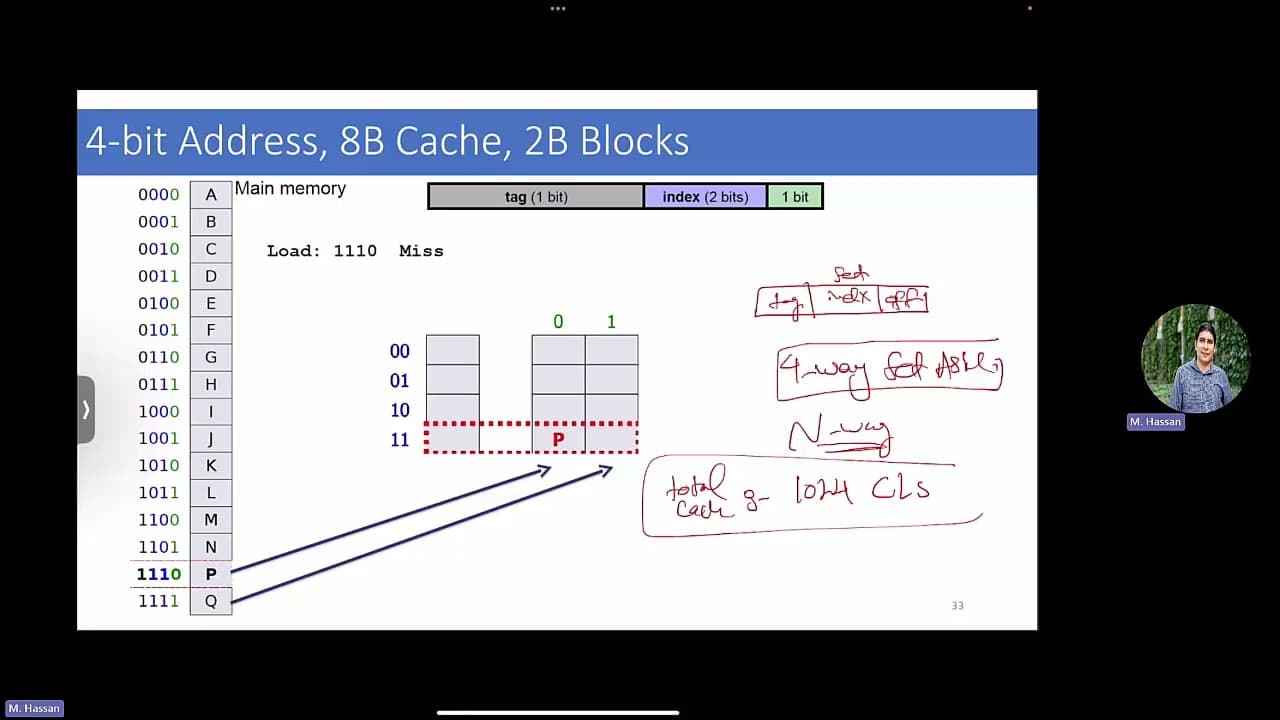
- Increasing cache line size leverages spatial locality but can lead to higher conflict misses due to fewer cache lines.
- Cache hierarchies are structured to optimize hit rates and minimize latencies, with L1 caches being smaller and faster.
- Critical word first strategy helps reduce miss penalties by prioritizing the retrieval of the requested data.
- Cache design involves trade-offs between capacity, associativity, and block size to achieve optimal performance.
- Modern systems typically use 64-byte cache lines, balancing spatial locality benefits and conflict miss risks.
Install to Summarize YouTube Videos and Get Transcripts
Explore YouTube Video Summarizer or Get YouTube Transcript Extractor
Questions & Answers
Q: What are the main types of cache organizations discussed?
The lecture discusses three main types of cache organizations: fully associative, direct-mapped, and set-associative caches. Fully associative caches allow any cache line to be placed anywhere, improving utilization but complicating search. Direct-mapped caches have specific locations for each line, enabling faster access but limiting flexibility. Set-associative caches offer a compromise, combining features of both.
Q: How does cache line size affect performance?
Cache line size affects performance by leveraging spatial locality and impacting conflict misses. Larger cache lines can improve spatial locality by fetching more relevant data, but they also reduce the number of available cache lines, potentially increasing conflict misses. The trade-off is finding a balance that maximizes locality benefits while minimizing conflict misses.
Q: What is the role of cache hierarchies in performance optimization?
Cache hierarchies play a crucial role in performance optimization by structuring caches to balance hit rates and latencies. L1 caches, being closer to the CPU, are smaller and faster, optimizing hit rates for frequently accessed data. Lower-level caches, like L2 and L3, have larger capacities to reduce miss rates but can tolerate higher latencies due to their distance from the CPU.
Q: What is the critical word first strategy?
The critical word first strategy is a technique used to reduce miss penalties by prioritizing the retrieval of the requested data. When a cache miss occurs, the requested data is fetched first and sent to the CPU, allowing the processor to continue execution while the remaining cache line data is fetched in the background. This strategy minimizes the stalling of the CPU pipeline.
Q: How does associativity impact cache performance?
Associativity impacts cache performance by influencing how cache lines are placed and searched. Higher associativity increases cache utilization by allowing more flexible placement of lines, reducing conflict misses. However, it also increases search complexity and latency. Direct-mapped caches have lower associativity, simplifying searches but increasing the likelihood of conflict misses.
Q: Why are modern cache lines typically 64 bytes?
Modern cache lines are typically 64 bytes because this size strikes a balance between leveraging spatial locality and minimizing conflict misses. Extensive benchmarking and performance analysis have shown that 64-byte cache lines provide optimal performance for common applications, maximizing locality benefits while keeping conflict misses manageable. Some server systems may use larger lines for specific workloads.
Q: What are the trade-offs involved in cache design?
Cache design involves trade-offs between capacity, associativity, and block size to achieve optimal performance. Larger capacities reduce miss rates but increase search latency. Higher associativity improves utilization but complicates searches. Larger block sizes enhance locality but risk higher conflict misses. Designers must balance these factors to optimize system performance based on typical application workloads.
Q: What is the impact of increasing cache capacity?
Increasing cache capacity generally reduces miss rates by allowing more data to be stored, improving hit rates. However, it also increases search latency, especially in associative caches, as more locations need to be checked. Cache hierarchies address this by using smaller, faster caches closer to the CPU and larger, slower caches further away, optimizing performance by balancing capacity and latency.
Summary & Key Takeaways
-
The lecture covers the organization of cache memory, emphasizing the importance of associativity, block size, and capacity in optimizing performance. Different cache types, such as fully associative, direct-mapped, and set-associative, are discussed, highlighting their advantages and disadvantages.
-
Cache line size impacts performance by influencing spatial locality and conflict misses. Larger cache lines can improve locality but may increase conflict misses due to fewer cache lines available. The lecture also explores the impact of cache hierarchies on hit rates and latencies.
-
Strategies like critical word first help mitigate miss penalties by prioritizing the retrieval of requested data. The lecture concludes with a discussion on how modern systems balance these factors, typically using 64-byte cache lines to optimize performance.
Read in Other Languages (beta)
Share This Summary 📚
Summarize YouTube Videos and Get Video Transcripts with 1-Click
Try YouTube Summary with ChatGPT & Claude or YouTube Transcript Generator