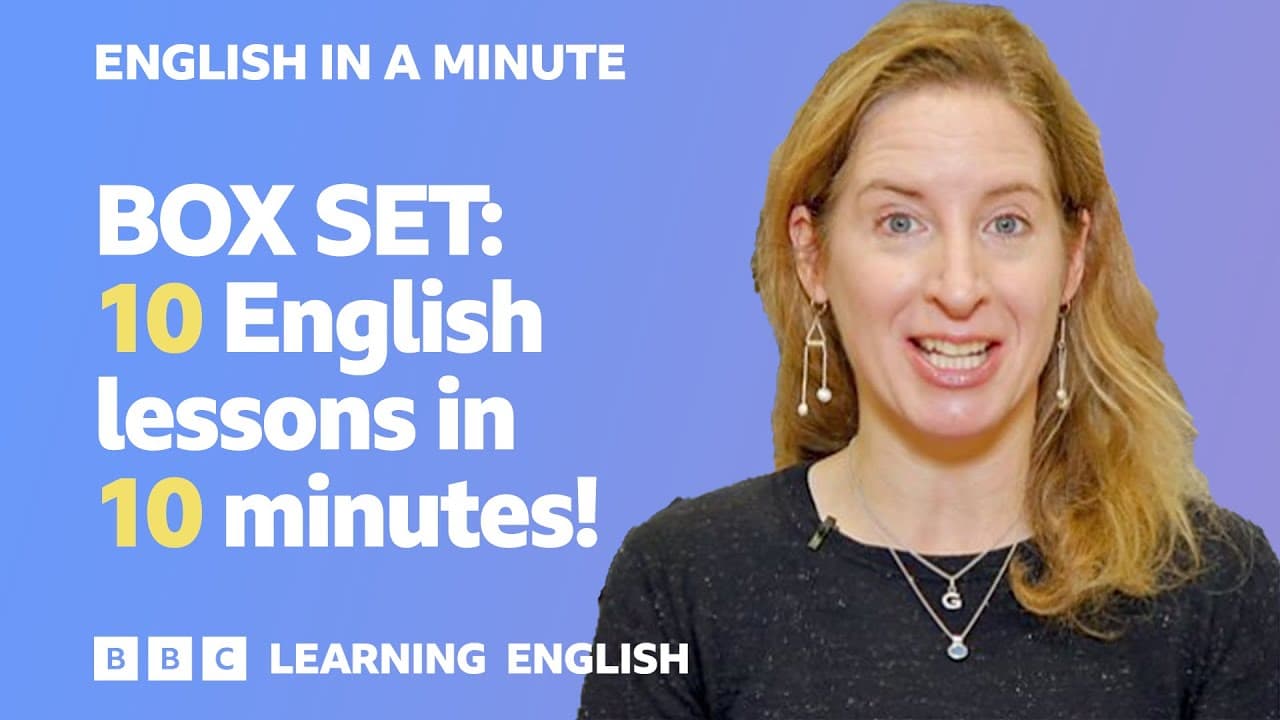
BOX SET: English In A Minute 2 – TEN English lessons in 10 minutes!
TL;DR
Learn essential English words and grammar in 10 minutes.
Transcript
It's just one of these, literally. It can mean 'to support weight', but figuratively, we use it to mean 'to put up with', what to tolerate. I can't bear this cold weather. It's too much for me. I can't bear this job. It's too hard. I can't bear to wait any longer. I'm going home. Another literal meaning is 'to carry something', but we more often us... Read More
Key Insights
- The verb 'bear' has both literal and figurative meanings, such as supporting weight or tolerating something. It's often used in idioms.
- 'See', 'look', and 'watch' are verbs related to using eyes, but differ in terms of attention and purpose.
- 'Especially' and 'specially' are adverbs with distinct meanings, often confused but contextually different.
- Certain verbs, like 'avoid' and 'enjoy', are followed by an -ing form, indicating habitual actions or preferences.
- 'Like' and 'as' are used to denote similarity but have different grammatical roles and implications.
- Words like 'whisper', 'murmur', and 'mumble' describe quiet speech but vary in clarity and intention.
- The verb 'get' has multiple meanings, from acquiring to arriving, depending on its usage in sentences.
- 'Hear' and 'listen' are often confused; the former refers to the ability to detect sound, while the latter involves intentional focus.
Install to Summarize YouTube Videos and Get Transcripts
Explore YouTube Video Summarizer or Get YouTube Transcript Extractor
Questions & Answers
Q: What are the different meanings of the verb 'bear'?
The verb 'bear' can mean to support or carry something physically. Figuratively, it means to tolerate or endure a situation. It is also used in idiomatic expressions like 'bear in mind', which means to remember or consider something. Understanding its context is crucial for proper usage.
Q: How do 'see', 'look', and 'watch' differ?
'See' involves the basic ability to use your eyes, often passively. 'Look' requires directing your eyes toward something intentionally. 'Watch' involves observing something carefully over time. These verbs differ in the level of attention and intentionality involved in the action.
Q: What is the difference between 'especially' and 'specially'?
'Especially' means 'in particular' or 'most of all', highlighting a preference or emphasis. 'Specially' means 'for a particular purpose' or 'in a particular way', indicating something done with a specific intention. Despite their similarities, they are used in different contexts.
Q: Which verbs are typically followed by an -ing form?
Verbs like 'avoid', 'deny', 'enjoy', 'recommend', and 'regret' are typically followed by an -ing form. These verbs often relate to habitual actions, preferences, or feelings about past actions. The -ing form indicates ongoing or completed actions related to these verbs.
Q: How are 'like' and 'as' used to compare things?
'Like' is used as a preposition to compare appearances or characteristics, meaning 'similar to'. 'As' is used to denote roles or functions, meaning 'in the role of'. Misusing these can change the meaning of a sentence, so understanding their distinct uses is important.
Q: What are the differences between 'whisper', 'murmur', and 'mumble'?
'Whisper' means speaking quietly to be heard by someone close. 'Murmur' involves speaking in a low, continuous voice, often hard to understand. 'Mumble' refers to speaking quietly and unclearly. Each term describes different ways of speaking softly, with varying clarity.
Q: What are the various uses of the verb 'get'?
The verb 'get' has multiple uses: it can mean to buy or obtain something, to receive, to become (when used with adjectives), to understand, or to arrive at a place. Its versatility makes it a common verb in everyday English, with context determining its specific meaning.
Q: How do 'hear' and 'listen' differ in meaning?
'Hear' refers to the ability to perceive sound, often passively and without intention. 'Listen' involves actively paying attention to sounds, usually with a specific focus. The distinction lies in the level of engagement and intentionality in perceiving auditory information.
Summary & Key Takeaways
-
This video from BBC Learning English offers a quick yet comprehensive overview of essential English grammar and vocabulary. It covers various topics, including the differences between similar words, common verb usages, and idiomatic expressions, all within a 10-minute timeframe.
-
The lesson includes explanations on when to use 'see', 'look', and 'watch', as well as the distinctions between 'especially' and 'specially'. It also delves into verbs that require an -ing form and the nuanced uses of 'like' and 'as'.
-
Viewers will learn about the subtle differences between 'whisper', 'murmur', and 'mumble', the versatile applications of the verb 'get', and the proper contexts for using 'hear' versus 'listen'. The video aims to boost English proficiency efficiently.
Read in Other Languages (beta)
Share This Summary 📚
Summarize YouTube Videos and Get Video Transcripts with 1-Click
Try YouTube Summary with ChatGPT & Claude or YouTube Transcript Generator
Explore More Summaries from BBC Learning English 📚
Summarize YouTube Videos and Get Video Transcripts with 1-Click
Try YouTube Summary with ChatGPT & Claude or YouTube Transcript Generator