The Incredible Cancer-Detecting Potential of Photoacoustic Imaging | Lei Li | TED
TL;DR
Breast cancer is a leading cause of cancer deaths globally, but a new technology called photoacoustic imaging could revolutionize breast cancer diagnosis and improve overall healthcare.
Transcript
Breast cancer is one of the leading causes of cancer deaths globally. About one in eight US women will develop invasive breast cancer over the course of their lifetime. And globally, millions of women suffer from breast cancer every year. But it is quite treatable if detected early. Right now, actually, mammography is the gold standard for breast c... Read More
Key Insights
- 🎗️ Breast cancer is a leading cause of cancer deaths globally, with one in eight US women developing invasive breast cancer. Early detection is key, but mammography has a 10 percent chance of missed detection, leading to potential lives lost each year.
- 📷 Photoacoustic imaging is an affordable, painless, and fast technology that provides clearer and more accurate breast cancer diagnoses compared to mammography, taking only 15 seconds to scan the entire breast in 3D.
- 🌍 Photoacoustic imaging has the potential to transform medical imaging beyond breast imaging, allowing us to see inside our bodies and potentially diagnose cancer via wearable devices that monitor circulating tumor cells.
- 🔍 Photoacoustic imaging uses the photoacoustic effect, converting light energy into sound energy to generate high-resolution images with clarity and detail surpassing traditional CT scans or ultrasound.
- 💡 The speaker's personal motivation for developing biomedical optical imaging was inspired by the loss of their grandparents to cancer and stroke, driving them to improve imaging technology for early diagnosis and disease understanding.
- 🔍 Photoacoustic imaging can provide non-invasive imaging with exceptional clarity, such as in scans of animal models, enabling the differentiation of tumors from normal tissue without the need for contrast agents.
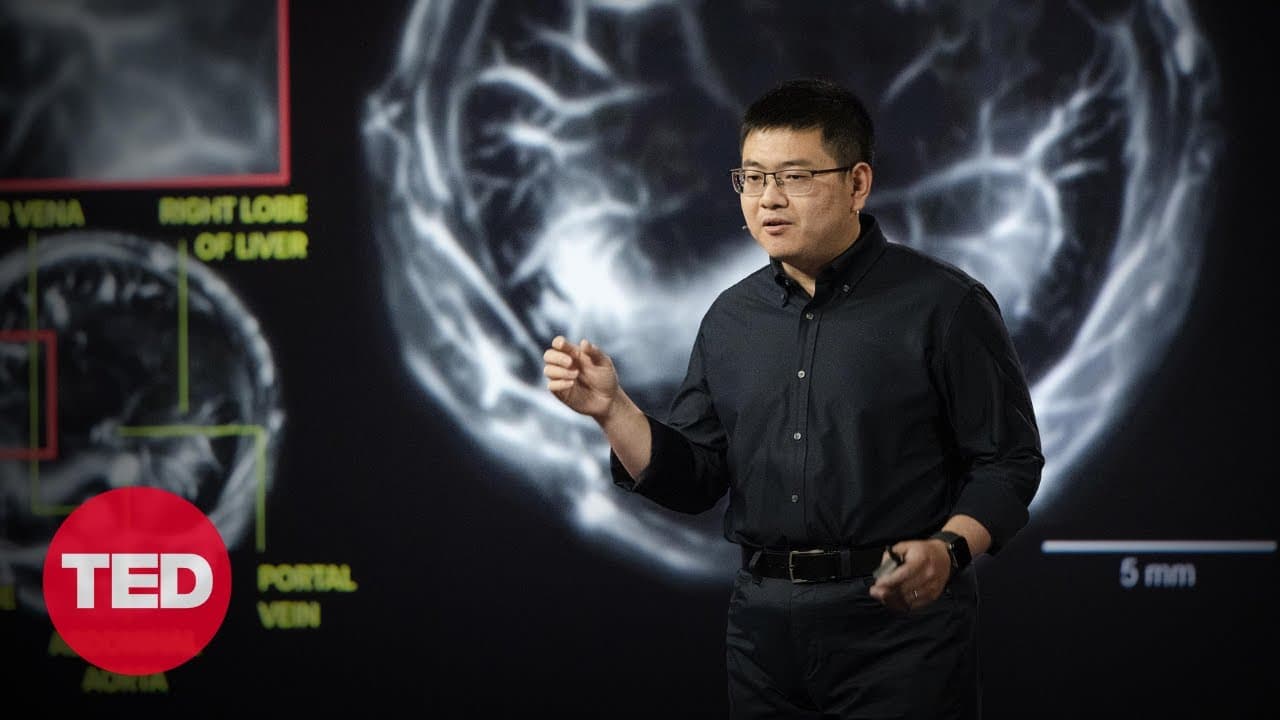
- 🧠 Photoacoustic imaging can also be used to reveal detailed vasculature in human brain imaging, providing faster detection of brain functions compared to MRI and without the need for high-magnetic fields.
- 🌐 Photoacoustic imaging holds promises for whole body penetration in humans using microwaves instead of light, which could aid in early cancer and brain disease diagnosis, ultimately benefiting global health.
Install to Summarize YouTube Videos and Get Transcripts
Explore YouTube Video Summarizer or Get YouTube Transcript Extractor
Questions & Answers
Q: What is the current gold standard for breast cancer diagnosis?
The current gold standard for breast cancer diagnosis is mammography. It is widely used but has a 10 percent chance of missed detection, which can result in lives being lost each year.
Q: How does photoacoustic imaging work?
Photoacoustic imaging is based on the conversion of light energy into sound energy. A gentle laser pulse is directed onto the tissue, causing a rise in temperature and generating acoustic waves. Sensors process these sound signals to create a high-resolution image with exceptional clarity and detail.
Q: What are the advantages of photoacoustic imaging over traditional CT scans or ultrasound?
Photoacoustic imaging offers advantages such as a much clearer image, leading to a more accurate diagnosis. It is also painless, fast, and non-invasive, taking only 15 seconds to scan the entire breast in 3D. Additionally, it does not require the injection of contrast agents and uses a light dose well below safety limits.
Q: How can photoacoustic imaging be used to map brain functions?
Photoacoustic imaging can reveal detailed vasculature in the brain and detect brain functions with faster detection compared to MRI. It does not rely on costly high-magnetic field equipment and provides a non-invasive method for studying brain activity, enabling advancements in understanding and diagnosing brain diseases.
Q: Can photoacoustic imaging aid in guiding and controlling micro robots inside the body?
Yes, photoacoustic imaging can serve as a GPS for micro robots inside the body. By locating, guiding, and controlling them, this technology can overcome the challenge of navigating hard-to-reach areas within the body and potentially revolutionize disease treatment in the future.
Summary & Key Takeaways
-
Breast cancer is a leading cause of cancer deaths, but is treatable if detected early. Mammography, the current gold standard for diagnosis, has a 10 percent missed detection rate, risking lives.
-
Photoacoustic imaging is a new technology that provides clearer, more accurate images for breast cancer diagnosis. It is affordable, painless, and fast, with results delivered immediately to patients.
-
Photoacoustic imaging has broad applications in medical imaging, including mapping brain functions and guiding medical micro robots for drug delivery. It holds promises for whole body penetration in humans in the future.
Read in Other Languages (beta)
Share This Summary 📚
Summarize YouTube Videos and Get Video Transcripts with 1-Click
Try YouTube Summary with ChatGPT & Claude or YouTube Transcript Generator
Explore More Summaries from TED 📚






Summarize YouTube Videos and Get Video Transcripts with 1-Click
Try YouTube Summary with ChatGPT & Claude or YouTube Transcript Generator