How to Calculate Surface Area of a Rotated Curve
TL;DR
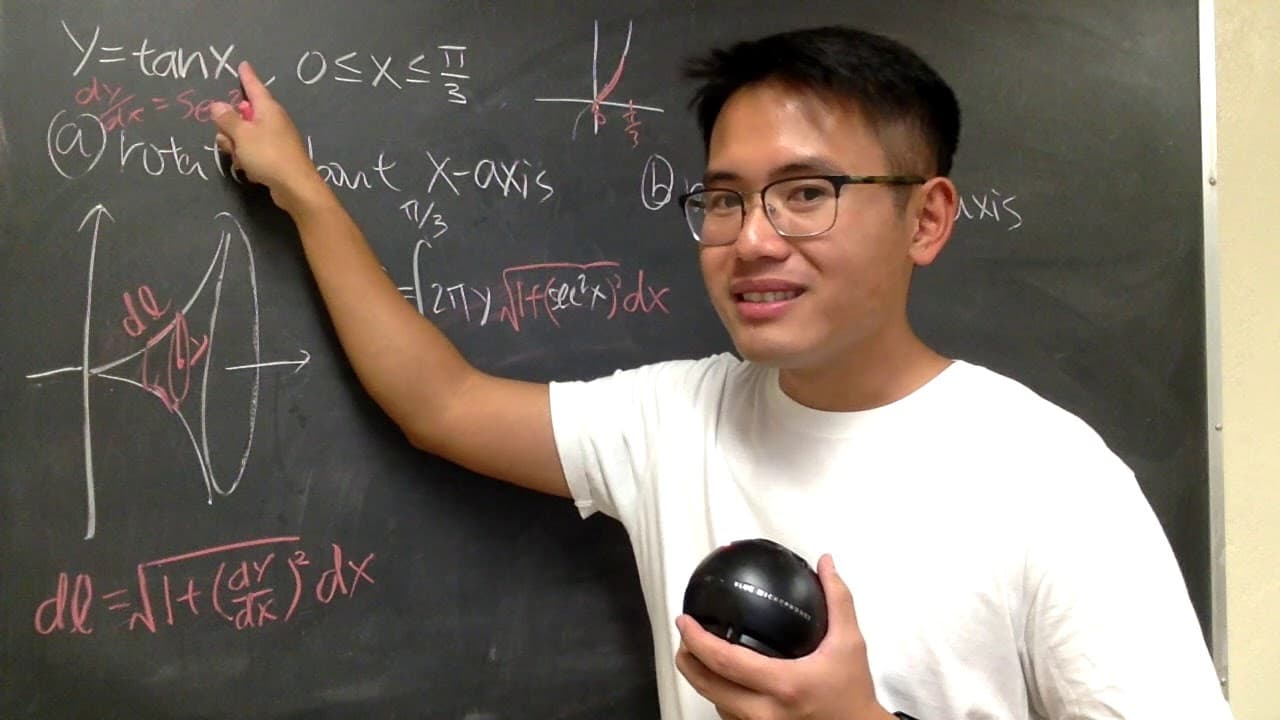
To calculate the surface area of a curve rotated around the x-axis, use the formula s = 2πy * √(1 + (dy/dx)²), integrating from x=0 to x=π/3. For rotation around the y-axis, the formula changes to s = 2πx * √(1 + (dy/dx)²), still integrating from x=0 to x=π/3, with the radius being y for the x-axis and x for the y-axis.
Transcript
okay this video show you guys how to find a surface area and we are given the curve to be ten generics and we're going from x equals to zero up to PI over three so this is the curve that we are talking about and first let's talk about what happens if I take this and rotate about the x axis let me show you guys a picture first so to do so I will jus... Read More
Key Insights
- 🍬 To find the surface area of a rotated curve, use the formulas s = 2πy * √(1 + (dy/dx)^2) for x-axis rotation and s = 2πx * √(1 + (dy/dx)^2) for y-axis rotation.
- ❣️ The radius for x-axis rotation is y, while for y-axis rotation it is x.
- 🐞 The term √(1 + (dy/dx)^2) is crucial to calculate the incremental distance on the curve accurately.
- ❓ Integration is required in both formulas to obtain the total surface area.
- 🍉 These formulas are applicable to any curve given its function in terms of x.
- ❓ Additional practice and examples are recommended to grasp the concept better.
- 😥 The surface area can vary depending on the points of rotation and the shape of the curve.
Install to Summarize YouTube Videos and Get Transcripts
Explore YouTube Video Summarizer or Get YouTube Transcript Extractor
Questions & Answers
Q: How do you find the surface area of a curve when rotating it around the x-axis?
To find the surface area, use the formula s = 2πy * √(1 + (dy/dx)^2), where y is the function of x. Integrate this equation from x=0 to x=π/3 to get the surface area.
Q: Is the radius different when rotating the curve around the y-axis?
Yes, when rotating around the y-axis, the radius is x instead of y. The surface area equation becomes s = 2πx * √(1 + (dy/dx)^2). Integrate this equation from x=0 to x=π/3 to obtain the surface area.
Q: What is the significance of the term √(1 + (dy/dx)^2) in the surface area equation?
This term is used to calculate the incremental distance, represented by DL, on the curve. It ensures an accurate approximation of the arc length when rotating the curve.
Q: Can these formulas be applied to any curve?
Yes, these surface area formulas can be applied to any curve given its function in terms of x. Make sure to use the correct formulas and adjust the radius accordingly when rotating around different axes.
Summary & Key Takeaways
-
To find the surface area of a curve when rotated around the x-axis, use the formula s = 2πy * √(1 + (dy/dx)^2) and integrate from x=0 to x=π/3.
-
When rotating the curve around the y-axis, the surface area formula becomes s = 2πx * √(1 + (dy/dx)^2) and the integration is done from x=0 to x=π/3.
-
The radius for the x-axis rotation is y, while for the y-axis rotation it is x. The "dy/dx" part represents the derivative of the function.
Read in Other Languages (beta)
Share This Summary 📚
Summarize YouTube Videos and Get Video Transcripts with 1-Click
Try YouTube Summary with ChatGPT & Claude or YouTube Transcript Generator
Explore More Summaries from blackpenredpen 📚


Summarize YouTube Videos and Get Video Transcripts with 1-Click
Try YouTube Summary with ChatGPT & Claude or YouTube Transcript Generator