3 - Phase Induction Motor | Working | Part-2/2 | Lec-19
TL;DR
The three-phase induction motor operates on rotor currents and magnetic fields; torque enables armature rotation.
Transcript
hello everyone in the last session we discussed the working of the three-phase induction motor up to the induced currents of the rotor circuit just to observe the rotor is three phase winding three phase winding and windings also three-phase winding and displace it by 120 degrees so those all are displaced by 120 degrees so automatically so it will... Read More
Key Insights
- 🧑🦼 The three-phase induction motor relies on three-phase windings arranged 120 degrees apart to create a rotating magnetic field.
- 🏑 Rotational motion is achieved through the interaction of the rotor's magnetomotive force (MMF) and the stator's magnetic field.
- 👮 Induced currents in rotor conductors oppose changes in their state due to Lenz's law, necessitating careful design for efficient operation.
- 🐎 The relationship between rotor speed and synchronous speed defines the slip, which affects the motor's operational efficiency.
- 💋 The slip percentage varies typically between 1% and 3%, impacting the motor's ability to deliver consistent performance.
- 🧑🦼 Understanding the dynamics of rotor and stator field interaction is essential for optimizing motor design and application.
- 🐎 The concept of relative speed is crucial, as it influences torque generation – effective torque requires synchronous directionality.
Install to Summarize YouTube Videos and Get Transcripts
Explore YouTube Video Summarizer or Get YouTube Transcript Extractor
Questions & Answers
Q: What is the role of slip in a three-phase induction motor?
Slip is defined as the difference between the synchronous speed of the stator and the actual speed of the rotor. It plays a crucial role in determining how effectively the motor can convert electrical energy into mechanical energy. A small slip indicates that the motor is operating efficiently, as it closely matches synchronous speed, while a large slip suggests reduced efficiency.
Q: How does torque get produced in a three-phase induction motor?
Torque is produced when the rotor's magnetic field interacts with the stator's rotating magnetic field. The relative motion between these two fields creates induced currents in the rotor, ultimately leading to a torque that causes the rotor to turn. This torque must overcome any opposing forces to initiate and maintain motion.
Q: Why is the direction of rotation important in the induction motor?
The direction of rotation is crucial because it determines how the rotor and stator magnetic fields interact. For effective torque production, the rotor must move in the same direction as the stator's rotating magnetic field. If the rotor turns in the opposite direction, the effectiveness of torque generation is compromised.
Q: Can you explain how the rotor behaves during different speed conditions?
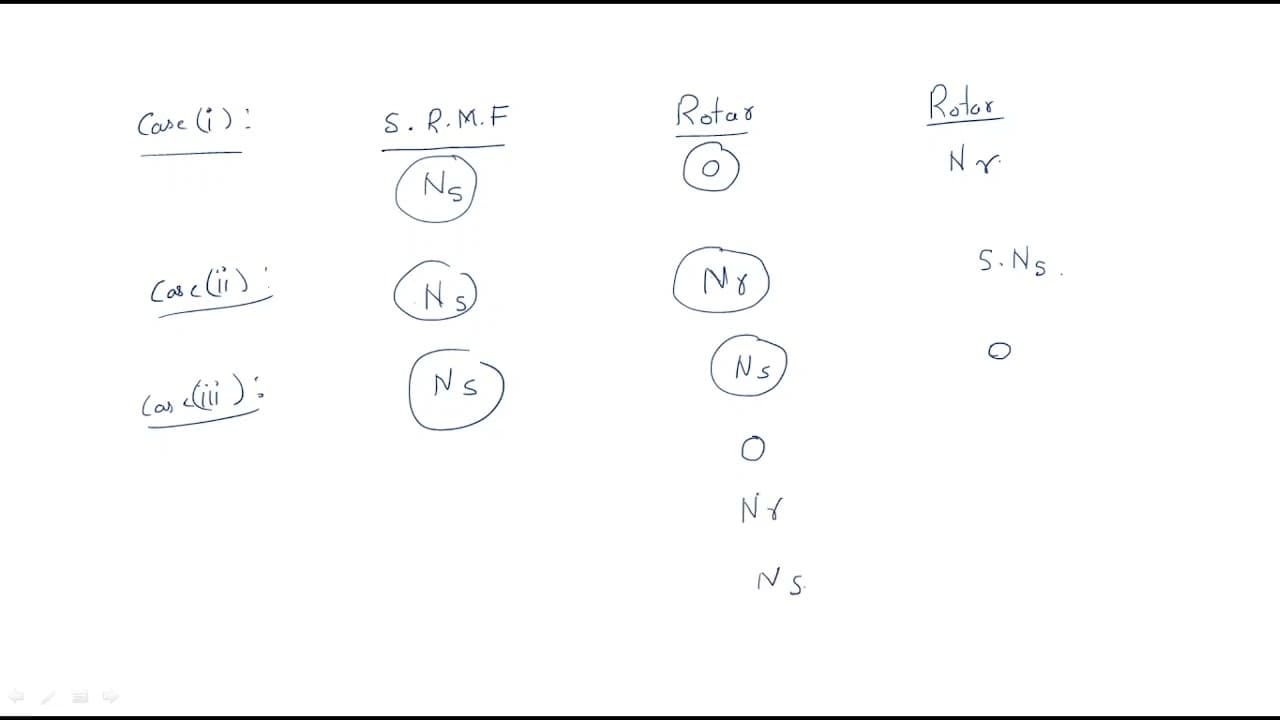
The rotor's behavior varies with changes in speed relative to the synchronous speed. Initially, the rotor at zero speed begins to rotate due to induced currents as it approaches synchronous speed. Once it achieves synchronous speed, slip becomes zero, and the rotor ceases to accelerate further, illustrating the importance of maintaining a certain slip for optimal operation.
Summary & Key Takeaways
-
The three-phase induction motor generates a rotating magnetic field through three-phase windings, leading to induced currents in the rotor and subsequent torque production.
-
The rotor's operation is based on the interaction between the stator's rotating magnetic field and the rotor's magnetic field, which moves at synchronous speed.
-
The motor's slip, defined as the difference between synchronous speed and rotor speed, is crucial for understanding its performance and efficiency.
Read in Other Languages (beta)
Share This Summary 📚
Summarize YouTube Videos and Get Video Transcripts with 1-Click
Try YouTube Summary with ChatGPT & Claude or YouTube Transcript Generator