Gray code | Binary to Gray conversion | STLD | Lec-19
TL;DR
This video explains gray code and its binary conversion methods.
Transcript
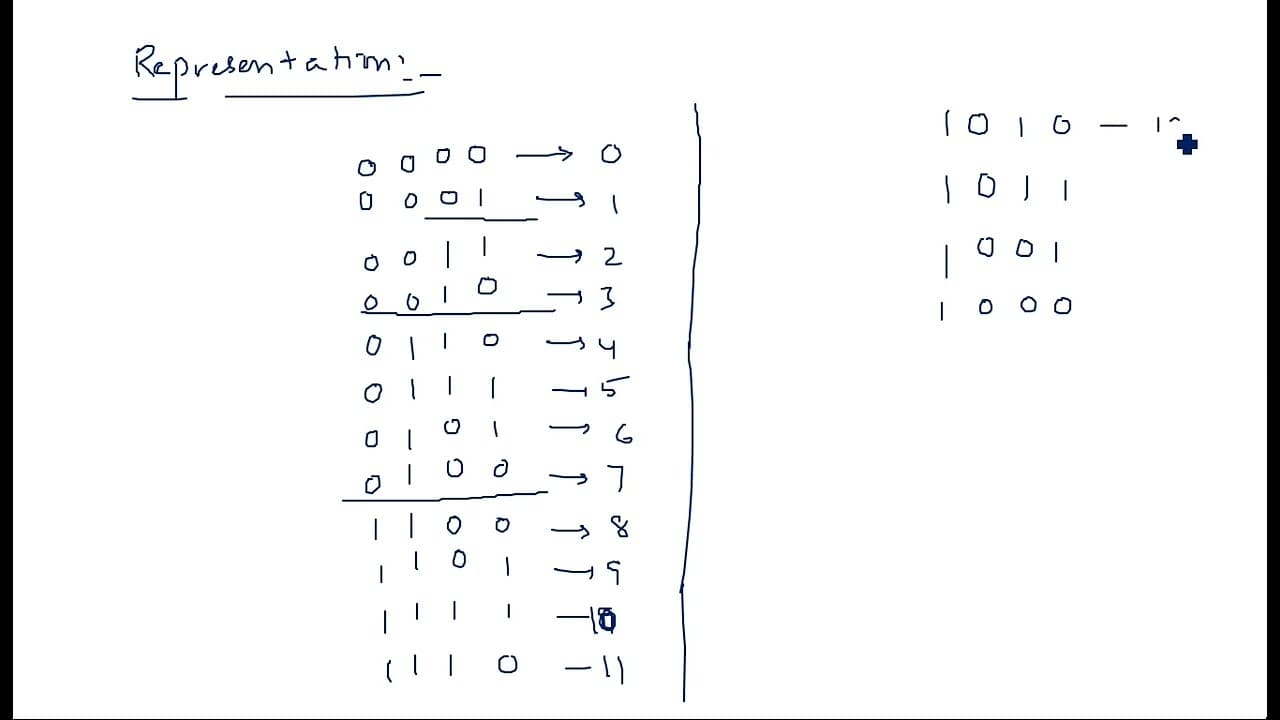
hi everyone in this video I'm going to explain you about the gray code and its conversion from binary to gray code and gray code to Binary it is very easy gray code is nothing but a non-weighted code it is also known as simply reflective code great code it is a nonweighted code non- weighted code means 2 power 0 2 power 1 we don't have like that no... Read More
Key Insights
- 🫦 Gray code operates on the principle of minimal bit change, crucial for reducing transition errors.
- 🫦 It can only represent transitions with one bit difference between successive codes, beneficial for specific digital applications.
- 💄 The conversion process relies heavily on XOR logic, making it computationally efficient.
- 👨💻 Gray code is cyclic and reflective but not applicable for arithmetic computations.
- 👨💻 Understanding gray code aids in grasping broader concepts in digital signal processing and coding theory.
- 👨💻 Its non-weighted nature sets gray code apart from other coded systems like Binary-Coded Decimal (BCD).
- 👨💻 Implementing gray code can enhance data integrity in systems that count or transmit binary numbers sequentially.
Install to Summarize YouTube Videos and Get Transcripts
Explore YouTube Video Summarizer or Get YouTube Transcript Extractor
Questions & Answers
Q: What is gray code and why is it significant?
Gray code is a binary numeral system that ensures only one bit changes at a time when counting, which reduces the risk of errors in digital systems. It is significant because it helps avoid glitches in digital circuits, especially in position encoders and rotary encoders where such transitions can lead to incorrect readings.
Q: How is gray code different from traditional binary coding?
Unlike traditional binary coding, where each bit might change multiple positions when transitioning from one number to another, gray code only changes one bit at a time. This characteristic minimizes the chance of erroneous readings in digital transitions and simplifies error detection in digital communication systems.
Q: What are the conversion methods from binary to gray code?
The binary to gray code conversion involves retaining the most significant bit (MSB) and applying the XOR operation between successive bits. For instance, the gray code bit for each position is derived by XORing the current binary bit with the previous one, ensuring only one bit changes for each increment.
Q: Why is gray code described as a reflective code?
Gray code is termed a reflective code because its structure can be visualized as a series of binary numbers written in reverse. Each segment of the code is generated by reflecting the preceding segment, ensuring that only a single bit transitions between numbers, characteristic of reflective symmetry.
Q: Can gray code be used in arithmetic operations?
Gray code is not suitable for arithmetic operations such as addition or multiplication due to its non-weighted nature. Since it does not adhere to typical positional values of binary digits, performing arithmetic calculations directly on gray code representations would yield incorrect results.
Q: How can we verify the correctness of a gray code conversion?
To verify a gray code conversion, one can check the resultant gray code against a standard table of gray codes for equivalent decimal values. If the table confirms the conversion, it ensures the accuracy of binary to gray code or vice versa.
Q: What applications utilize gray code in technology?
Gray code is widely used in applications that require precise position tracking and error correction, such as rotary encoders, digital circuitry, and certain types of coding systems for minimizing errors in data transmission and processing.
Q: What is the role of XOR gates in gray code conversion?
XOR gates are fundamental in the conversion between gray code and binary because they effectively determine the single bit changes needed. The XOR operation allows for smooth transitions between bits, ensuring only one alteration occurs at a time during both conversions, reinforcing the gray code's unique properties.
Summary & Key Takeaways
-
Gray code is a non-weighted code known for having only one bit difference between consecutive numbers, making it suitable for error correction in digital systems.
-
The conversion between binary and gray code can be easily performed using XOR operations, with specific formulas for each conversion step.
-
Gray code is reflection-based and cyclic but is not suitable for arithmetic operations, distinguishing it from weighted binary codes.
Read in Other Languages (beta)
Share This Summary 📚
Summarize YouTube Videos and Get Video Transcripts with 1-Click
Try YouTube Summary with ChatGPT & Claude or YouTube Transcript Generator