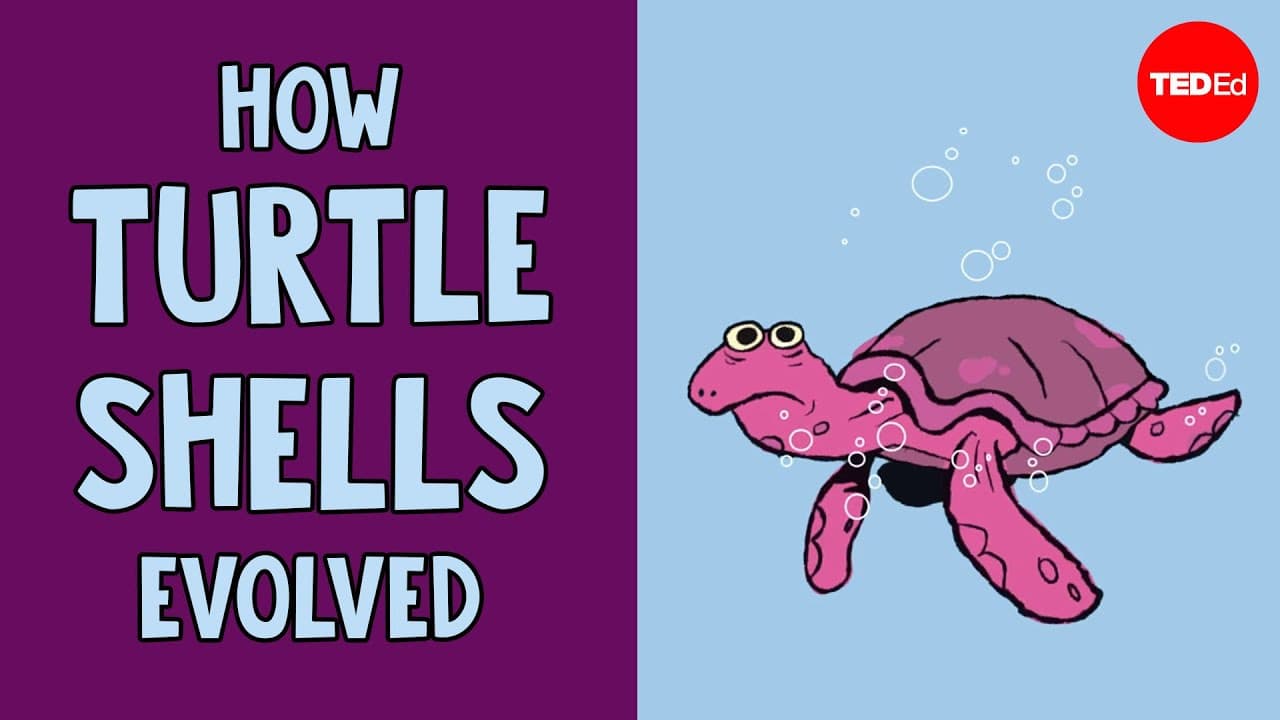
How turtle shells evolved... twice - Judy Cebra Thomas
TL;DR
Turtle shells develop from separate parts connected to the embryo, providing unique advantages and challenges.
Transcript
Meet Odontochelys semitestacea. This little creature spends its days splashing in Late Triassic swamps with a host of other reptiles. Under the surface lies its best defense against attack: a hard shell on its belly. Odontochelys is an early ancestor of the turtle. Its half-shelled body illustrates an important point about the modern turtle: it... Read More
Key Insights
- 🦮 Turtle shell evolution involves separate development of carapace and plastron from undifferentiated cells guided by specialized structures.
- 💁 Fossil evidence reveals transitional forms like Odontochelys and Proganochelys showcasing incremental steps in turtle shell evolution.
- 💪 Challenges in turtle growth include rigid shells limiting breathing flexibility and unique solutions using abdominal muscles.
- 🐢 Different turtle species exhibit diverse shell adaptations suited to their habitats and lifestyles, from swimming sea turtles to burrowing tortoises.
Install to Summarize YouTube Videos and Get Transcripts
Explore YouTube Video Summarizer or Get YouTube Transcript Extractor
Questions & Answers
Q: How do turtle embryos develop their distinctive shells?
Turtle embryos develop two shells, carapace and plastron, from undifferentiated cells guided by the carapacial ridge and neural crest cells, forming a complex bony structure.
Q: What challenges does the rigid turtle shell pose as the turtle grows?
As turtles grow, the rigid shell with spreading sutures limits rib flexibility for breathing, requiring abdominal muscle movement instead, showing the trade-offs in shell evolution.
Q: What were the key transitional steps in turtle shell evolution?
Transitional turtle ancestors like Odontochelys semitestacea and Proganochelys quenstedti show the development of thicker ribs, belly plates, and fused ribs, leading to modern turtle shell adaptations.
Q: How do modern turtle shell adaptations reflect their habitats and lifestyles?
Sea turtles have flatter shells for swimming, tortoises have domed shells for protection, and softshell turtles have flexible shells for mobility in various environments.
Summary & Key Takeaways
-
Odontochelys semitestacea is an early turtle ancestor with a half-shell on its belly, showcasing a transitional form in turtle evolution.
-
Turtle embryos develop two separate shells from undifferentiated cells through gene activity and communication.
-
The turtle shell evolution involves thickening ribs, the formation of carapace and plastron, and diverse shell adaptations.
Read in Other Languages (beta)
Share This Summary 📚
Summarize YouTube Videos and Get Video Transcripts with 1-Click
Try YouTube Summary with ChatGPT & Claude or YouTube Transcript Generator
Explore More Summaries from TED-Ed 📚




Summarize YouTube Videos and Get Video Transcripts with 1-Click
Try YouTube Summary with ChatGPT & Claude or YouTube Transcript Generator