Operation Research 6: Linear Programming Solution: Simplex Method for Minimization
TL;DR
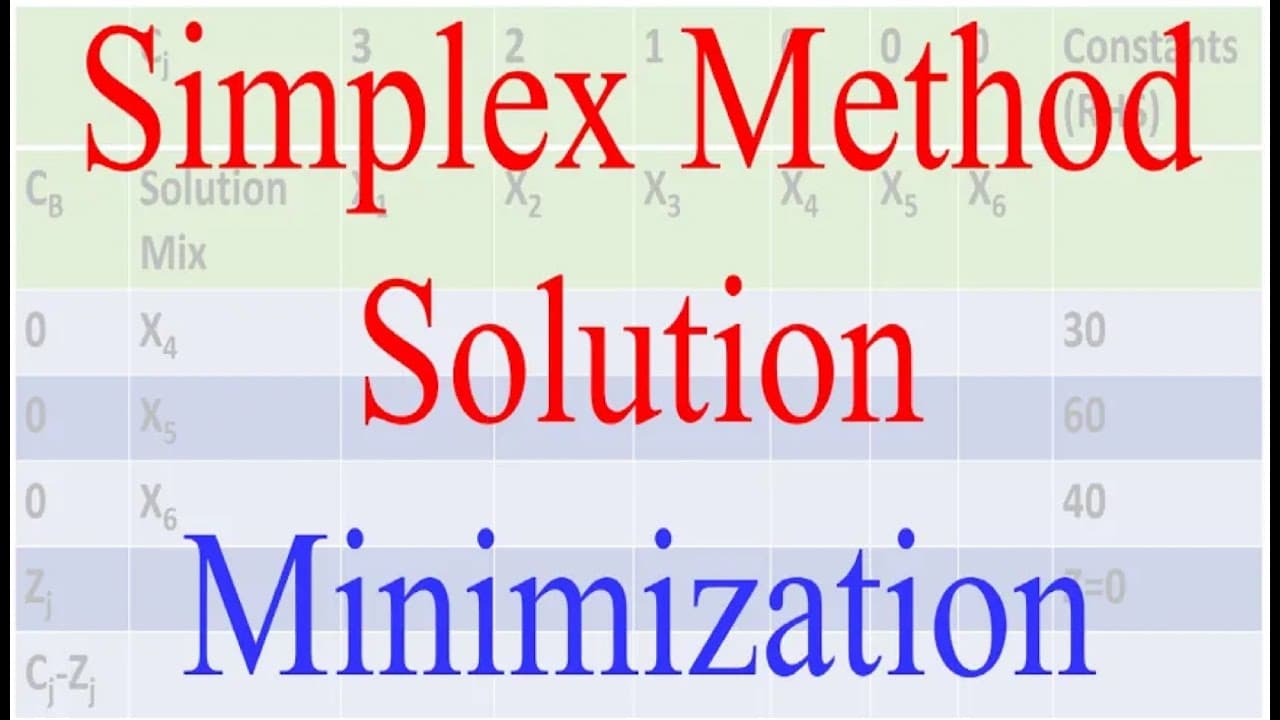
The video explains how to solve a linear programming problem using the simplex method for minimization.
Transcript
hello everybody and welcome to lesson six linear programming solution using simplex method in the case of minimization hence the learning objective of this lesson is to solve the linear programming using simplex method in the case of minimization in lesson five we have discussed about how to solve the linear programming using maxima using simplex m... Read More
Key Insights
- 🪜 In minimization problems, inequalities in constraints are converted to equalities by adding slack variables.
- 🤨 The steps for creating an initial simplex tableau and performing elementary row operations are the same for both minimization and maximization.
- 🤨 The main differences between minimization and maximization lie in determining the pivot column and pivot row.
- 🀄 Optimal solutions are reached when the cj - hj values are greater than or equal to zero.
- ↘️ The minimum solution is obtained from the entry in the lower right corner of the final table in minimization problems.
- 🤪 The z value represents the objective function value in the optimal solution.
- 🤨 If all the ratios in step 4 for determining the pivot row are negative, the solution is unbounded.
Install to Summarize YouTube Videos and Get Transcripts
Explore YouTube Video Summarizer or Get YouTube Transcript Extractor
Questions & Answers
Q: What is the main difference between solving linear programming problems using simplex method for maximization and minimization?
The main difference is in step 3, where for maximization, we locate the most positive entry in the cj - hj row to determine the pivot column, while for minimization, we locate the most negative entry.
Q: How do we determine the pivot row in the simplex method?
To determine the pivot row, we calculate the ratios of the right-hand side values to the corresponding values in the pivot column and select the least positive ratio.
Q: What happens if all the ratios in step 4 for determining the pivot row are negative?
If all the ratios are negative, it means the solution is unbounded, and the linear programming problem has no optimal solution.
Q: How do we calculate the zj values in the simplex method?
The zj values are calculated by multiplying the cb column with the corresponding xn column and summing them up.
Summary & Key Takeaways
-
The video discusses how to convert inequalities in linear programming problems to equalities by adding slack variables.
-
It explains the steps involved in creating an initial simplex tableau.
-
The video demonstrates how to determine the pivot column and pivot row, perform elementary row operations, and check for optimality.
Read in Other Languages (beta)
Share This Summary 📚
Summarize YouTube Videos and Get Video Transcripts with 1-Click
Try YouTube Summary with ChatGPT & Claude or YouTube Transcript Generator
Explore More Summaries from Solomon Getachew 📚


Summarize YouTube Videos and Get Video Transcripts with 1-Click
Try YouTube Summary with ChatGPT & Claude or YouTube Transcript Generator