Method of Sections Example 5 - Analysis of Truses - Engineering Mechanics
TL;DR
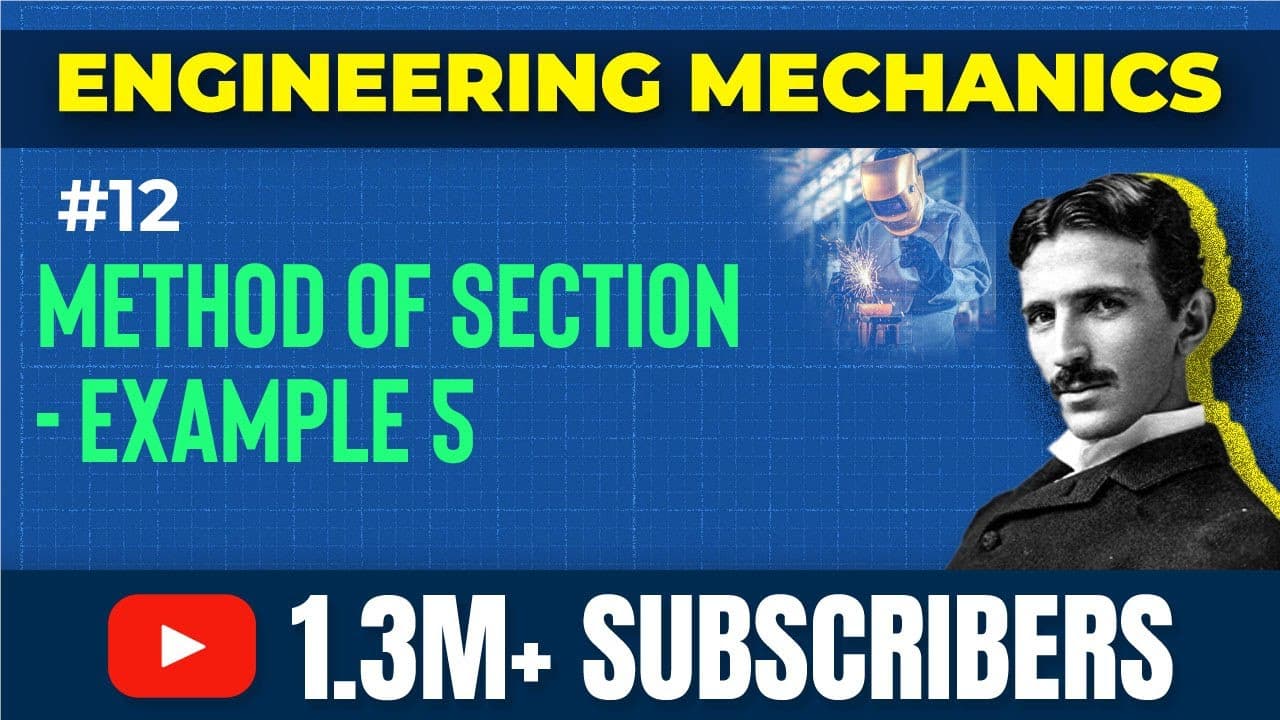
This example demonstrates the use of the method of sections to find the forces in multiple truss members by making multiple cuts in the truss.
Transcript
hello students now we will see the next example in method of sections we have already solved few examples using method of sections okay okay students this is the next example that we have for method of sections now it states that for the trust shown we have to find forces in the members b c c d d e and e f by using method of sections i'll just mark... Read More
Key Insights
- 💇 The method of sections simplifies the analysis of truss members by making accurate cuts to isolate desired forces.
- 🖐️ Support reactions play a crucial role in calculating the forces in the truss members.
- 💇 The choice of cutting planes affects the number of unknown forces and the complexity of the calculations.
- 😥 The forces in each member can be determined by taking moments about specific points and resolving the forces in their respective directions.
- 🔺 Careful consideration of angles and distances is essential for accurate force calculations in the method of sections.
- 🔨 The method of sections is a valuable tool for engineers in analyzing complex truss structures.
- 🤘 Compressive and tensile forces can be determined based on the signs of calculated forces in truss members.
Install to Summarize YouTube Videos and Get Transcripts
Explore YouTube Video Summarizer or Get YouTube Transcript Extractor
Questions & Answers
Q: What is the purpose of using the method of sections in truss analysis?
The method of sections allows us to determine the forces in specific truss members by making cuts and isolating smaller sections of the truss for analysis. It simplifies the calculation process for individual member forces.
Q: How are support reactions determined in this example?
Support reactions are determined by considering the sum of forces in the horizontal and vertical directions. The known forces and geometry of the truss are used to solve for the support reactions at the hinge and roller supports.
Q: Why is it necessary to cut the truss into multiple sections in this example?
The truss configuration in this example requires multiple cutting planes because a single cutting plane would result in additional unknown member forces. By making multiple cuts, we can isolate the desired members and simplify the force calculations.
Q: How are the forces in the truss members determined after the cuts?
After making the cuts, moments are taken at specific points to determine the forces in the desired truss members. By setting the sum of moments equal to zero, the unknown forces can be calculated using the known distances and angles.
Summary & Key Takeaways
-
The example involves finding the forces in members BC, CD, DE, and EF of a truss using the method of sections.
-
To analyze the truss, the truss is cut into multiple sections to solve for the forces in each member.
-
Support reactions and angles of certain members are calculated to determine the necessary moments for force calculations.
Read in Other Languages (beta)
Share This Summary 📚
Summarize YouTube Videos and Get Video Transcripts with 1-Click
Try YouTube Summary with ChatGPT & Claude or YouTube Transcript Generator
Explore More Summaries from Ekeeda 📚




Summarize YouTube Videos and Get Video Transcripts with 1-Click
Try YouTube Summary with ChatGPT & Claude or YouTube Transcript Generator