4.2.3 An Introduction to Trees - Video 2: CART
TL;DR
Using logistic regression and CART, this video explores the process of predicting Supreme Court decisions based on various case properties.
Transcript
To predict the outcomes of the Supreme Court, Martin used cases from 1994 through 2001. He chose this period of time because the Supreme Court was composed of the same nine justices that were justices when he made his predictions in 2002. These nine justices were Breyer, Ginsburg, Kennedy, O'Connor, Rehnquist-- who was the Chief Justice-- Scalia, S... Read More
Key Insights
- 😫 The data set used in this analysis is unique because it covers the longest period of time with the same set of justices in over 180 years.
- ⌛ Justice Stevens started as a moderate but shifted towards a more liberal stance during his time on the Supreme Court.
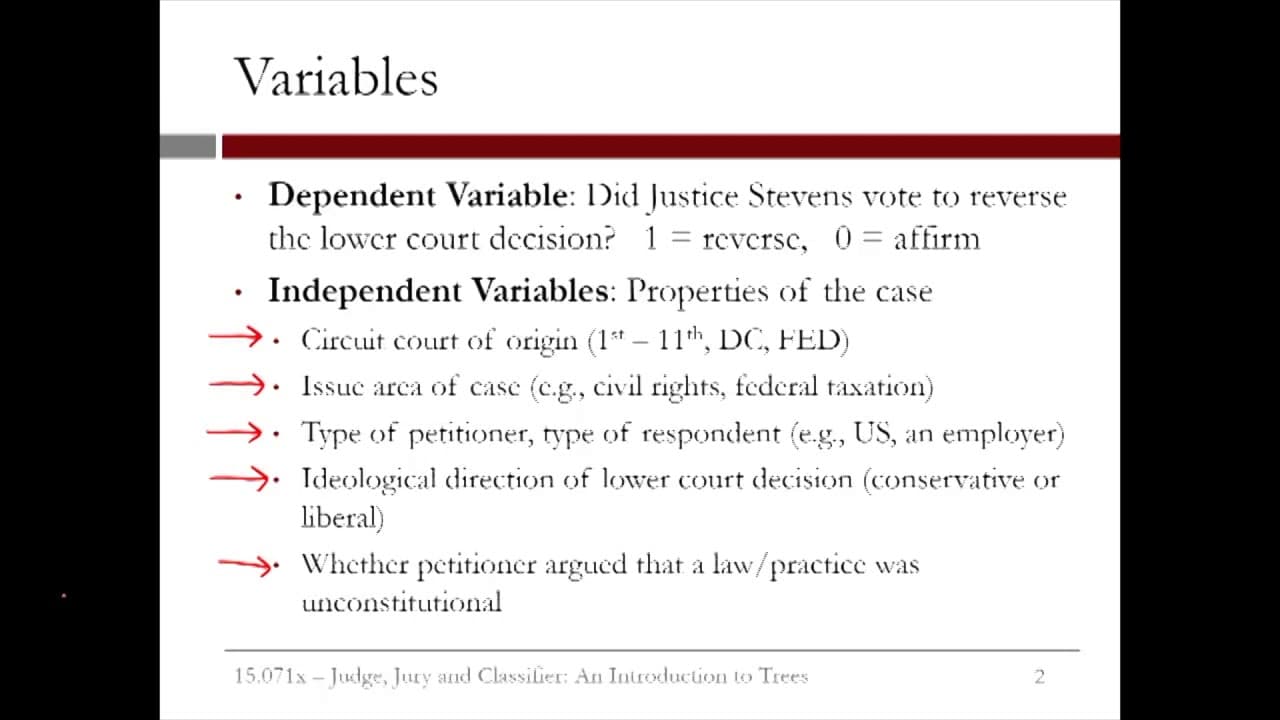
- 🎴 Variables such as circuit court, issue area, and ideological direction of the lower court decision play a role in predicting Justice Stevens' decisions.
- 🤸 Logistic regression and CART are two methods used to predict Supreme Court decisions, with CART being more interpretable and not assuming a linear model.
- 🌲 CART builds a tree by splitting on the values of independent variables and predicts the majority outcome within subsets.
- 🌲 The tree generated by CART represents the current model, and predictions are made by following the splits and majority outcomes.
- ↔️ Reading trees requires starting from the top and following the left (yes) or right (no) responses for each split.
Install to Summarize YouTube Videos and Get Transcripts
Explore YouTube Video Summarizer or Get YouTube Transcript Extractor
Questions & Answers
Q: How did the lecturer determine the variables for predicting Supreme Court decisions?
The lecturer and his colleagues coded various case properties, including circuit court, issue area, type of petitioner and respondent, ideological direction of the lower court decision, and whether the petitioner argued that a law was unconstitutional.
Q: What are some significant variables in the logistic regression model?
The case being from the 2nd or 4th circuit courts and the lower court decision being liberal are significant variables. They positively and negatively predict Justice Stevens reversing or affirming the case, respectively.
Q: What is the advantage of using CART for predicting Supreme Court decisions?
CART does not assume a linear model and is highly interpretable. It splits the data based on the values of independent variables and predicts the most frequent outcome in the training set that followed the same path.
Q: How are the predictions made in a CART model?
For a new observation, the model follows the splits in the tree and predicts the majority outcome in the subset where the observation falls.
Summary & Key Takeaways
-
The lecturer focuses on predicting the decisions of Justice Stevens, who started out as a moderate but became more liberal during his time on the Supreme Court.
-
The dependent variable is whether Justice Stevens voted to reverse or affirm the lower court decision, while the independent variables include properties of the case such as circuit court, issue area, and ideological direction of the lower court decision.
-
The lecturer compares logistic regression with CART and explains that CART is more interpretable and doesn't assume a linear model.
Read in Other Languages (beta)
Share This Summary 📚
Summarize YouTube Videos and Get Video Transcripts with 1-Click
Try YouTube Summary with ChatGPT & Claude or YouTube Transcript Generator
Explore More Summaries from MIT OpenCourseWare 📚



Summarize YouTube Videos and Get Video Transcripts with 1-Click
Try YouTube Summary with ChatGPT & Claude or YouTube Transcript Generator