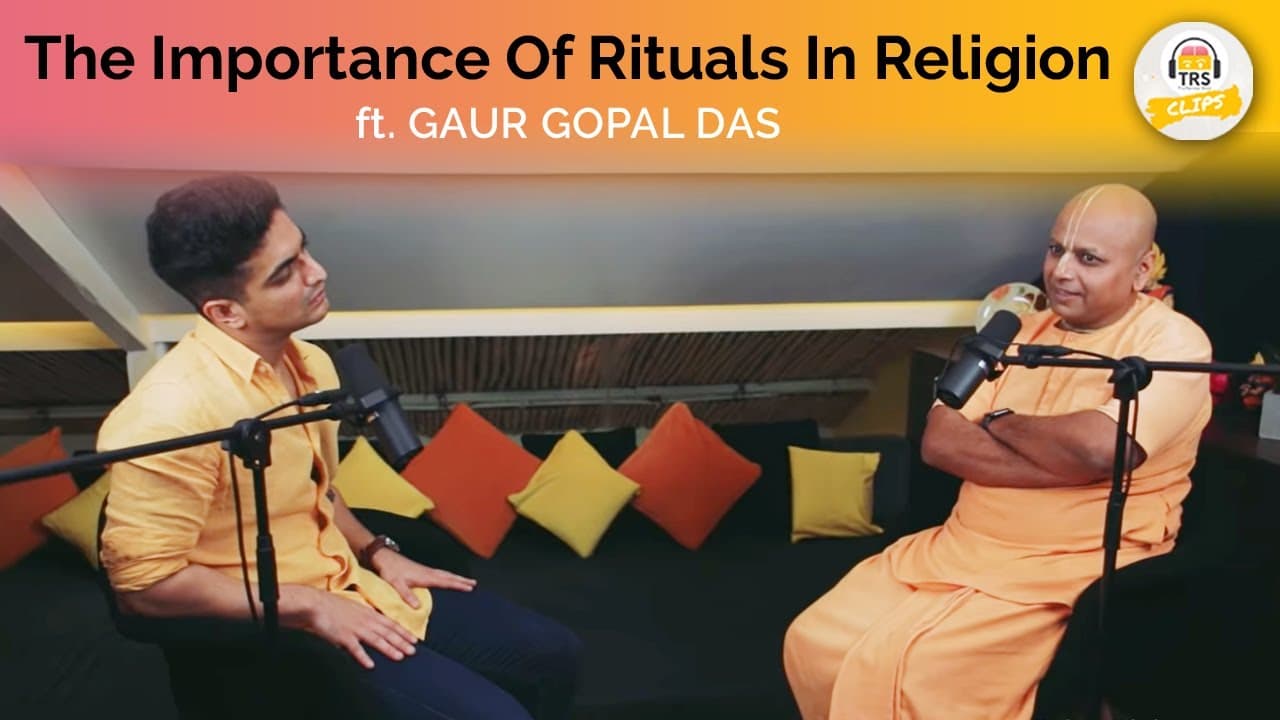
The Importance Of Rituals In Religion - Gaur Gopal Das | TheRanveerShow Clips
TL;DR
Rituals express feelings, but without spirit, they lose meaning.
Transcript
yesterday I was even talking about this to somebody and I was saying one some guy asked me in London some guy asked me what is the need for rituals in religion hmm you know whichever faith and I said to him why I've even talking about real ritual there's a part of religion hmm rituals are a part of life mmm I'd like two weeks back was well in times... Read More
Key Insights
- ❓ Rituals are omnipresent in human interactions, transcending cultural and religious boundaries to communicate emotions.
- 👔 The effectiveness of a ritual is deeply tied to the genuine intention behind it; without this, it can become meaningless.
- 🤟 Everyday events and gestures, like giving flowers or singing, involve rituals that resonate with deeper emotions.
- 🥺 Disconnection from spiritual meaning in rituals can lead to generational disengagement from traditional practices.
- ❓ Understanding the spirit behind rituals can revitalize interest in faith and spirituality among youth.
- 😑 Each culture employs rituals to express feelings, whether towards people, nature, or a higher power.
- 😌 The essence of rituals lies not only in their performance but in the emotional connections they help to forge.
Install to Summarize YouTube Videos and Get Transcripts
Explore YouTube Video Summarizer or Get YouTube Transcript Extractor
Questions & Answers
Q: What role do rituals play in everyday life?
Rituals serve as meaningful expressions of our feelings and intentions. From gifting flowers to singing birthday songs, they translate emotions into actions that convey affection and celebration. These practices, although part of various cultural or religious frameworks, are fundamentally about communication and connection among individuals, enhancing personal relationships.
Q: How does the speaker differentiate between rituals and spiritual experiences?
The speaker highlights that rituals can become mere actions devoid of true meaning if they lack genuine spirit or intention. For instance, saying "I love you" insincerely transforms a potentially profound moment into a routine ritual. True spirituality infuses rituals with depth and authenticity, bridging the heart's true feelings to its expression.
Q: Why do some youth disengage from traditional religious practices?
Many young individuals perceive traditional religions as primarily collections of empty rituals lacking deep significance. This perception arises when the spirit behind these rituals is overlooked, leading to a disconnection. Reinforcing the meaningful aspects of these practices may reignite interest by emphasizing their emotional and spiritual value.
Q: Can everyday actions be considered rituals as well?
Absolutely. Everyday actions like gift-giving, greeting someone, or even celebrating milestones can be seen as rituals that convey our emotions. They reflect an underlying intention to connect, communicate, and convey significance or care for another person, thus embedding meaning into commonplace interactions.
Summary & Key Takeaways
-
The speaker explains that rituals are integral to life and transcend religion, demonstrating how everyday actions communicate emotions.
-
Analyzing the difference between mere rituals and spiritual experiences highlights the significance of genuine intentions behind actions.
-
The speaker suggests that the decline in youth engagement with traditional religious practices results from their perception of rituals as hollow without true meaning.
Read in Other Languages (beta)
Share This Summary 📚
Summarize YouTube Videos and Get Video Transcripts with 1-Click
Try YouTube Summary with ChatGPT & Claude or YouTube Transcript Generator
Explore More Summaries from TRS Clips 📚



Summarize YouTube Videos and Get Video Transcripts with 1-Click
Try YouTube Summary with ChatGPT & Claude or YouTube Transcript Generator