Function generator | Sine and Square wave generator | Electrical Instruments ( EIM ) | Lec - 17
TL;DR
This video teaches the basics of sine and square wave signal generators.
Transcript
hi everyone in the previous lecture we have started the signal generators concept and we have seen what is the basic meaning of signal generator what is the purpose of signal generator and we have also seen standard signal generator in this video we will learn sine and square root generator followed by function generator for the generation of sine ... Read More
Key Insights
- 👋 Signal generators, specifically sine and square wave generators, are fundamental in electronics, used to create continuous waveforms for testing purposes.
- 👋 The Wien bridge oscillator is a key component that naturally generates sine waves, while square waves require conversion processes involving specific circuit configurations.
- 👨💼 Amplitude selectors and function switches are critical in ensuring that the output signals of both sine and square generators have the desired characteristics for various applications.
- 🧡 Function generators are versatile tools that offer a range of signal types, crucial for building and testing electronic circuits in academic and professional settings.
- 🎮 The ability to control frequency and amplitude is essential for precise measurements and successful experimentation in electronic applications.
- 🤩 The principles of wave generation illustrate key concepts of oscillators, amplifiers, and signal modulation, foundational for students pursuing careers in electronics engineering.
- 🖐️ Comparators and Schmitt triggers play significant roles in the conversion processes between waveform types, showcasing the interconnectedness of electronics components.
Install to Summarize YouTube Videos and Get Transcripts
Explore YouTube Video Summarizer or Get YouTube Transcript Extractor
Questions & Answers
Q: What is the primary function of a sine wave generator?
The primary function of a sine wave generator is to produce a continuous sine wave signal, which is essential for various applications in electronics. It often employs oscillators such as the Wien bridge oscillator to achieve stable and accurate sine waves. These sine waves can be utilized in testing and analyzing electronic circuits and systems.
Q: How does a square wave generator convert signals?
A square wave generator converts sine wave signals using devices such as comparators or Schmitt triggers. These circuits transform the smooth transitions of a sine wave into the abrupt changes characteristic of square waves, essential for generating signals needed in digital electronics and testing.
Q: What components are essential in a sine wave generator setup?
Essential components in a sine wave generator setup include the Wien bridge oscillator, amplitude selector, sine wave amplifier, and attenuator. Each plays a crucial role in defining the characteristics of the output signal, ensuring it meets particular amplitude requirements while enhancing signal strength.
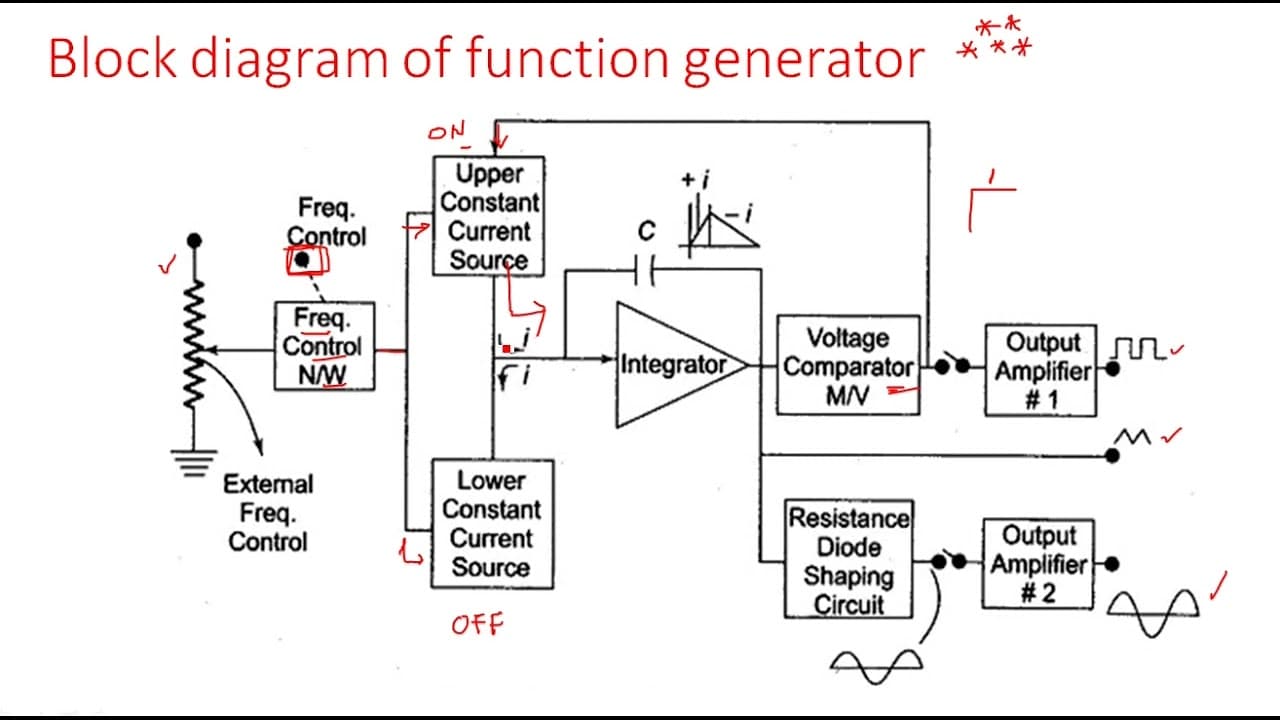
Q: What types of waveforms can a function generator produce?
A function generator can produce various types of waveforms, primarily sine, square, and triangular waves, across a wide range of frequencies. This versatility makes it an essential tool in electronic labs for testing and simulating circuit behavior under different signal conditions.
Q: How does frequency control work in signal generation?
Frequency control in signal generators allows for the selection of different frequencies for the output signals. This is typically achieved through a frequency control network that adjusts the frequency range, which can be set either internally or externally, ensuring precision in generating the desired waveforms.
Q: Why is understanding the operation of a function generator important for engineering students?
Understanding the operation of a function generator is vital for engineering students as it equips them with the knowledge needed for practical laboratory work. It lays the foundation for comprehending how various waveforms are generated, measured, and utilized in electronic circuits, enhancing problem-solving skills and theoretical understanding.
Summary & Key Takeaways
-
The lecture introduces signal generators, focusing on sine and square wave generation using oscillators like the Wien bridge oscillator.
-
Key components such as amplitude selectors, amplifiers, and function switches are discussed, emphasizing their roles in shaping the waves produced.
-
The function generator is highlighted for its ability to create various waveforms like sine, square, and triangular, essential for laboratory experiments.
Read in Other Languages (beta)
Share This Summary 📚
Summarize YouTube Videos and Get Video Transcripts with 1-Click
Try YouTube Summary with ChatGPT & Claude or YouTube Transcript Generator