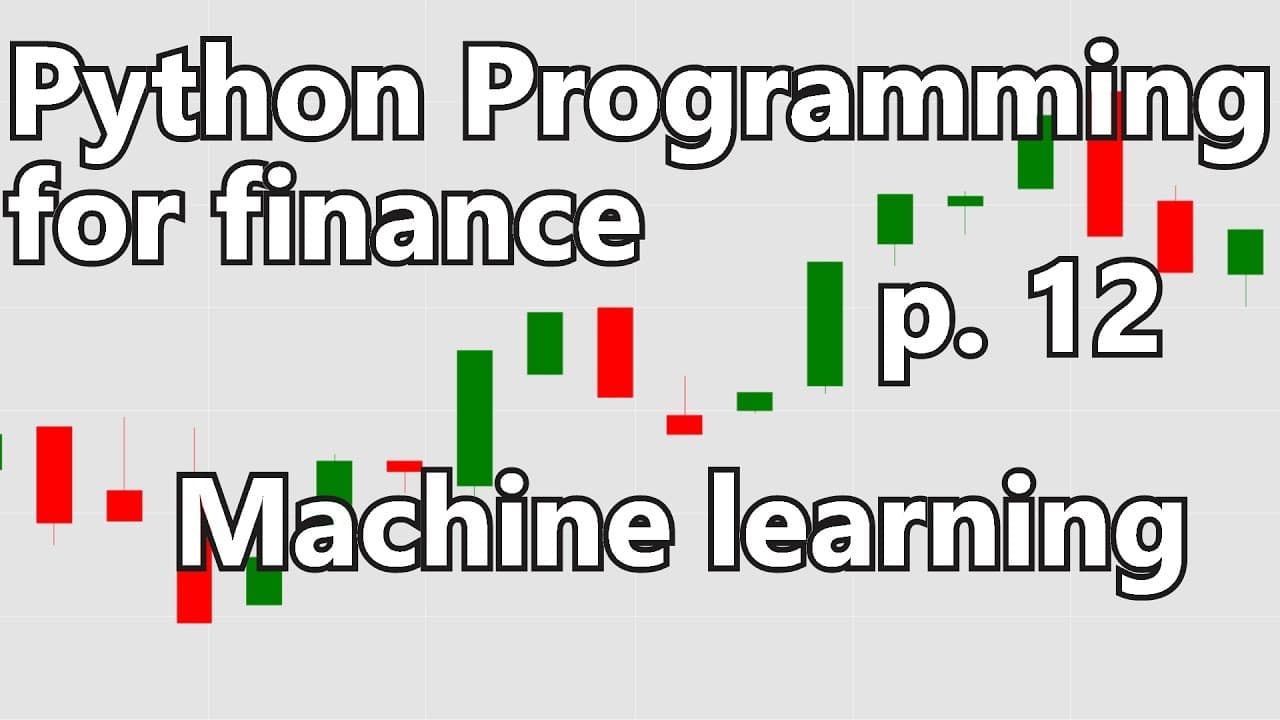
Machine learning - Python Programming for Finance p. 12
TL;DR
In this tutorial, the author demonstrates how to use SVM, KNN, and Random Forest classifiers for machine learning in finance using Python.
Transcript
what is going on everybody welcome to the moment of truth as well as part 12 with the Python for Finance tutorial series in the previous tutorials we've worked on grabbing the data we worked on creating our feature said creating our targets we returned our feature sets our labels in the data frame just in case and now what we're going to do is actu... Read More
Key Insights
- 🎰 This tutorial is part of a Python for Finance tutorial series and focuses on machine learning classifiers.
- 📚 The author demonstrates the process of creating training and testing samples and fitting classifiers using Python's scikit-learn library.
- 🏆 The imbalanced data issue is discussed, and different test size values are explored to find a better balance.
- 🌍 The accuracy and predictions for a sample dataset are presented, highlighting the potential for improvement in real-world applications.
- 🛩️ The tutorial emphasizes the importance of understanding classifier parameters and notes that deep learning may not be suitable for small datasets like the one used in this tutorial.
Install to Summarize YouTube Videos and Get Transcripts
Explore YouTube Video Summarizer or Get YouTube Transcript Extractor
Questions & Answers
Q: What classifiers are used in this tutorial for machine learning in finance using Python?
SVM, cross-validation, KNN, and Random Forest classifiers are used in this tutorial.
Q: How is the training and testing data divided?
The data is divided into training and testing samples using cross-validation to ensure blind testing.
Q: What is the purpose of the voting classifier?
The voting classifier allows multiple classifiers to vote on the best prediction, helping to smooth out unstable classifications.
Q: How is the imbalanced data issue addressed in this tutorial?
The tutorial explores different values for the test size parameter to balance the data and improve accuracy.
Summary & Key Takeaways
-
The tutorial introduces SVM, cross-validation, neighbors, and voting classifiers for machine learning in finance using Python.
-
The author explains the process of creating training and testing samples and fitting the input data to the target using classifiers.
-
The tutorial shows the accuracy and predictions for a sample dataset and discusses the imbalanced data issue.
Read in Other Languages (beta)
Share This Summary 📚
Summarize YouTube Videos and Get Video Transcripts with 1-Click
Try YouTube Summary with ChatGPT & Claude or YouTube Transcript Generator
Explore More Summaries from sentdex 📚
Summarize YouTube Videos and Get Video Transcripts with 1-Click
Try YouTube Summary with ChatGPT & Claude or YouTube Transcript Generator