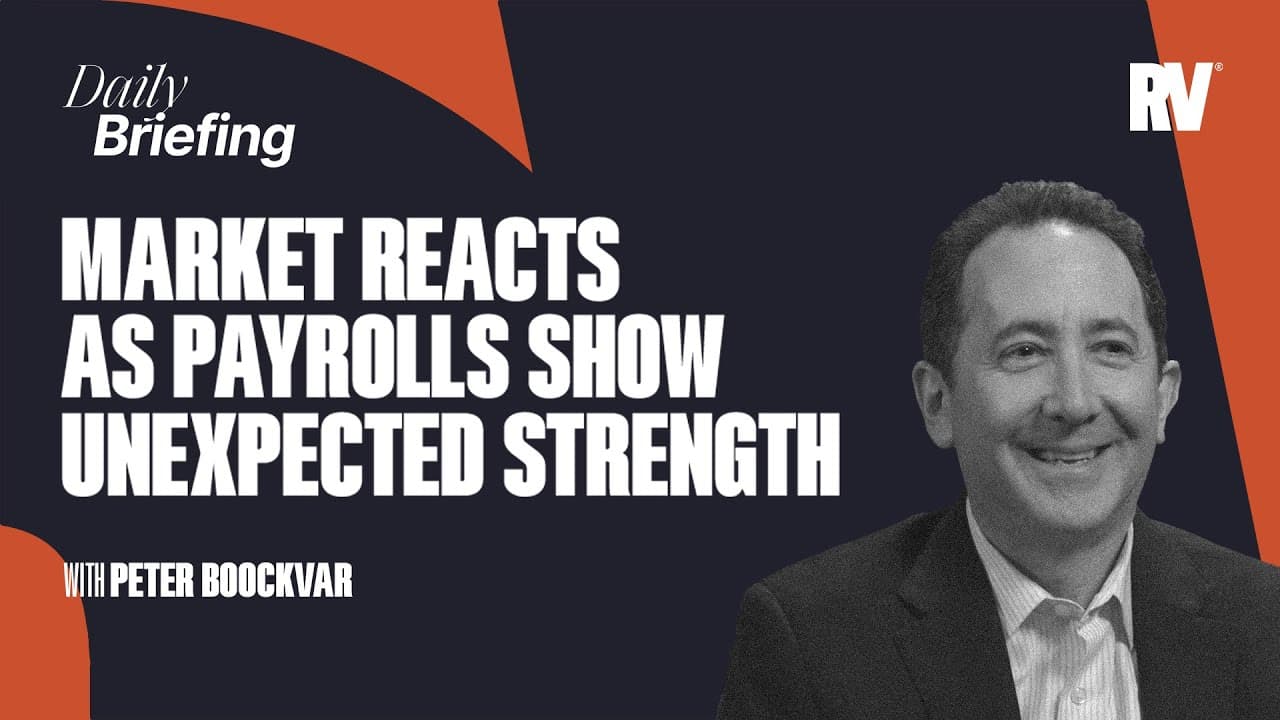
What Does the Fed Do Now? With Peter Boockvar
TL;DR
The markets experienced a volatile end to the week due to a surprising increase in payroll numbers. Treasury yields and the US dollar rose, causing a selloff in stocks, but the market eventually rallied, albeit with some fading towards the close.
Transcript
hey everyone today's real Vision Deli briefing is sponsored by crane shares learn about their krbn ETF at cran shares.com krbn realvision now to the top analysis of today's markets what does the FED do now hi everyone Welcome to the Real Vision Daily Briefing with me today is Peter bfar CIO of ble Lea Financial advisory hey Peter it's great to see ... Read More
Key Insights
- 🫰 Extreme conditions, such as oversold stock market and overbought dollar index, contributed to market volatility.
- 🛀 Payroll numbers showed mixed results, with government job gains and private sector growth exceeding expectations.
- 😮 Rising long-term interest rates may impact the Fed's decision-making and their ability to control inflation.
- 🫢 The rise in energy prices, particularly natural gas, could pose challenges, especially for Europe during the winter season.
- ✋ Precious metals, oil, and copper are expected to see higher prices in the future.
- ⚖️ The impact of higher interest rates on customer balance sheets could affect big cap tech stocks, despite their strong balance sheets.
- 🪜 The unpredictability of geopolitical events and government policies adds to market uncertainty.
Install to Summarize YouTube Videos and Get Transcripts
Explore YouTube Video Summarizer or Get YouTube Transcript Extractor
Questions & Answers
Q: What were the factors contributing to the volatility in the market?
The extreme conditions, such as oversold stock market, overbought dollar index, and overbought oil prices, played a role in the market volatility. The unexpected increase in payroll numbers also sparked a reaction.
Q: How significant were the payroll numbers in relation to the overall market movement?
While the headline number was positive, it was largely influenced by an increase in government jobs. The private sector job growth exceeded expectations but was not as extreme as the headline number suggested. Combined with plateauing wage growth, the overall impact on the market was less significant than anticipated.
Q: Did the government job gains have any implications for the overall economy?
Government jobs are typically seen as less economically impactful than private sector jobs. While they contribute to job growth and provide paychecks, they do not reflect the same economic decision-making as businesses hiring in the private sector. Therefore, the increase in government jobs was not seen as a sign of overheating in the economy.
Q: How does the rise in long-term interest rates impact the Fed's decision-making?
The rise in long-term interest rates has tightened financial conditions, which helps the Fed's goal of controlling inflation. However, if rates continue to rise rapidly, it may push the Fed to take action or intervene in the long end of the yield curve. The Fed is closely monitoring the market's response and will make decisions accordingly.
Summary & Key Takeaways
-
Market action was influenced by extreme conditions, such as oversold stock market, overbought dollar index, and overbought oil prices.
-
The payroll numbers showed an increase in government jobs, but the private sector job growth exceeded expectations.
-
Despite the positive numbers, the job gains were mediocre, and wage growth remained plateaued.
Read in Other Languages (beta)
Share This Summary 📚
Summarize YouTube Videos and Get Video Transcripts with 1-Click
Try YouTube Summary with ChatGPT & Claude or YouTube Transcript Generator
Explore More Summaries from Real Vision Daily Briefing 📚

Summarize YouTube Videos and Get Video Transcripts with 1-Click
Try YouTube Summary with ChatGPT & Claude or YouTube Transcript Generator