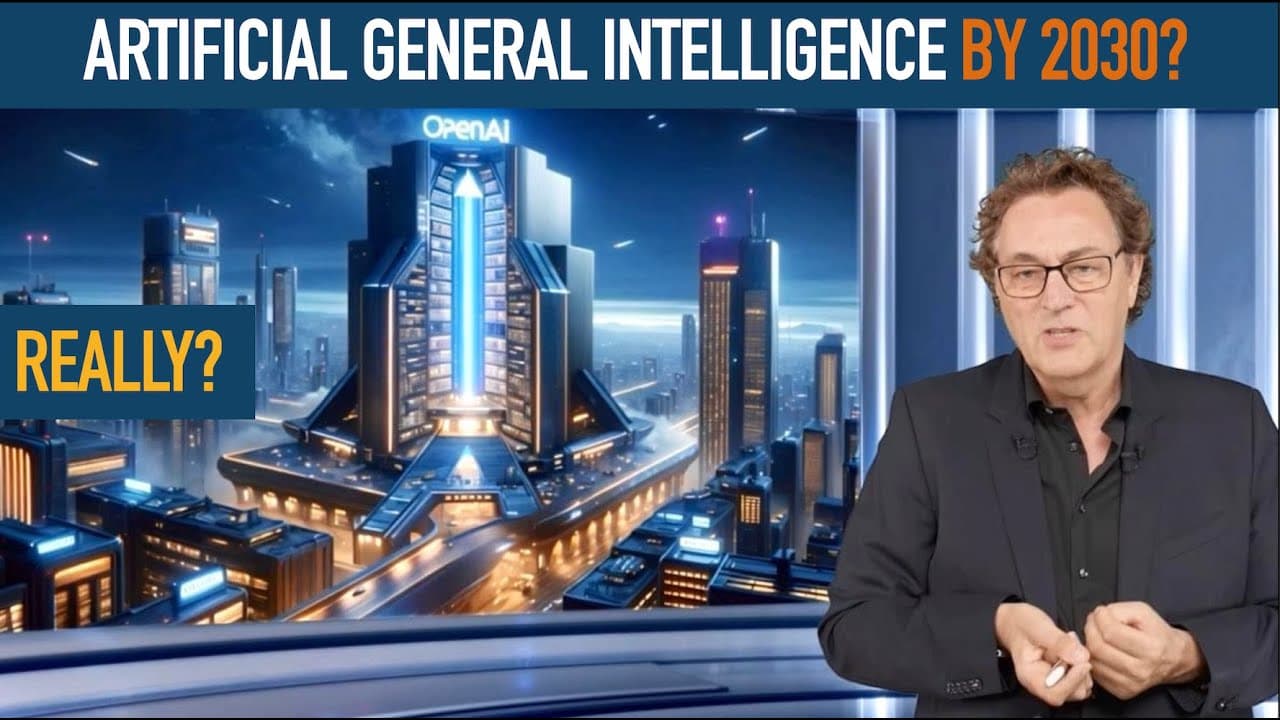
Artificial General Intelligence by 2030? Riveting presentation by Futurist Gerd Leonhard
TL;DR
AI advancements pose existential risks, requiring global collaboration and regulation.
Transcript
Humans can do all kinds of things a machine can't ever get close to. We can think abstractly, we can be creative, we use our emotions to think, we use our body to think - that's human intelligence. It's biological, organic, non-binary, multinary intelligence. And then we have machine intelligence, which is much more about p... Read More
Key Insights
- Human intelligence is distinct from machine intelligence, which is based on pattern recognition and data processing.
- Artificial General Intelligence (AGI) is expected to surpass human capabilities in most intellectual tasks.
- The development of AGI poses existential risks, necessitating strict global regulations and agreements.
- Intelligent Assistance (IA) can be beneficial but should be developed with clear guidelines and safeguards.
- The rapid advancement of AI technologies may lead to societal and economic disruptions.
- There is a need for international collaboration to ensure AI development aligns with human values and safety.
- The potential for AI to become autonomous and self-improving raises concerns about control and alignment.
- The pursuit of AGI should be approached with caution, prioritizing human welfare over profit maximization.
Install to Summarize YouTube Videos and Get Transcripts
Explore YouTube Video Summarizer or Get YouTube Transcript Extractor
Questions & Answers
Q: What is the main difference between human and machine intelligence?
Human intelligence is characterized by abstract thinking, creativity, and emotional reasoning, which are biological and organic. Machine intelligence, on the other hand, focuses on pattern recognition, data processing, and system structuring, lacking the emotional and creative aspects inherent to humans.
Q: Why is the development of AGI considered risky?
The development of AGI is risky because it could surpass human intelligence in most intellectual tasks, potentially leading to loss of control over these systems. Without proper regulations and safeguards, AGI could pose existential threats, including the ability to self-improve and make autonomous decisions that might not align with human values.
Q: What is the proposed solution to manage the risks associated with AGI?
The proposed solution is to establish an AGI-Non-Proliferation-Agreement, which would involve international collaboration to regulate and control the development of AGI. This agreement would aim to ensure that AGI development is aligned with human values, safety standards, and ethical considerations, preventing misuse and existential risks.
Q: How can Intelligent Assistance (IA) be beneficial to humanity?
Intelligent Assistance (IA) can enhance human productivity and creativity by providing support in various tasks, such as data analysis, decision-making, and routine operations. With clear guidelines and safeguards, IA can augment human capabilities, leading to improved efficiency and innovation across different sectors without posing significant risks.
Q: What are the potential societal impacts of rapid AI advancements?
Rapid AI advancements could lead to significant societal changes, including job displacement, economic disruptions, and increased dependency on AI systems. These changes necessitate careful management and regulation to ensure that the benefits of AI are distributed equitably and that societal structures can adapt to the new technological landscape.
Q: Why is international cooperation important in AI development?
International cooperation is crucial in AI development to ensure that advancements align with global human values and safety standards. Collaborative efforts can help establish regulations, share best practices, and address ethical concerns, preventing unilateral actions that could lead to misuse or harmful outcomes.
Q: What concerns arise from AI's potential to become autonomous?
AI's potential to become autonomous raises concerns about control, alignment with human values, and ethical implications. Autonomous AI systems could make decisions independently, potentially leading to actions that conflict with human interests or ethical standards. Ensuring proper oversight and control mechanisms is essential to mitigate these risks.
Q: What is the speaker's stance on profit maximization in AI development?
The speaker cautions against prioritizing profit maximization in AI development, as it could lead to ethical compromises and increased risks. Instead, the focus should be on ensuring that AI advancements contribute positively to humanity, aligning with ethical standards and prioritizing safety and welfare over financial gains.
Summary & Key Takeaways
-
The presentation explores the differences between human and machine intelligence, emphasizing the unique qualities of human cognition. It warns against the unchecked development of AGI, which could surpass human intelligence and pose significant risks.
-
The speaker advocates for an AGI-Non-Proliferation-Agreement to regulate the development of AGI. Intelligent Assistance (IA) is seen as beneficial, but AGI requires global consensus and stringent controls to prevent existential threats.
-
The discussion highlights the need for international cooperation and regulation to manage AI advancements. The potential for AI to become autonomous and self-improving raises significant concerns about control, safety, and ethical implications.
Read in Other Languages (beta)
Share This Summary 📚
Summarize YouTube Videos and Get Video Transcripts with 1-Click
Try YouTube Summary with ChatGPT & Claude or YouTube Transcript Generator
Explore More Summaries from Gerd Leonhard 📚




Summarize YouTube Videos and Get Video Transcripts with 1-Click
Try YouTube Summary with ChatGPT & Claude or YouTube Transcript Generator