34.3 Angular Impulse
TL;DR
Momentum and angular momentum can be defined as the product of mass/velocity and a matter of choice of point, respectively.
Transcript
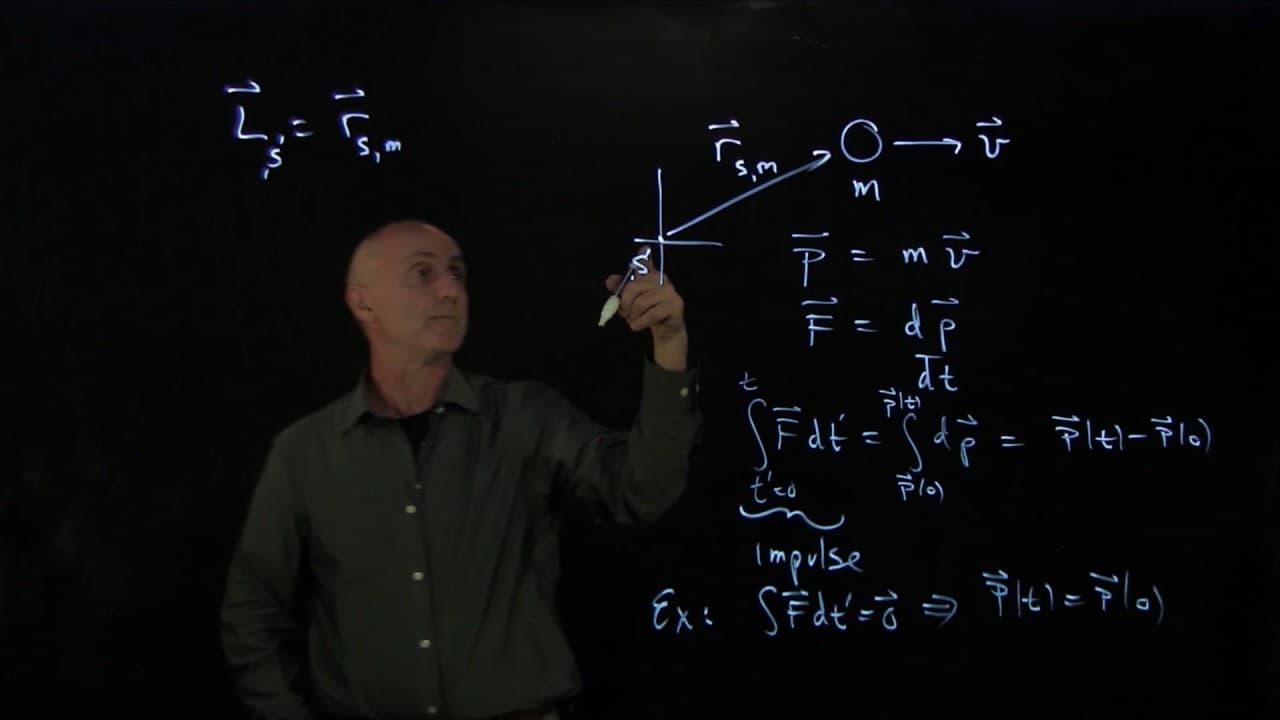
Let's consider the motion of a single particle moving with a velocity v in a ground reference frame, say. Recall that we defined the momentum of this object as mv. And we know that Newton's second law can be written in terms of the change of momentum dp/dt. And when we integrated Newton's second law, for impulse causes the integral of ADP from some... Read More
Key Insights
- 😥 Momentum of a single particle is defined as the product of mass and velocity, while angular momentum is defined differently, depending on the choice of a point.
- 💱 Newton's second law can be written in terms of the change in momentum, and impulse causes this change.
- 0️⃣ Impulse can be zero, indicating that the momentum of a particle remains constant.
Install to Summarize YouTube Videos and Get Transcripts
Explore YouTube Video Summarizer or Get YouTube Transcript Extractor
Questions & Answers
Q: How is momentum defined for a single particle?
Momentum is defined as the product of the mass of a particle and its velocity. It represents the quantity of motion possessed by the particle.
Q: How does impulse affect the momentum of a single particle?
Impulse, which is the integral of force over time, causes the momentum of a particle to change. If the impulse is zero, the momentum remains constant.
Q: What is the difference between momentum and angular momentum?
Momentum is independent of any point and is simply the product of mass and velocity. However, angular momentum depends on the choice of a point, represented by the vector from the point to the object, cross the object's momentum.
Q: What causes the change in angular momentum?
Torque, which is the product of force and the lever arm, causes the change in angular momentum. Just as force causes a change in momentum, torque affects the angular momentum of a particle.
Summary & Key Takeaways
-
Momentum is the product of mass and velocity, and Newton's second law can be written in terms of the change in momentum.
-
Impulse causes the change in momentum, and if the impulse is zero, the momentum remains unchanged.
-
Angular momentum is defined as the cross product of the vector from a chosen point to the object and the object's momentum, and torque causes the change in angular momentum.
Read in Other Languages (beta)
Share This Summary 📚
Summarize YouTube Videos and Get Video Transcripts with 1-Click
Try YouTube Summary with ChatGPT & Claude or YouTube Transcript Generator
Explore More Summaries from MIT OpenCourseWare 📚



Summarize YouTube Videos and Get Video Transcripts with 1-Click
Try YouTube Summary with ChatGPT & Claude or YouTube Transcript Generator