Connecting the Dots: Milestones in Graph Theory
TL;DR
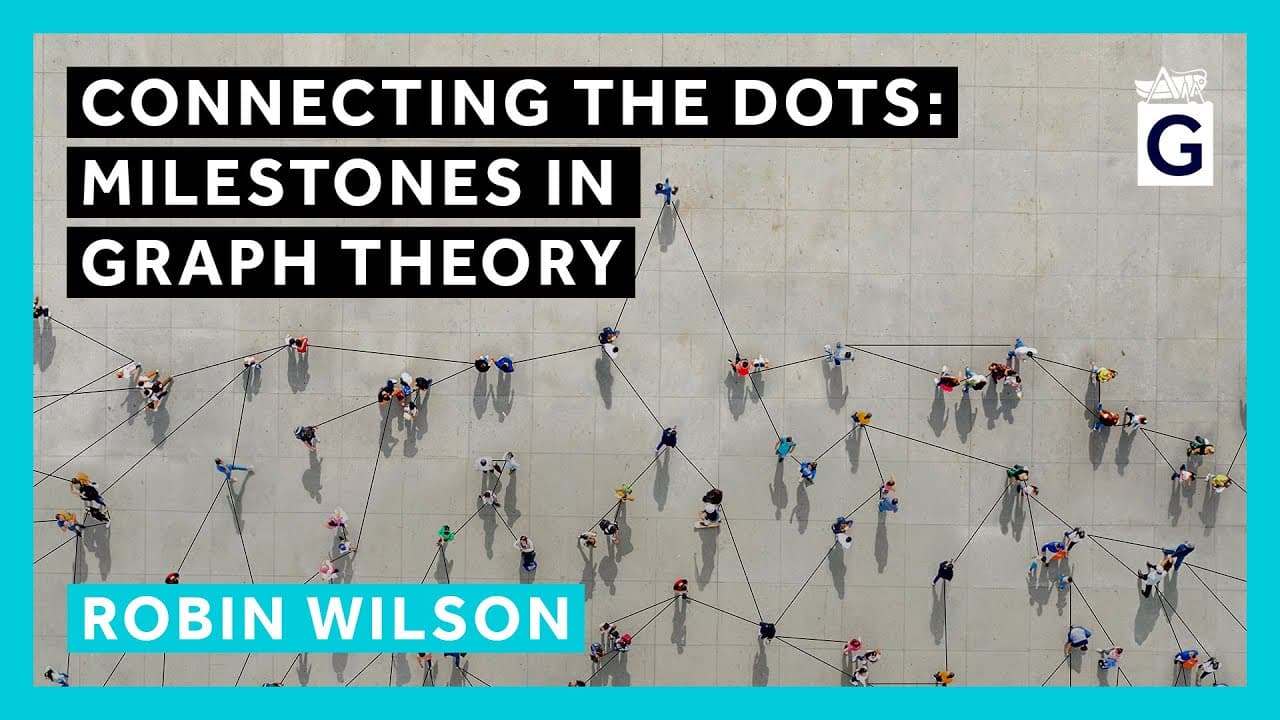
Graph theory, a mathematical field focused on the relationships between interconnected points, has a rich history and is used in various applications such as maps, puzzles, and chemical molecules.
Transcript
foreign but these graphs are not the curves like Y equals X cubed that you see in maths books but are diagrams that depict connections between things such as the London Underground network of stations linked by rails or chemical molecules as shown here with carbons and hydrogen atoms linked by chemical bonds the nature of the connections doesn't ma... Read More
Key Insights
- 🫠 Graph theory studies the connections between points, called vertices or nodes, using edges or arcs.
- 🏑 Graph theory has practical applications in various fields, including transportation networks, social networks, chemistry, and computer science.
- 💨 Euler's solution to the Koenigsberg bridges problem paved the way for the development of graph theory as a distinct mathematical discipline.
- 🍁 The four-color theorem states that any map on a plane can be colored with just four colors, with no adjacent regions having the same color.
- #️⃣ The Two-Color problem on a torus is an open question, and for each number of holes in the torus, there is a minimum number of colors needed to color the map.
Install to Summarize YouTube Videos and Get Transcripts
Explore YouTube Video Summarizer or Get YouTube Transcript Extractor
Questions & Answers
Q: How did Euler solve the Koenigsberg bridges problem?
Euler solved the Koenigsberg bridges problem by representing it as a graph and using a counting argument. He proved that a solution is not possible if the number of bridges around each region is odd. If exactly two numbers are odd, a solution is possible if the starting and ending regions are the odd ones.
Q: What is a tree in graph theory?
In graph theory, a tree is a graph with no cycles, where each vertex is connected to exactly one other vertex. It is equivalent to a family tree and is fundamental in representing interconnected systems without loops.
Q: How is graph theory applied to chemical molecules?
Chemical molecules can be represented as graphs, where atoms are vertices and chemical bonds are edges. Graph theory helps analyze and understand the structures of molecules, such as determining isomers (different structures with the same formula) and studying molecular connectivity.
Q: What is the difference between the Koenigsberg bridges problem and the knight's tour problem?
The Koenigsberg bridges problem involves finding a walk that crosses every bridge in the city of Koenigsberg once, while the knight's tour problem focuses on finding a sequence of moves for a knight on a chessboard to visit every square exactly once. Both problems can be solved using graph theory concepts.
Summary & Key Takeaways
-
The lecture discusses the history and applications of graph theory, focusing on puzzles and maps, including the famous Koenigsberg bridges problem.
-
The lecturer introduces terminology and concepts in graph theory, such as vertices, edges, cycles, trees, and planar graphs.
-
Various puzzles and problems related to graph theory are highlighted, including the knight's tour problem, utilities problem, and map coloring problem.
Read in Other Languages (beta)
Share This Summary 📚
Summarize YouTube Videos and Get Video Transcripts with 1-Click
Try YouTube Summary with ChatGPT & Claude or YouTube Transcript Generator
Explore More Summaries from Gresham College 📚

Summarize YouTube Videos and Get Video Transcripts with 1-Click
Try YouTube Summary with ChatGPT & Claude or YouTube Transcript Generator