LCM and HCF | Least number divisible | Aptitude | Part- 09 | Bharath Kumar
TL;DR
This content explains how to find the least number leaving the same remainder for multiple divisors using LCM.
Transcript
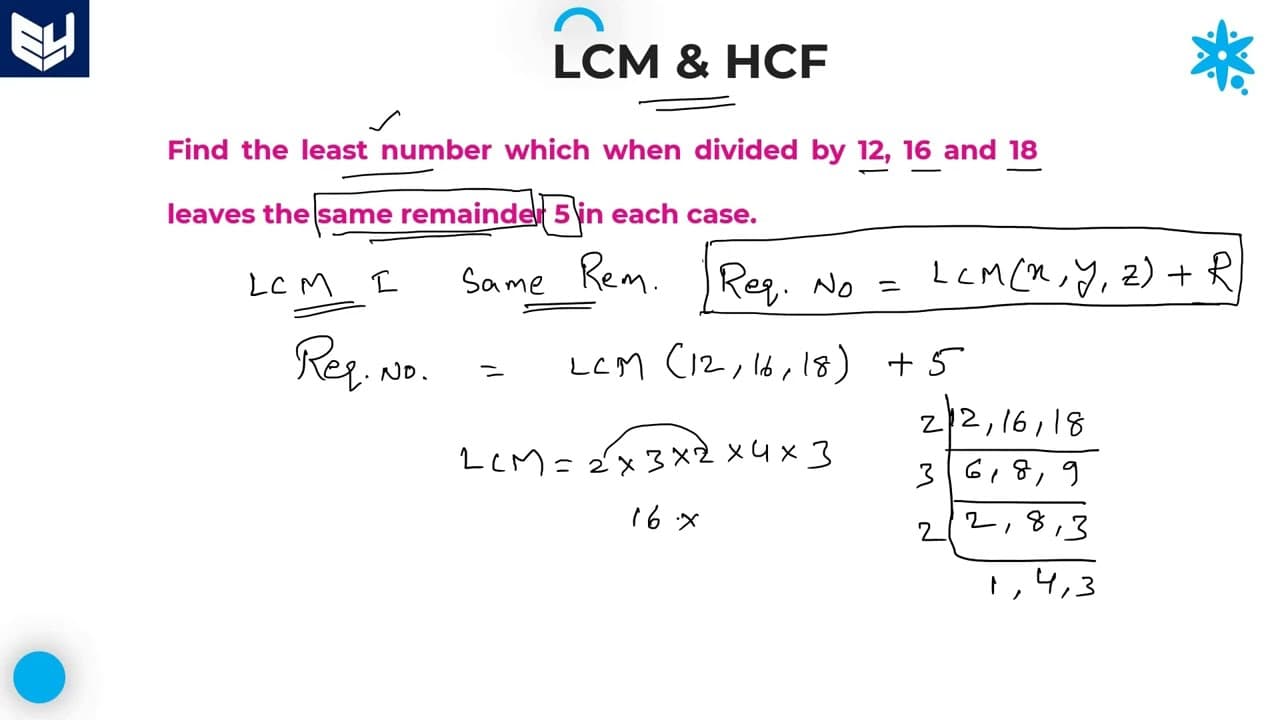
hi everyone in this session i am continuing lcm and hercf in the last session we discussed a few problems related to lcm and hcf let's see the first question in this session see here find the least number which when divided by 12 16 18 leaves the same remainder leaves the same remainder 5 in each case leaves the same remainder 5 in each case guys t... Read More
Key Insights
- ❓ The systematic approach of using LCM combined with remainders simplifies problem-solving in modular arithmetic.
- 🍳 Long division is an effective tool for breaking down the process of finding LCM.
- 🏃 Each question reinforces engagement with the mathematical principles of LCM and HCF through practical exercises.
- 🅰️ Understanding the relationship between divisors and remainders is pivotal to solving these types of mathematical problems.
- ❓ The session highlights that consistent processes yield accurate results in mathematics, especially in patterns and properties.
- #️⃣ Mastery of these concepts is essential for advanced mathematics, including algebra and number theory.
- ❓ The techniques addressed are applicable in various mathematical contexts, enhancing computational efficiency.
Install to Summarize YouTube Videos and Get Transcripts
Explore YouTube Video Summarizer or Get YouTube Transcript Extractor
Questions & Answers
Q: What is the formula for finding the least number that leaves the same remainder when divided by given numbers?
The formula for finding such a number is to first determine the least common multiple (LCM) of the given numbers, then add the specified remainder to that LCM. This approach ensures the resultant number meets the remainder requirement when divided by each divisor.
Q: How does the division method work for calculating LCM in the problems presented?
The long division method involves dividing the given numbers by prime factors until all are reduced to 1. This systematic approach ensures accurate LCM computation. For each prime factorization, you multiply the highest powers of each prime found during the division to get the LCM.
Q: Can you explain the significance of the remainder in these problems?
The remainder is crucial because it defines the conditions under which the least number must meet specific criteria when divided by each divisor. Adding the remainder to the LCM provides a solution that gives the expected equivalent remainders in calculations.
Q: Why is the least number significantly larger than the numbers being divided in the examples?
The least number often exceeds the individual divisors since it is derived from their LCM plus a specified remainder. Since LCM represents a common multiple, it inherently reflects the combination of the values, necessitating a larger resultant value to meet all conditions.
Summary & Key Takeaways
-
The session focuses on solving problems related to least common multiples (LCM) and highest common factors (HCF), specifically finding numbers that leave the same remainder for different divisors.
-
The first problem illustrates finding the smallest number divisible by 12, 16, and 18 while leaving a remainder of 5, demonstrating the formula LCM + remainder.
-
The second problem extends the concept, seeking the least number for divisors 6, 7, 8, 9, and 12 that leaves a remainder of 1, reinforcing the method previously established.
Read in Other Languages (beta)
Share This Summary 📚
Summarize YouTube Videos and Get Video Transcripts with 1-Click
Try YouTube Summary with ChatGPT & Claude or YouTube Transcript Generator