Spatial Models
TL;DR
Spatial models explain product differentiation and firm location strategies.
Transcript
hi today we're going to look at some models which economists use to help understand product differentiation when do firms choose to make their products similar to their competitors and when and why do they choose to make their products different from their competitors these are called spatial models because the analogy is going to be to location le... Read More
Key Insights
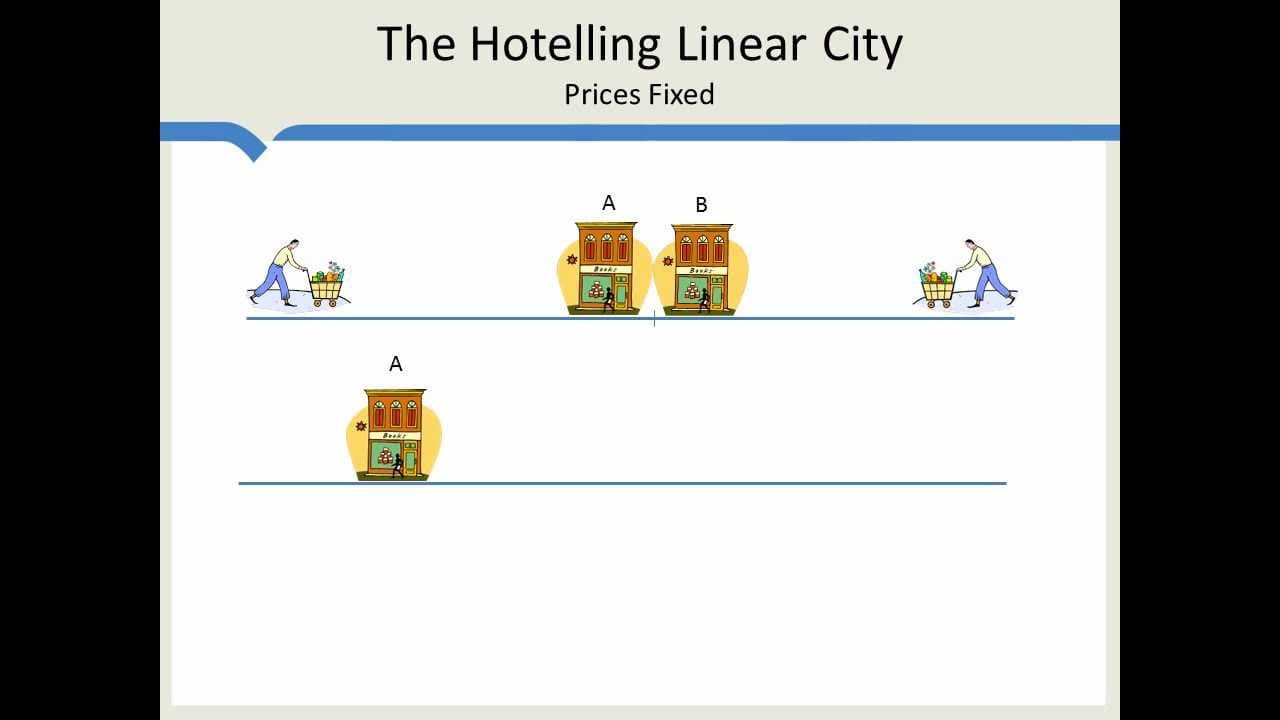
- Hotelling's linear city model illustrates how firms choose locations to maximize market share, often resulting in minimal differentiation.
- The Nash equilibrium occurs when neither firm can improve its market share by unilaterally changing location, leading both to position centrally.
- In politics, spatial models suggest parties align with the median voter to capture the majority, illustrating minimal differentiation.
- When firms can set prices, maximum differentiation occurs as firms spread out to gain monopoly power and charge higher prices.
- Quadratic transportation costs imply consumers face increasing costs with distance, influencing firm location strategies.
- Spatial models reveal opposing forces: firms seek proximity for market share and distance for pricing power.
- The ideal differentiation minimizes consumer transportation costs, suggesting firms should locate at quarter points along the spectrum.
- Spatial models lack an invisible hand result, meaning market forces do not necessarily lead to optimal consumer outcomes.
Install to Summarize YouTube Videos and Get Transcripts
Explore YouTube Video Summarizer or Get YouTube Transcript Extractor
Questions & Answers
Q: What is the basic premise of Hotelling's linear city model?
Hotelling's linear city model illustrates how firms choose locations along a spectrum, such as Main Street, to maximize their market share. The model predicts that firms selling similar products will position themselves centrally to equally divide the market, resulting in minimal differentiation. This positioning is driven by the desire to capture the largest number of consumers.
Q: How does the Nash equilibrium apply to spatial models?
In spatial models, a Nash equilibrium occurs when firms are positioned such that neither can improve its market share by unilaterally changing its location. This typically results in both firms positioning themselves centrally, as any deviation would allow the competitor to capture a larger portion of the market. The Nash equilibrium ensures stability in firm locations.
Q: How do spatial models apply to political strategies?
Spatial models apply to political strategies by suggesting that political parties align themselves with the median voter to capture the majority of votes. This leads to minimal differentiation between parties, as each seeks to appeal to the largest segment of the electorate. The model demonstrates how parties adjust their positions to maximize electoral success.
Q: What happens when firms can set their own prices in spatial models?
When firms can set their own prices, spatial models predict maximum differentiation, where firms spread out to gain monopoly power. This allows them to charge higher prices as each firm captures consumers who face high transportation costs to reach a competitor. The increased distance between firms reduces competition and increases pricing power.
Q: What role do quadratic transportation costs play in spatial models?
Quadratic transportation costs imply that the cost to consumers increases at an increasing rate with distance from their preferred store. This affects firm location strategies, as firms must balance the desire to be closer to competitors for market share against the benefit of being farther apart to charge higher prices due to reduced competition.
Q: What are the opposing forces in spatial models?
The opposing forces in spatial models are the desire for firms to move closer to competitors to gain market share and the desire to move farther apart to gain monopoly power and charge higher prices. Firms must navigate these forces to optimize their location strategies, balancing consumer convenience with pricing power.
Q: What is the ideal differentiation for minimizing transportation costs?
The ideal differentiation for minimizing transportation costs occurs when firms are located at the quarter and three-quarter points along the spectrum. This positioning minimizes the distance consumers must travel, thereby reducing transportation costs. It represents a socially optimal distribution, balancing consumer convenience with competition.
Q: Do spatial models lead to optimal consumer outcomes?
Spatial models do not inherently lead to optimal consumer outcomes, as they lack an invisible hand result. Market forces may result in too little or too much differentiation, rather than the socially optimal distribution. The ideal differentiation, minimizing transportation costs, occurs by chance rather than as a natural market outcome, highlighting potential inefficiencies.
Summary & Key Takeaways
-
Spatial models help economists understand how firms differentiate products and choose locations relative to competitors. Hotelling's linear city model shows firms often cluster centrally due to market share considerations, leading to minimal differentiation. In politics, parties similarly position themselves to appeal to the median voter.
-
When firms can set prices, maximum differentiation occurs as they spread out to gain monopoly power. Quadratic transportation costs mean consumers face increasing costs with distance, influencing firm location decisions. The balance between market share and pricing power drives firm strategies.
-
The ideal differentiation minimizes consumer transportation costs, suggesting firms should locate at quarter points. However, spatial models lack an invisible hand result, meaning market forces do not always lead to optimal consumer outcomes. Further reading includes foundational texts by Hotelling and Downs.
Read in Other Languages (beta)
Share This Summary 📚
Summarize YouTube Videos and Get Video Transcripts with 1-Click
Try YouTube Summary with ChatGPT & Claude or YouTube Transcript Generator
Explore More Summaries from Marginal Revolution University 📚

Summarize YouTube Videos and Get Video Transcripts with 1-Click
Try YouTube Summary with ChatGPT & Claude or YouTube Transcript Generator