7.2: Wolfram Elementary Cellular Automata - The Nature of Code
TL;DR
Study the history, rules, and outcomes of Cellular Automata using simple code examples.
Transcript
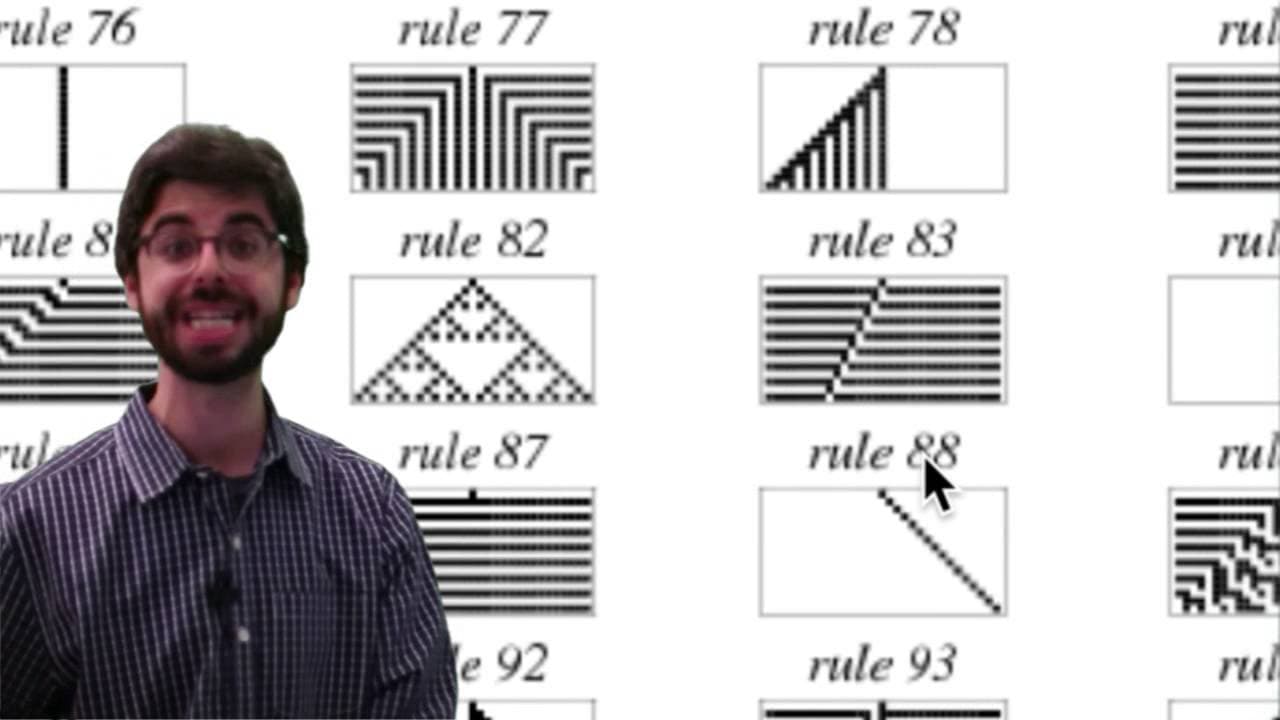
all right we're ready to look at our first cellular automaton now first I should mention that CA has kind of a there's a rich history of work you know that you could really look back into into the 1950s and were look at the work of John von Neumann in Stanislaw ulam there are all sorts of interesting beginning uses of this idea of modeling behavior... Read More
Key Insights
- 🤑 Cellular automata have a rich history dating back to the 1950s with influential figures like von Neumann and Ulam.
- 👾 The game of life by Stephen Wolfram is a well-known cellular automaton illustrating behavior modeling through simple rules.
- ❓ By exploring one-dimensional grids and defining rulesets, we observe various outcomes like uniformity, repetition, randomness, and complexity.
- ⚾ Wolfram classifies cellular automata outcomes into distinct categories based on observed patterns such as uniformity, repetition, randomness, and complexity.
- 📏 Patterns in cellular automata can exhibit surprising complexity and unpredictability despite originating from simple rules.
- 🥺 Rule configurations in cellular automata lead to outcomes ranging from ordered and repeating patterns to random and complex behaviors.
- ✊ The emergence of intelligent and complex behavior in cellular automata highlights the power of computational systems to model natural processes.
Install to Summarize YouTube Videos and Get Transcripts
Explore YouTube Video Summarizer or Get YouTube Transcript Extractor
Questions & Answers
Q: What is the history of cellular automata, and who were the key figures involved?
Cellular automata have roots in the 1950s, with key figures like John von Neumann and Stanislaw Ulam contributing to the early development of the concept.
Q: How are rules defined in elementary cellular automata, and how do they determine the state of each cell in the next generation?
Rules in elementary cellular automata are based on the states of a cell's neighboring cells, which dictate the cell's state in the next generation following simple rule functions.
Q: What are the classifications of outcomes in cellular automata according to Wolfram, and how do they manifest in the results?
Wolfram categorizes cellular automata outcomes into uniformity, repetition, randomness, and complexity, each representing different behaviors observed in the evolving patterns.
Q: How can simple rules in cellular automata lead to complex and unpredictable results such as randomness and ordered patterns?
Cellular automata demonstrate that complex and intelligent behaviors can emerge from simple rules, showcasing the intriguing nature of computational systems.
Summary & Key Takeaways
-
Cellular automata have a rich history dating back to the 1950s with pioneers like John von Neumann and Stanislaw Ulam.
-
Cellular automata, like the game of life by Stephen Wolfram, model behavior through simple rules and neighborhood interactions.
-
By exploring simple scenarios and rulesets in one-dimensional grids, we can observe uniformity, repetition, randomness, and complexity.
Read in Other Languages (beta)
Share This Summary 📚
Summarize YouTube Videos and Get Video Transcripts with 1-Click
Try YouTube Summary with ChatGPT & Claude or YouTube Transcript Generator
Explore More Summaries from The Coding Train 📚


Summarize YouTube Videos and Get Video Transcripts with 1-Click
Try YouTube Summary with ChatGPT & Claude or YouTube Transcript Generator