Calculus - Lesson 15 | Relation between Differentiation and Integration | Don't Memorise
TL;DR
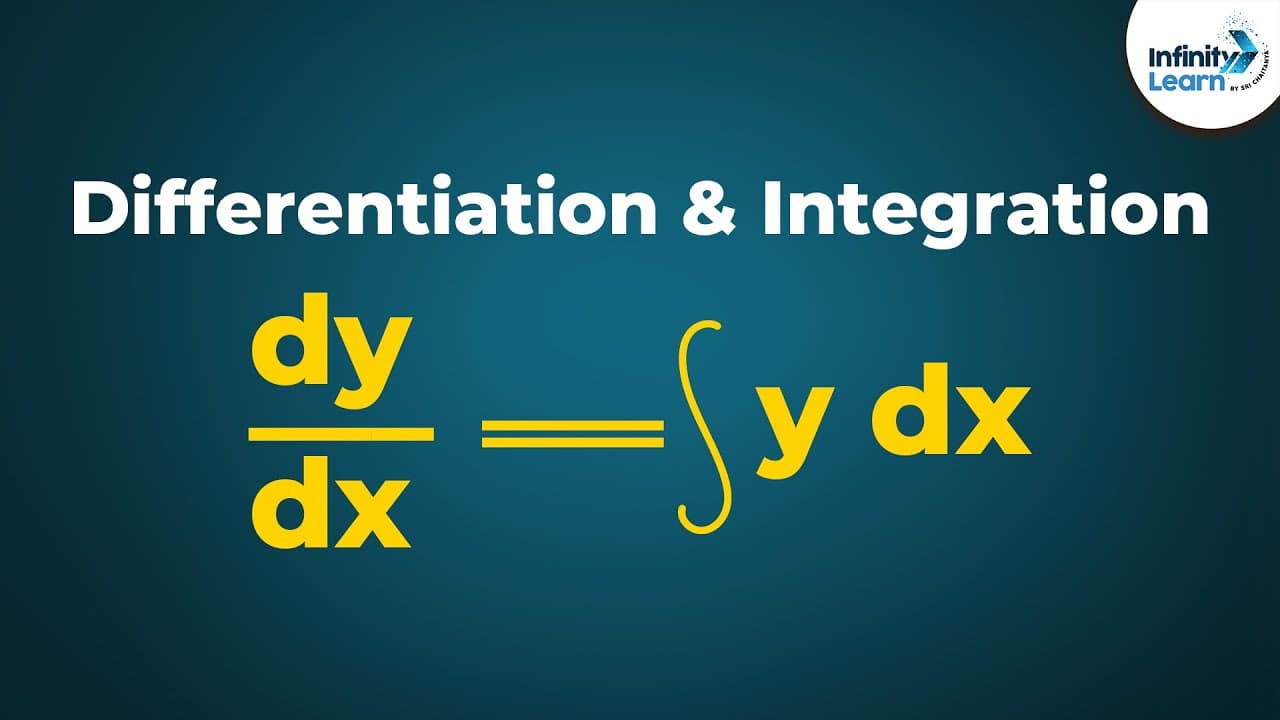
Differentiation and integration are opposite processes, where differentiation finds the instantaneous rate of change and integration finds the area under a graph. Integrals can be found using the Fundamental Theorem of Calculus.
Transcript
By now, we are well-acquainted with the idea of differentiation and integration. We know that the derivative of a function tells us its instantaneous rate of change and the integral of a function tells us the area under its graph. We can see that these two ideas were developed to tackle two different kinds of problems. But it turns out that these i... Read More
Key Insights
- ☠️ Differentiation and integration are opposite processes in calculus, with differentiation finding the rate of change and integration finding the area under a graph.
- ❓ The process of finding integrals can be simplified using the Fundamental Theorem of Calculus, which states the relationship between integrals and derivatives.
- 🍹 The area under a graph can be found by dividing it into rectangles and summing their areas, and for certain shapes, integration can be achieved without explicit calculation.
- 👻 The relationship between differentiation and integration allows us to easily find integrals by evaluating the function at the limits of integration.
Install to Summarize YouTube Videos and Get Transcripts
Explore YouTube Video Summarizer or Get YouTube Transcript Extractor
Questions & Answers
Q: How are differentiation and integration related to each other?
Differentiation and integration are opposite processes in calculus. Differentiation finds the instantaneous rate of change, while integration finds the area under a graph.
Q: How can the Fundamental Theorem of Calculus be used to find integrals?
The Fundamental Theorem of Calculus states that the integral of a function is equal to the difference in the values of the function evaluated at the limits of integration. This allows us to find integrals easily by evaluating the function at the limits.
Q: What is the relationship between the derivative and integral of a function?
The derivative of a function gives the rate of change, while the integral gives the area under the graph. The derivative and integral of a function are inverses of each other.
Q: What is an anti-derivative or indefinite integral?
An anti-derivative or indefinite integral is a function whose derivative is equal to the original function. It allows us to find integrals easily by finding the anti-derivative of the function.
Summary & Key Takeaways
-
Differentiation and integration are related processes in calculus that tackle different types of problems.
-
Integration finds the area under a graph by dividing it into rectangles and summing their areas, while differentiation finds the instantaneous rate of change.
-
The Fundamental Theorem of Calculus states that the integral of a function is equal to the difference in the values of the function evaluated at the limits of integration.
Read in Other Languages (beta)
Share This Summary 📚
Summarize YouTube Videos and Get Video Transcripts with 1-Click
Try YouTube Summary with ChatGPT & Claude or YouTube Transcript Generator
Explore More Summaries from Infinity Learn NEET 📚


Summarize YouTube Videos and Get Video Transcripts with 1-Click
Try YouTube Summary with ChatGPT & Claude or YouTube Transcript Generator