1.3 Displacement Vector in 1D
TL;DR
This content explains how to describe the position and displacement vectors of a runner as they move along a road.
Transcript
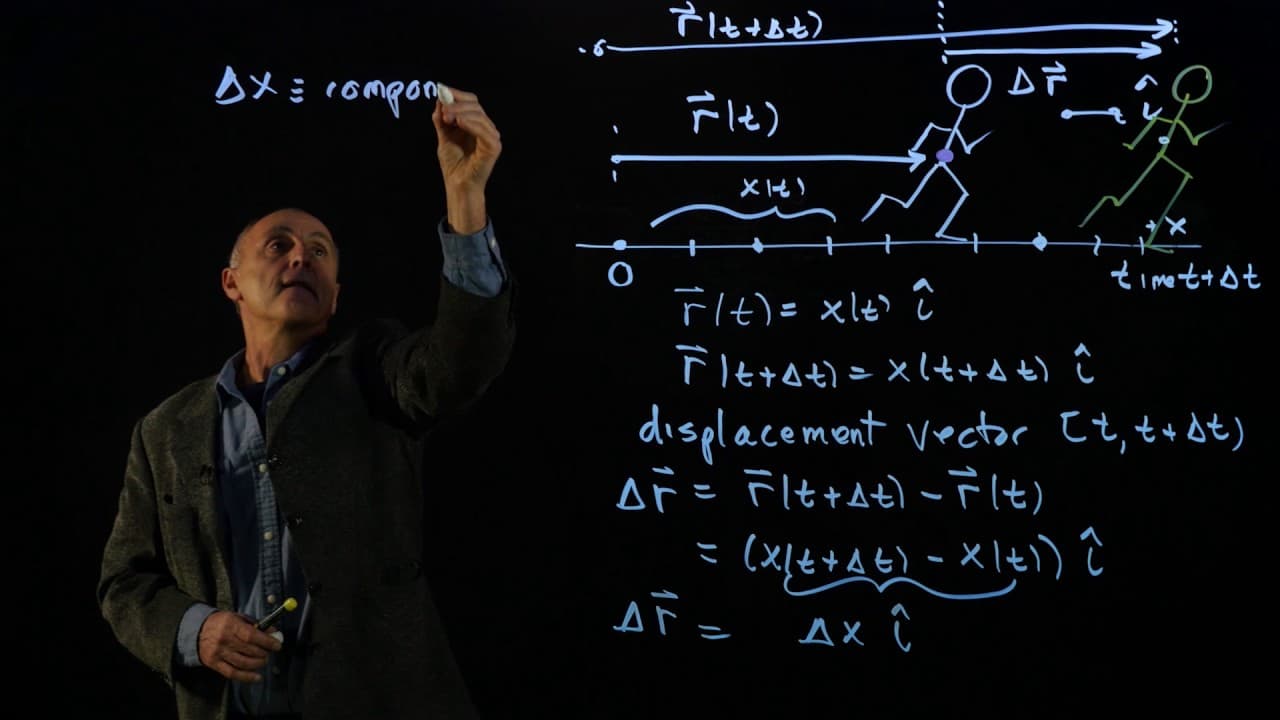
Now that we've described the position vector of the runner, let's try to describe what happens in time as a runner moves along our road. Suppose at a later time our runner has gone down the road just a little bit. And so the runner has moved a little bit. Remember, at time t, we described the position vector r(t) was equal to the coordinate functio... Read More
Key Insights
- 🏃 Position vector, r(t), describes the runner's location as a function of time.
- 🧘 Displacement vector, delta r, represents the change in position between two different times.
- 🏃 The component of the displacement vector, delta x, can be positive, zero, or negative, depending on the runner's movement along the x-axis.
- 🏃 Positive delta x means the runner has moved in the positive x-direction, negative delta x means the runner is to the left of their initial position, and zero delta x means the runner has returned to their starting point.
Install to Summarize YouTube Videos and Get Transcripts
Explore YouTube Video Summarizer or Get YouTube Transcript Extractor
Questions & Answers
Q: What does the position vector, r(t), represent?
The position vector, r(t), represents the runner's position as a function of time. It describes where the runner is located along the road at a particular time.
Q: How is the displacement vector, delta r, defined?
The displacement vector, delta r, is defined as the vector difference between the position vectors at two different times, specifically r(t) plus delta t minus r(t). It shows the change in position of the runner during that interval.
Q: Can the displacement vector have a positive component?
Yes, the displacement vector can have a positive component. A positive component indicates that the runner has moved in the positive x-direction along the road during the interval from time t to t plus delta t.
Q: What does a zero displacement vector mean?
A zero displacement vector means that the runner has returned to the same spot at time t plus delta t as they were at time t. It indicates that the runner has run forward and then come back to their initial position.
Summary & Key Takeaways
-
The content discusses the position vector, r(t), which represents the runner's position as a function of time, and how it changes as the runner moves along the road.
-
It introduces the concept of the displacement vector, delta r, which is the difference between the position vectors at two different times, indicating the change in position.
-
The video explains how the displacement vector can have positive, zero, or negative components, depending on the direction and distance of the runner's movement.
Read in Other Languages (beta)
Share This Summary 📚
Summarize YouTube Videos and Get Video Transcripts with 1-Click
Try YouTube Summary with ChatGPT & Claude or YouTube Transcript Generator
Explore More Summaries from MIT OpenCourseWare 📚



Summarize YouTube Videos and Get Video Transcripts with 1-Click
Try YouTube Summary with ChatGPT & Claude or YouTube Transcript Generator