Multi-range ammeter | Aryton shunt | Electrical Instruments ( EIM ) | Lec - 05
TL;DR
Overview of the retention multi-range ammeter with shunt connections for different current ranges.
Transcript
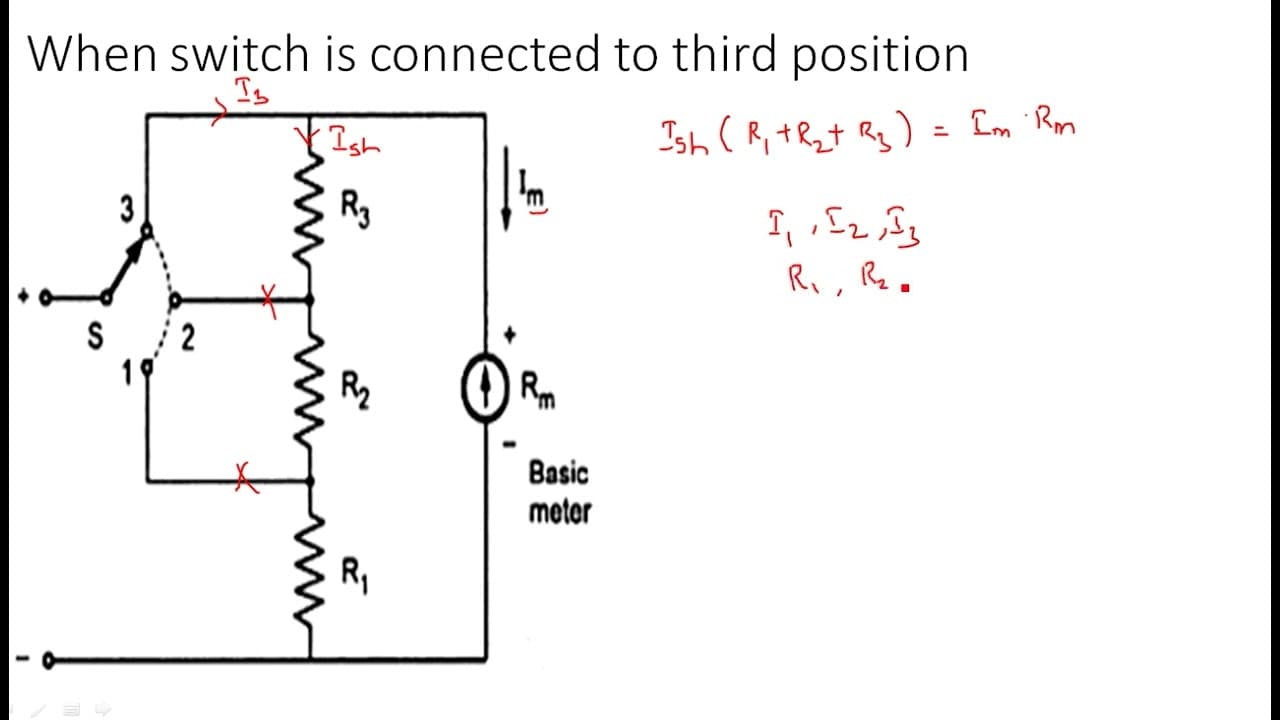
we are going to see the retention multi-range ammeter in the previous lecture we have seen a shunt type multi-range emitter shunt type means where the resistors are connected individually for every range suppose if you are taking i1 range one particular resistor is there and i2 range one particular resistor is there but in the case of r810 shunt mu... Read More
Key Insights
- 🧡 The retention multi-range ammeter is characterized by a cascaded resistor arrangement to measure varying currents accurately.
- 🧘 Each switching position corresponds to a distinct resistive pathway that directly influences the ammeter's reading, crucial for precise measurements.
- 🧡 The equations derived from the switching positions help in systematically determining unknown resistor values essential for each current range.
- 🧡 It is vital that resistors do not alter the behavior of the ammeter and maintain consistent performance across all operational ranges.
- 🎨 Understanding the relationships between resistors in series and parallel is critical for effective ammeter design and function.
- 🖐️ The internal resistance of the movement plays a significant role in calculations, affecting the total resistance and current through the system.
- 🙈 Practical applications of this knowledge are often seen in examinations, emphasizing the theoretical understanding of electronic circuits.
Install to Summarize YouTube Videos and Get Transcripts
Explore YouTube Video Summarizer or Get YouTube Transcript Extractor
Questions & Answers
Q: What is the fundamental principle behind the retention multi-range ammeter?
The retention multi-range ammeter operates on the principle of using multiple resistors connected in parallel to achieve various current sensitivity levels, ensuring the original characteristics of the ammeter remain intact while allowing for accurate measurement under different conditions.
Q: How does switching to different positions affect the circuit of the multi-range ammeter?
When the switch is changed to different positions, it alters the combination of resistors in the circuit. Each position connects distinct resistors in series or parallel, impacting the current entering the meter and requiring different equations for analysis to maintain accurate readings.
Q: What role do the resistor values play in the functioning of the ammeter?
Resistor values determine the meter's sensitivity and range by defining the current paths. Correct resistor selection is essential for ensuring that the ammeter accurately measures various current levels without exceeding its maximum input, which could damage the instrument.
Q: Can you describe the process to derive the resistor values needed for specific current ranges?
The process involves writing equations based on selected current ranges, utilizing Kirchhoff's laws, and substituting known values to solve for the unknown resistances. Each range provides a different equation that helps calculate the necessary resistor values for accurate functioning.
Summary & Key Takeaways
-
The content explains the working of a retention multi-range ammeter that utilizes cascaded connections of resistors for different current ranges, where resistors are selectively parallel and series connected.
-
Each range corresponds to a specific resistor in a parallel configuration, allowing accurate measurement without altering the ammeter's original behavior, crucial for maintaining circuit integrity.
-
Detailed equations are provided for calculating the values of resistors based on different selected current ranges, emphasizing the importance of these calculations in application and examination contexts.
Read in Other Languages (beta)
Share This Summary 📚
Summarize YouTube Videos and Get Video Transcripts with 1-Click
Try YouTube Summary with ChatGPT & Claude or YouTube Transcript Generator