PHILOSOPHY - Language: Conditionals #4 [HD]
TL;DR
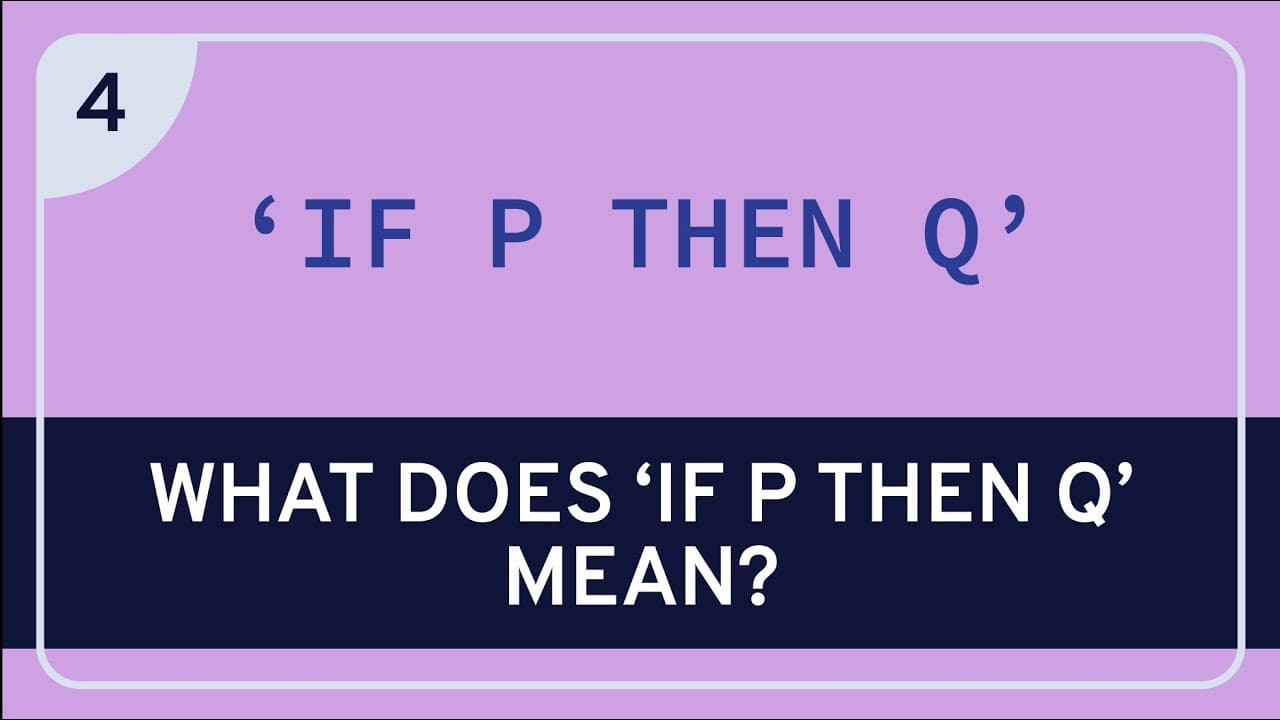
The video explains the Conditional Assertion Theory of conditionals.
Transcript
welcome to the fourth and final part in our series on conditionals I'm Justin coup to briefly recap what we've covered so far recall that we began with the question of what conditional sentences like one mean if the safety net needs repair I will fix it so far we tackled this question by thinking about the conditions under which one would be true o... Read More
Key Insights
- The Conditional Assertion Theory views uttering a conditional as making a conditional bet, unlike the categorical assertion made by material and strict conditional theories.
- Conditional bets are contingent on their antecedents, meaning no commitment is made if the antecedent is false, unlike categorical bets, which ensure a winner and loser.
- A conditional assertion commits to the truth of a statement only under specific conditions, similar to placing a wager based on a condition.
- The Conditional Assertion Theory suggests that the meaning of a conditional sentence is derived from the act of making a conditional assertion, not from the meanings of its parts.
- According to the theory, conditionals can be neither true nor false if the antecedent condition does not occur, differing from the material and strict conditional theories.
- The theory helps address problems faced by previous theories, such as predicting false validity in certain philosophical arguments.
- Despite its advances, the Conditional Assertion Theory faces challenges, such as incorrectly predicting the validity of certain arguments, similar to the issues with the material conditional theory.
- The video concludes by encouraging further exploration of conditionals, suggesting resources like Dorothy Edgington's work.
Install to Summarize YouTube Videos and Get Transcripts
Explore YouTube Video Summarizer or Get YouTube Transcript Extractor
Questions & Answers
Q: What distinguishes the Conditional Assertion Theory from other conditional theories?
The Conditional Assertion Theory differs by treating conditionals as conditional bets rather than categorical assertions. This means that a conditional statement commits to being true only under specific conditions, unlike the material and strict conditional theories that categorize the truth based on the antecedent and consequent.
Q: How does the Conditional Assertion Theory address the problems of previous theories?
The theory mitigates issues by suggesting that conditionals are neither true nor false if the antecedent condition does not occur. This approach prevents the problem of making it too easy for conditionals to be true and avoids incorrectly predicting the validity of certain philosophical arguments.
Q: What are the implications of viewing conditionals as conditional bets?
Viewing conditionals as conditional bets implies that no commitment is made if the antecedent is false, unlike categorical bets that ensure a winner and loser. This perspective aligns the meaning of conditionals with the act of making a conditional assertion rather than the meanings of its parts.
Q: Why might the Conditional Assertion Theory still face challenges?
Despite its advances, the theory shares some drawbacks with the material conditional theory, such as incorrectly predicting the validity of certain arguments. This issue arises because the theory suggests that the only way for a conditional to be false is if its antecedent is true and its consequent is false.
Q: How does the theory approach the truth value of conditionals?
The Conditional Assertion Theory proposes that conditionals can be neither true nor false if the antecedent condition does not occur. This differs from the material and strict conditional theories, which rely on the truth values of the antecedent and consequent to determine the truth of the conditional.
Q: What philosophical problems does the theory aim to resolve?
The theory aims to resolve issues like predicting false validity in philosophical arguments, such as the existence of God argument. By treating conditionals as conditional assertions, it avoids the pitfalls of making conditionals too easily true, which plagued previous theories.
Q: What example illustrates the difference between categorical and conditional bets?
An example is betting on a baseball game being canceled if it rains. A conditional bet only binds if the condition (rain) occurs, whereas a categorical bet, like betting on a cat being on a mat, ensures a winner and loser regardless of conditions.
Q: What resources are suggested for further exploration of conditionals?
The video suggests exploring Dorothy Edgington's work on conditionals, particularly through the Stanford Encyclopedia of Philosophy, for those interested in delving deeper into the topic and understanding the nuances of various conditional theories.
Summary & Key Takeaways
-
The video introduces the Conditional Assertion Theory, which distinguishes itself by treating conditionals as conditional bets rather than categorical assertions. This approach addresses some issues faced by previous theories, such as the material and strict conditional theories.
-
Conditional assertions are commitments to the truth of a statement under certain conditions, unlike categorical assertions that are binding regardless of conditions. This theory proposes that conditionals can be neither true nor false if conditions are unmet.
-
Despite its strengths, the Conditional Assertion Theory shares some drawbacks with the material conditional theory, such as incorrectly predicting the validity of certain arguments. The video ends by suggesting further resources for those interested in exploring conditionals.
Read in Other Languages (beta)
Share This Summary 📚
Summarize YouTube Videos and Get Video Transcripts with 1-Click
Try YouTube Summary with ChatGPT & Claude or YouTube Transcript Generator
Explore More Summaries from Wireless Philosophy 📚
Summarize YouTube Videos and Get Video Transcripts with 1-Click
Try YouTube Summary with ChatGPT & Claude or YouTube Transcript Generator