What Happens When Matter is Pushed to the Extreme
TL;DR
Scientists use diamonds, lasers, and even nuclear explosions to generate extreme pressures for studying materials and phenomena in different environments, from deep inside the Earth to distant star systems.
Transcript
It’s not just a surprisingly common topic for song lyrics for the last several centuries, scientists have been fascinated by what happens to materials when they’re under pressure. The hope is that with these experiments, we can model the chemistry of places we’ll never be able to visit, like deep inside the Earth, or Saturn, or the Sun. And with th... Read More
Key Insights
- 🤩 Scientists use high-pressure experiments to model conditions in inaccessible environments like the Earth's core or distant star systems.
- 💯 Diamond Anvil Cells (DACs) are commonly used to exert high pressures on samples, with pressures reaching into the hundreds of gigapascals.
- 👻 Dynamic experiments using lasers and shockwaves can generate even higher pressures, allowing for the exploration of physics in more massive planets.
- 👋 The vaporization of diamonds through lasers creates strong pressure waves and enables the study of extreme pressure phenomena.
- 🍝 Nuclear explosions were used in the past to reach record pressures, but such experiments are no longer feasible.
- 🥶 High-pressure experiments have allowed researchers to create superionic ice, which behaves as a solid and a liquid simultaneously.
- ✋ While physicists have theories about high-pressure phenomena, further experiments are needed to confirm their hypotheses.
Install to Summarize YouTube Videos and Get Transcripts
Explore YouTube Video Summarizer or Get YouTube Transcript Extractor
Questions & Answers
Q: How do scientists increase pressure in experiments?
Scientists can increase pressure by either increasing the force exerted or by decreasing the area of force. Decreasing the area is the easiest way to increase pressure, which is why shark teeth have points.
Q: What are Diamond Anvil Cells (DACs) and how do they work?
DACs are devices that use two diamonds as anvils to squeeze a sample, exerting a lot of force over a tiny area. The sample is sandwiched between the diamonds' facets, and as they're pushed together, pressures in the hundreds of gigapascals can be achieved.
Q: How do lasers contribute to generating extreme pressure?
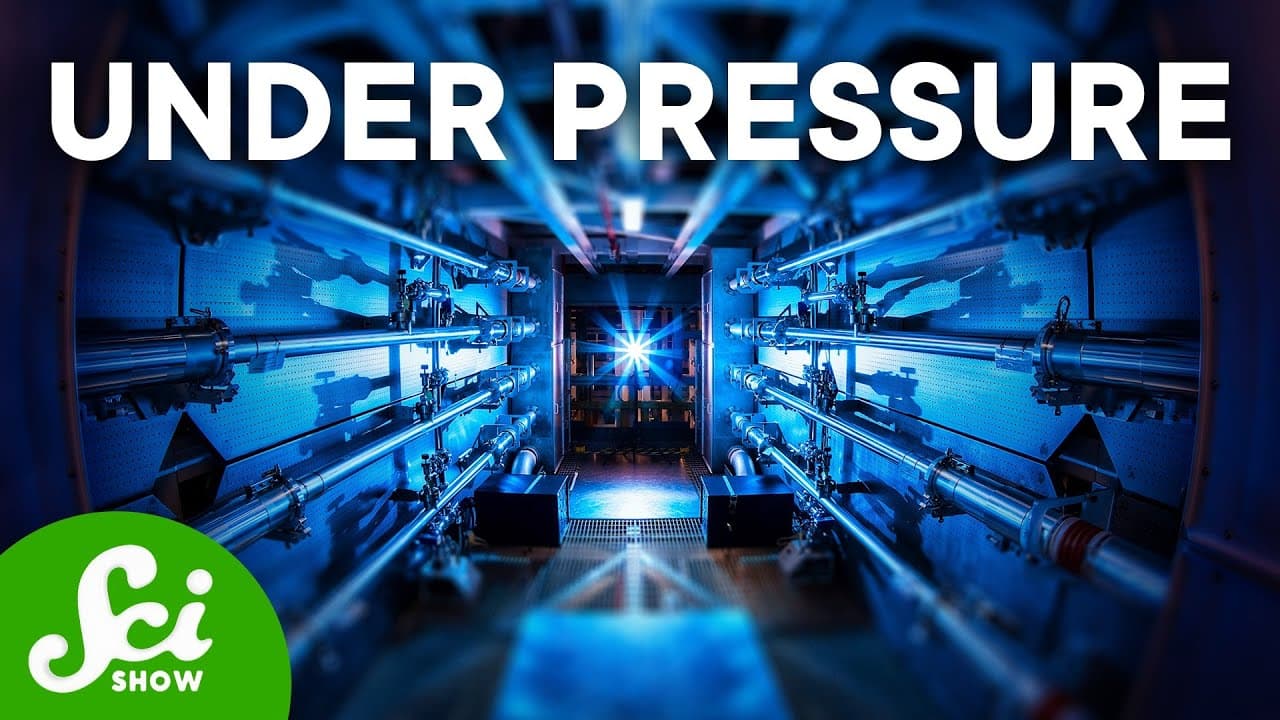
Lasers can be used to vaporize diamonds, creating a ramp compression wave that generates intense pressure. This method allows pressures of up to 5 terapascals, comparable to the center of Jupiter.
Q: How have nuclear explosions been used to study high-pressure effects?
Underground nuclear explosions during the Cold War were used to study the compression of metals. The shockwaves generated reached pressures of up to 700 terapascals, but such experiments are no longer conducted.
Summary & Key Takeaways
-
Scientists have been studying the effects of pressure on materials for centuries, hoping to model the chemistry of inaccessible places like the Earth's core or Saturn.
-
They use Diamond Anvil Cells (DACs) to exert high pressures on samples, with pressures reaching millions of times greater than what is experienced on Earth's surface.
-
Dynamic experiments using lasers and shockwaves can generate even higher pressures, up to billions of times Earth's atmospheric pressure.
Read in Other Languages (beta)
Share This Summary 📚
Summarize YouTube Videos and Get Video Transcripts with 1-Click
Try YouTube Summary with ChatGPT & Claude or YouTube Transcript Generator
Explore More Summaries from SciShow 📚


Summarize YouTube Videos and Get Video Transcripts with 1-Click
Try YouTube Summary with ChatGPT & Claude or YouTube Transcript Generator