Why Doesn’t the Palo Verde Tree Need Water?
TL;DR
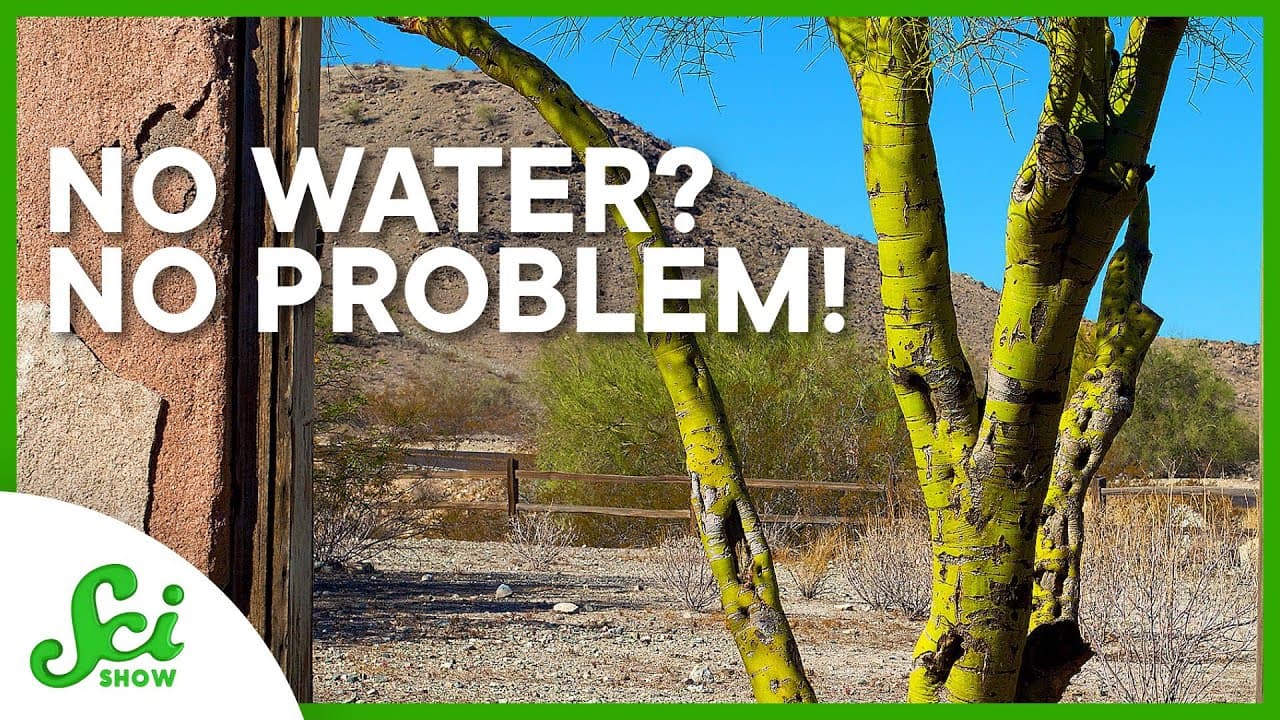
The palo verde tree is a unique deciduous tree that has adapted to survive in water-scarce environments through stem photosynthesis and other specialized features.
Transcript
[ ♪ INTRO ] This episode is sponsored by 80,000 Hours. 80,000 Hours is a nonprofit that aims to help people have a positive impact with their career. Head to 80000hours.org/scishow to start planning a career that can help solve one of the world’s most pressing problems. Most living things need water, from the smallest single-celled organism to your... Read More
Key Insights
- 🌱 The palo verde tree is an example of a plant species that has adapted to survive in arid environments with limited rainfall.
- 🍃 Its unique features, such as small leaves, green trunk and stems, and stem photosynthesis, enable it to reduce water loss and produce food without leaves.
- 🌲 The tree's adaptations have allowed it to thrive in regions where other trees would not survive.
- 💁 Understanding the palo verde tree's vulnerabilities and adaptations can help inform conservation efforts in a warmer and more wildfire-prone world.
- 🌱 The study of plant adaptations, such as those seen in the palo verde tree, can provide valuable insights into how plants can cope with climate change.
- 💦 The palo verde tree's ability to survive with minimal water holds potential for applications in water-scarce regions and agriculture.
- 🌲 Conservation efforts should consider the impact of invasive grasses on the vulnerability of palo verde trees to wildfires.
Install to Summarize YouTube Videos and Get Transcripts
Explore YouTube Video Summarizer or Get YouTube Transcript Extractor
Questions & Answers
Q: How does the palo verde tree conserve water in arid environments?
The palo verde tree has small leaves and green trunk and stems to limit transpiration and reduce water loss. It also has trichomes that help capture and conserve water.
Q: How does the palo verde tree carry out photosynthesis without leaves?
The palo verde tree conducts photosynthesis through its green trunk and stems, a process known as stem photosynthesis. This allows it to produce food even without leaves.
Q: What advantages does the palo verde tree have over other deciduous trees?
The palo verde tree's adaptations, such as stem photosynthesis, trichomes, and deep roots, enable it to survive and thrive in water-scarce environments where other deciduous trees would struggle.
Q: What are the vulnerabilities of the palo verde tree?
The palo verde tree has thin bark, making it susceptible to wildfires, especially in areas where invasive grasses facilitate fire spread.
Summary & Key Takeaways
-
The palo verde tree, found in the American southwest, has evolved to thrive in regions with little rainfall.
-
The tree has small leaves and a green trunk and stem, which helps reduce water loss through transpiration.
-
It drops its leaves during hot and dry weather and conducts photosynthesis through its stem, allowing it to produce food without the need for leaves.
Read in Other Languages (beta)
Share This Summary 📚
Summarize YouTube Videos and Get Video Transcripts with 1-Click
Try YouTube Summary with ChatGPT & Claude or YouTube Transcript Generator
Explore More Summaries from SciShow 📚


Summarize YouTube Videos and Get Video Transcripts with 1-Click
Try YouTube Summary with ChatGPT & Claude or YouTube Transcript Generator