Streamline Function and Velocity Potential Function in Rectangular Coordinate - Fluid Mechanics 1
TL;DR
This content explains velocity and streamline functions in fluid mechanics, including their relation to rotational and irrotational flow.
Transcript
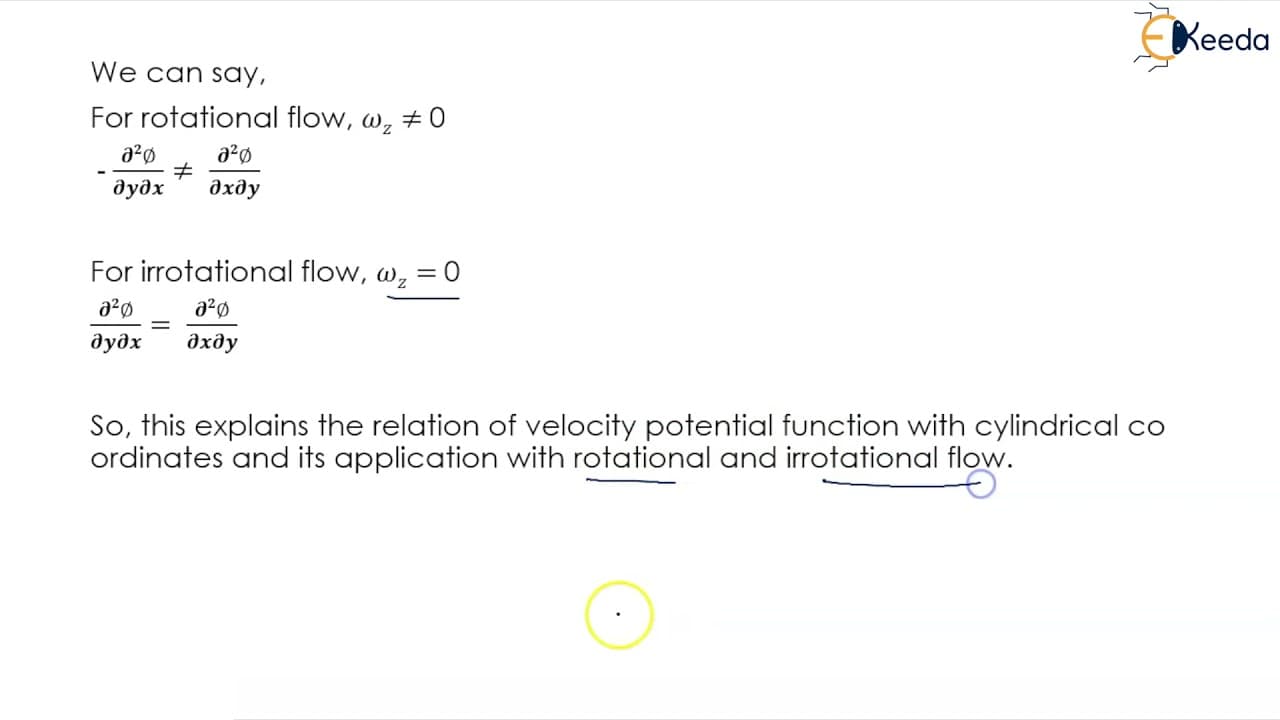
so students let us start with streamline function and velocity potential function in rectangular coordinates velocity potential function in cylindrical coordinates is expressed in terms of r theta and z but in fluid mechanics its scope is limited only to r and theta so by the partial differentiation of velocity potential function that is phi we get... Read More
Key Insights
- 🦾 The velocity potential function and the streamline function are essential tools in fluid mechanics to describe flow fields.
- 💐 The velocity potential function provides a scalar representation of the flow, while the streamline function relates to the velocity components.
- 💐 The equations involving ωz help determine if a flow is rotational or irrotational.
- 0️⃣ Rotational flow has non-zero vorticity along the z-axis, while irrotational flow has zero vorticity.
Install to Summarize YouTube Videos and Get Transcripts
Explore YouTube Video Summarizer or Get YouTube Transcript Extractor
Questions & Answers
Q: What is the velocity potential function in fluid mechanics?
The velocity potential function, denoted by φ, describes the flow field in terms of its scalar potential. It can be expressed in terms of r, theta, and z coordinates in cylindrical coordinates.
Q: How can we determine if a flow is rotational or irrotational?
We can use the equation ωz = 1/2 (∂²ψ/∂x² + ∂²ψ/∂y²), where ωz represents the vorticity along the z-axis. If ωz is not equal to zero, the flow is rotational. If ωz is equal to zero, the flow is irrotational.
Q: What is the relation between streamline function and cylindrical coordinates?
In cylindrical coordinates, the streamline function ψ relates to the velocity components uθ and ur. Specifically, uθ = ∂ψ/∂r and ur = 1/r (∂ψ/∂θ).
Q: How can we determine if a flow is rotational or irrotational using the streamline function?
For rotational flow, the equation ∂²ψ/∂x² = ∂²ψ/∂y² holds. In contrast, for irrotational flow, the equation ∂²ψ/∂x² = -∂²ψ/∂y² applies. By examining these equations, we can determine the nature of the flow.
Summary & Key Takeaways
-
Velocity potential function in cylindrical coordinates is expressed in terms of r, theta, and z, but in fluid mechanics, its scope is limited to r and theta.
-
The equation ωz = 1/2 (∂²ψ/∂x² + ∂²ψ/∂y²) is used to determine whether the flow is rotational or irrotational.
-
The relation of streamline function with cylindrical coordinates is given by uθ = ∂ψ/∂r and ur = 1/r (∂ψ/∂θ).
Read in Other Languages (beta)
Share This Summary 📚
Summarize YouTube Videos and Get Video Transcripts with 1-Click
Try YouTube Summary with ChatGPT & Claude or YouTube Transcript Generator
Explore More Summaries from Ekeeda 📚





Summarize YouTube Videos and Get Video Transcripts with 1-Click
Try YouTube Summary with ChatGPT & Claude or YouTube Transcript Generator