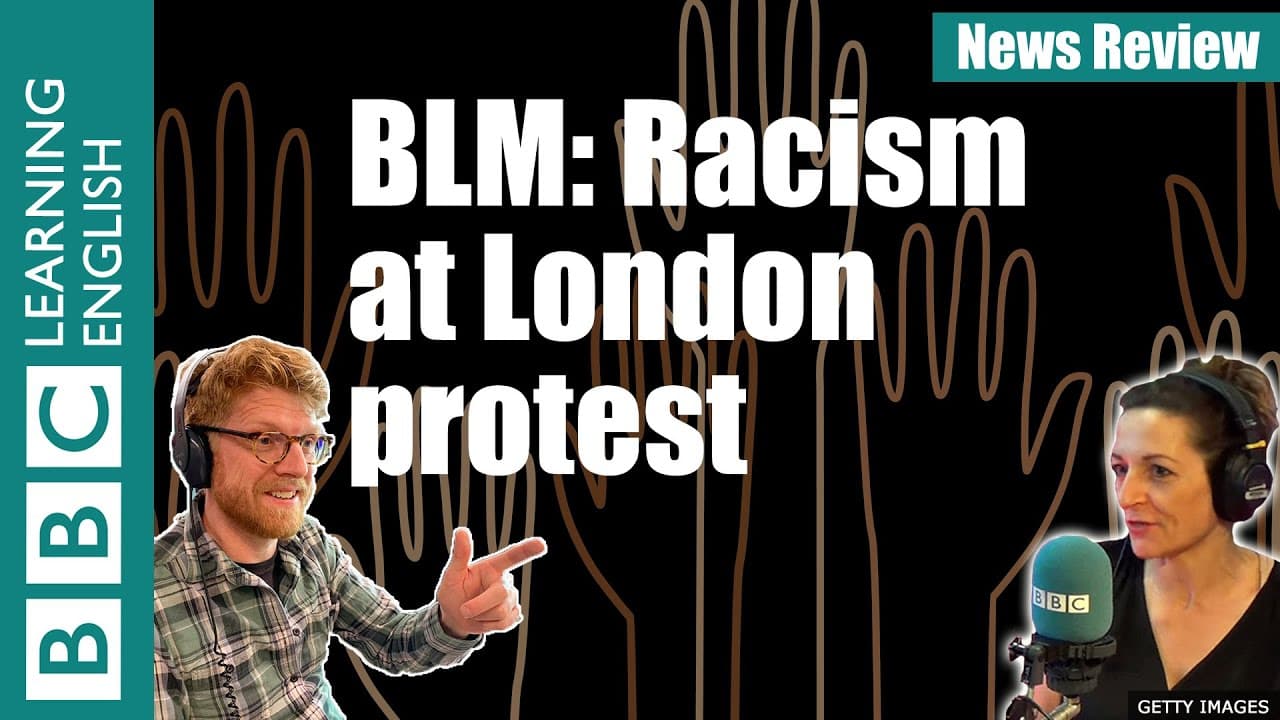
Black Lives Matter: Racism at London protest: BBC News Review
TL;DR
Discussing vocabulary from Black Lives Matter protests in London.
Transcript
hello and welcome to News Review I Neil and joining me across on the other side of London is Katherine hi Katherine hello Niall hello everyone now what story have you got for us today well today we're looking at the black lives matter protests that have been happening in a lot of countries around the world okay let's find out some more about that f... Read More
Key Insights
- The Black Lives Matter protests in London saw violent clashes, leading to over 100 arrests, highlighting the tension between protesters and the police.
- The term 'thuggery' is used to describe violent behavior, often associated with hooliganism and aggressive actions in protests or sports events.
- A 'clash' refers to a fight or confrontation, which can be physical or verbal, and is commonly used in media headlines to describe conflicts.
- The phrase 'headed off' means to prevent something from happening, often used in contexts where proactive measures avert potential issues.
- The protests in London were partly sparked by concerns over the vandalism of historical statues, such as that of Winston Churchill.
- The vocabulary discussed helps in understanding media narratives around protests and the language used to describe violent events.
- The educational segment aims to enhance English vocabulary by explaining terms used in news reports about protests and demonstrations.
- Understanding such vocabulary is crucial for comprehending news stories about social movements and political events around the world.
Install to Summarize YouTube Videos and Get Transcripts
Explore YouTube Video Summarizer or Get YouTube Transcript Extractor
Questions & Answers
Q: What sparked the protests in London?
The protests in London were sparked by global Black Lives Matter demonstrations following the death of George Floyd in the United States. Concerns over the vandalism of historical statues, such as Winston Churchill's, also contributed to the tensions leading to clashes between protesters and the police.
Q: What does the term 'thuggery' refer to?
The term 'thuggery' refers to violent behavior, often characterized by aggressive and hooligan-like actions. It is used to describe situations where peaceful protests turn violent, and is commonly associated with disturbances at sports events, such as football matches.
Q: How is the word 'clash' used in the context of protests?
In the context of protests, 'clash' is used to describe a fight or confrontation between opposing groups, such as protesters and police. It can refer to both physical and verbal conflicts and is a popular term in media headlines to depict dramatic confrontations.
Q: What does 'headed off' mean in relation to preventing events?
The phrase 'headed off' means to prevent something from happening. It is often used in contexts where proactive measures are taken to avert potential issues, such as planning to prevent natural disasters or stopping protesters from reaching their target locations.
Q: Why were the protests in London controversial?
The protests in London were controversial due to the involvement of far-right demonstrators who clashed with the police. These individuals claimed to protect statues from vandalism, which led to violent confrontations and arrests, raising concerns about racism and public safety.
Q: How can understanding protest-related vocabulary be beneficial?
Understanding protest-related vocabulary is beneficial as it helps individuals comprehend news narratives and media reports about social movements and political events. It provides clarity on the language used to describe conflicts, aiding in informed discussions and analyses of current affairs.
Q: What role did historical statues play in the protests?
Historical statues played a significant role in the protests as they became focal points for demonstrations. Concerns over their potential vandalism, particularly the statue of Winston Churchill, led to heightened tensions and clashes between protesters, far-right groups, and the police.
Q: What educational purpose does the vocabulary segment serve?
The vocabulary segment serves an educational purpose by explaining terms used in news reports about protests, enhancing English language proficiency. It aims to provide learners with the tools to understand and discuss media portrayals of social and political events effectively.
Summary & Key Takeaways
-
The Black Lives Matter protests in London led to significant clashes between far-right demonstrators and the police, resulting in numerous arrests. The vocabulary discussed in the segment helps in understanding the media's portrayal of such events.
-
Key terms like 'thuggery', 'clash', and 'headed off' are explained to provide a better grasp of the language used in news reports about protests. This educational content aims to enhance English vocabulary related to current events.
-
The segment highlights the importance of understanding protest-related vocabulary to comprehend news narratives. The discussion includes examples of how these terms are used in different contexts, such as sports and political debates.
Read in Other Languages (beta)
Share This Summary 📚
Summarize YouTube Videos and Get Video Transcripts with 1-Click
Try YouTube Summary with ChatGPT & Claude or YouTube Transcript Generator
Explore More Summaries from BBC Learning English 📚
Summarize YouTube Videos and Get Video Transcripts with 1-Click
Try YouTube Summary with ChatGPT & Claude or YouTube Transcript Generator