How Does DeepMind's AI Surpass Human Performance?
TL;DR
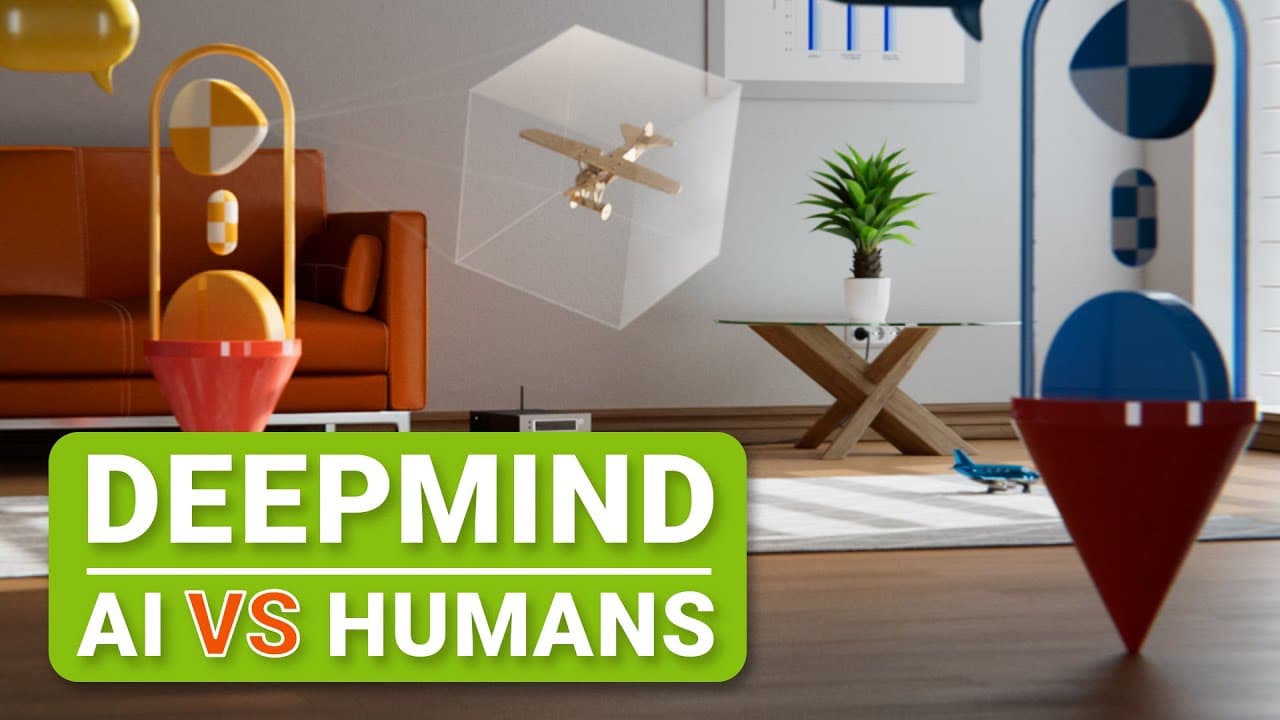
DeepMind's AI initially learns through behavioral cloning but greatly enhances its performance by adopting a reward model based on human feedback. This approach allows the AI to not only match but ultimately exceed human capabilities in over 150 standardized tasks, including building and arranging objects.
Transcript
Dear Fellow Scholars, this is Two Minute Papers with Dr. Károly Zsolnai-Fehér. Today we are going to have a peek into DeepMind’s journey into creating an AI that behaves like a human. How? Well, by dropping it into a virtual playhouse, asking humans to give it tasks, judging it rather harshly, and hoping that it learns something from it. Bu... Read More
Key Insights
- ❓ DeepMind's AI agent starts with behavioral cloning but requires the introduction of a reward model to enhance performance.
- 🧑🏫 The reward model helps the AI agent learn the expectations of human teachers and adapt its behavior accordingly.
- 🤵 With training, the AI agent not only matches but exceeds human performance on tasks such as building towers, arranging objects, and cleaning rooms.
Install to Summarize YouTube Videos and Get Transcripts
Explore YouTube Video Summarizer or Get YouTube Transcript Extractor
Questions & Answers
Q: How does DeepMind teach its AI agent to perform tasks?
DeepMind initially uses behavioral cloning, where the AI agent observes and imitates human interactions. However, this method proves to be ineffective on its own. To improve performance, DeepMind introduces a reward model, where humans score the AI agent's performance on tasks and provide feedback.
Q: What does the reward model help the AI agent learn?
The reward model helps the AI agent understand what actions would be considered favorable to a human teacher. By learning the reward model, the AI agent can adapt its behavior to meet the expectations of the human teacher and improve its task performance.
Q: Does the AI agent eventually outperform humans?
Yes, with further training, the AI agent not only matches but surpasses human performance on a variety of tasks. It showcases the ability to build towers, arrange objects, and even clean rooms with flying colors. The AI agent's performance exceeds that of humans on a set of over 150 standardized tasks.
Q: What implications does this research have for artificial intelligence?
This research suggests that AI agents can learn tasks that require an understanding of physics, finesse, and instruction following. The ability of the AI agent to surpass human performance on standardized tasks indicates a step towards achieving general intelligence.
Summary & Key Takeaways
-
DeepMind starts with an AI agent that learns from humans by observing their interactions with previous AI agents, but the agent's performance is not good due to a lack of understanding of physics.
-
Using a reward model, the AI agent is trained on various tasks and receives scores from humans based on its performance. This process helps the agent learn the reward model itself, enabling it to perform tasks more effectively.
-
The AI agent's performance improves over time, and it is able to build towers, arrange objects, and clean rooms almost as well as a human. With further training, it even surpasses human performance on a set of over 150 standardized tasks.
Read in Other Languages (beta)
Share This Summary 📚
Summarize YouTube Videos and Get Video Transcripts with 1-Click
Try YouTube Summary with ChatGPT & Claude or YouTube Transcript Generator
Explore More Summaries from Two Minute Papers 📚




Summarize YouTube Videos and Get Video Transcripts with 1-Click
Try YouTube Summary with ChatGPT & Claude or YouTube Transcript Generator