How to Sort CSV files and lists in Python
TL;DR
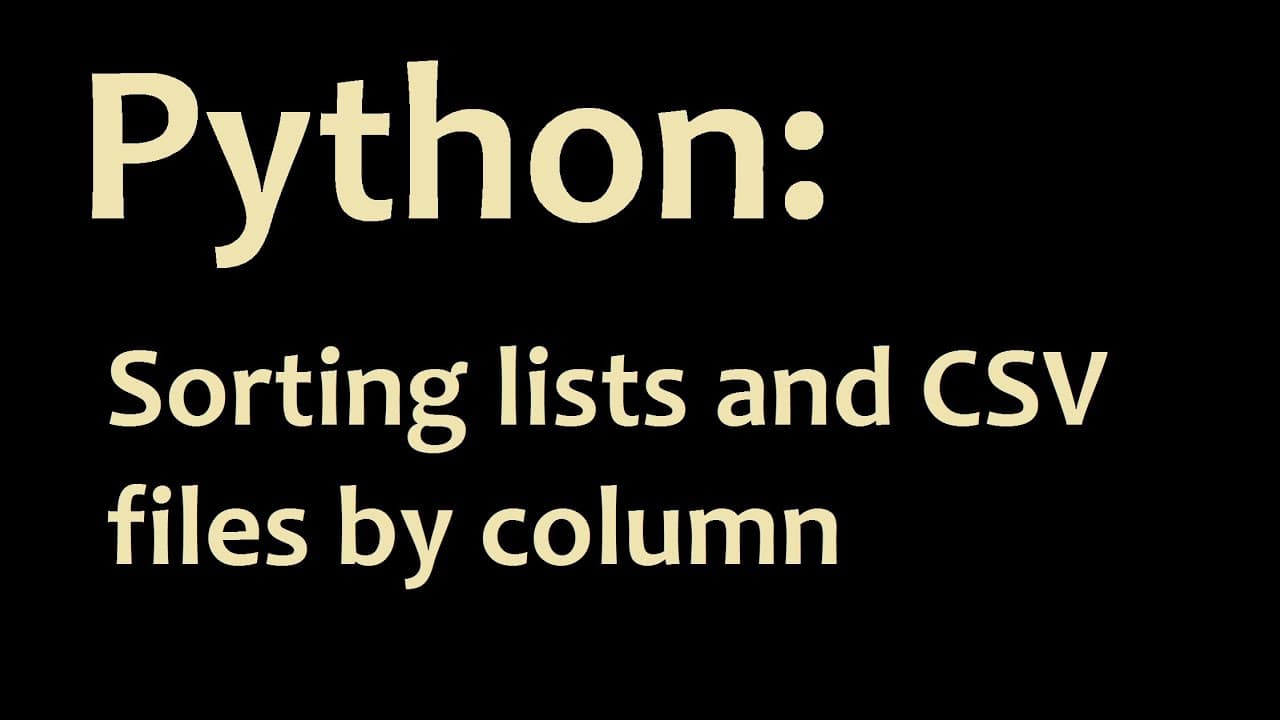
This Python tutorial demonstrates how to organize lists in Python, specifically with CSV files, using the CSV reader and the operator module.
Transcript
what's going on guys welcome to another Python tutorial in this tutorial I'll be showing you guys how you can organize lists in Python and I'll show you specifically with a CSV since a lot of people will be working with CSVs but actually you don't have to do it just with CSVs and really you don't even need the csv reader to do any of this but for t... Read More
Key Insights
- 📁 The CSV reader in Python is a convenient tool for reading and organizing data from CSV files.
- 😒 However, it is not necessary to use the CSV reader to organize lists in Python; other methods can be used.
- ❓ The operator module provides useful functions, such as itemgetter(), for sorting and organizing data in Python.
- 👂 Sorting lists based on specific columns or elements can be very helpful for merging and organizing data.
- 🫠 The alternative method of reading and sorting data from non-CSV files can be useful in various scenarios.
- ✊ The examples provided in the tutorial demonstrate the flexibility and power of Python in organizing lists.
- 👂 The tutorial emphasizes that the CSV reader is not essential for organizing lists in Python.
Install to Summarize YouTube Videos and Get Transcripts
Explore YouTube Video Summarizer or Get YouTube Transcript Extractor
Questions & Answers
Q: How can you organize lists in Python using the CSV reader?
To organize lists in Python using the CSV reader, you can import the CSV module, read the CSV file, and use the sorted() function with the key parameter to specify the column or element to sort by.
Q: Can you organize lists in Python without using the CSV reader?
Yes, you can. Instead of using the CSV reader, you can open the file, split it by new line and then split each line by the delimiter (comma in this case) to create a list of lists. You can then use the sorted() function to sort the list based on the desired column or element.
Q: What is the purpose of the operator module in organizing lists in Python?
The operator module in Python provides functions that can be used as key functions for sorting and organizing data. In the tutorial, the itemgetter() function from the operator module is used to specify the column or element to sort by.
Q: How can you organize lists in Python based on a different column or element?
To organize lists in Python based on a different column or element, you can change the argument passed to the itemgetter() function to specify the desired column or element. This will sort the list based on that column or element.
Summary & Key Takeaways
-
The tutorial shows how to use the CSV reader and operator module in Python to sort and organize data in a CSV file.
-
It explains that the CSV reader is not necessary and shows an alternative method of reading and sorting data from other types of files.
-
The tutorial provides examples of sorting data based on different columns or elements within a list.
Read in Other Languages (beta)
Share This Summary 📚
Summarize YouTube Videos and Get Video Transcripts with 1-Click
Try YouTube Summary with ChatGPT & Claude or YouTube Transcript Generator
Explore More Summaries from sentdex 📚



Summarize YouTube Videos and Get Video Transcripts with 1-Click
Try YouTube Summary with ChatGPT & Claude or YouTube Transcript Generator