Pie chart | Family Savings | Data Interpretation | Reasoning | Part - 03 | Bharath Kumar
TL;DR
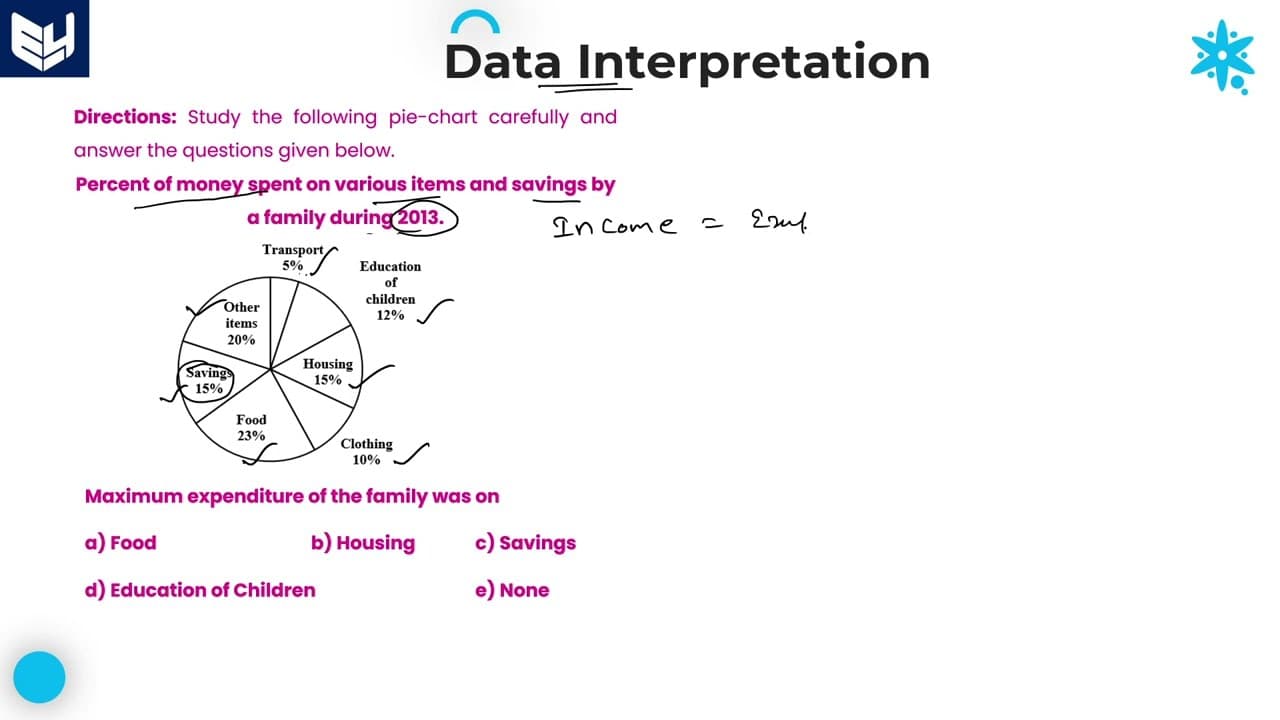
A detailed explanation of a pie chart illustrating family expenditures in 2013.
Transcript
hi everyone welcome to the session in this session I am continuing pie chart data and reparation I am continuing pie chart date and operation first of all read the information which is provided in the uh in this slide after that you can go with the problems first of all we need to understand the given information carefully then only we have to move... Read More
Key Insights
- 😫 Understanding the allocation of a family's budget can reveal significant spending patterns prevalent in the data set.
- 😫 The pie chart illustrated the importance of savings, reflecting that 15% of total income was set aside for savings.
- 🍹 By summing the expenditures, the content affirmed that all categories together totaled 100% of income.
- 🥡 A focus on efficiency in calculations can significantly reduce the time taken to solve questions based on pie charts.
- 🦻 The content showcased how visual data aids in understanding financial distributions effectively, such as identifying which expenditures are prioritized.
- 🥧 Questions surrounding pie charts often assess basic arithmetic skills, making them approachable for exam-takers.
- 💁 The session highlighted the need for careful reading and understanding of information before proceeding to problem-solving, a crucial skill in any analytical task.
Install to Summarize YouTube Videos and Get Transcripts
Explore YouTube Video Summarizer or Get YouTube Transcript Extractor
Questions & Answers
Q: What is the maximum expenditure category for the family according to the pie chart?
The maximum expenditure for the family is on food, accounting for 23% of their total budget. This is noted as the highest spending category when compared to others, such as housing at 15% and clothing at 10%. The pie chart clearly indicates food as the primary expenditure.
Q: How were total savings calculated from the family’s income?
Total savings were determined to be 15% of the income, inferred from the relationship where income equals expenditures plus savings. Given that the pie chart shows 100% income allocation and savings are explicitly listed as 15%, the remaining 85% represents the family's overall expenditure.
Q: What percentage of the family’s total income was allocated to education?
The family spent 12% of their total income on education. Specifically, with their total income set at 1 lakh, this expenditure translates into 12,000. This calculation is straightforward, as one simply applies the percentage to the total income.
Q: What is the combined percentage spent on transport and other items?
The combined percentage spent on transport and other items totals 25%. Transport accounts for 5%, while other items comprise 20%. Thus, adding these figures together (5% + 20% = 25%) reflects the inquiry posed in the session.
Q: How was the difference in expenses between housing and transport calculated?
The difference between housing and transport expenditures was calculated based on their percentages: housing is 15%, and transport is 5%. The difference equates to 10%, and when applied to a total income of 1 lakh, it yields 10,000 as the monetary difference.
Q: What strategies can be utilized to solve pie chart questions quickly?
To solve pie chart-related questions swiftly, focus on memorizing percentage allocations of each category and practice performing quick calculations. This method allows individuals to answer these types of questions within 10 seconds, optimizing both time and accuracy in assessments or competitive exams.
Q: Why might pie chart questions be prevalent in clerical levels and engineering placements?
Pie chart questions are commonly included in assessments at clerical levels and engineering placements due to their emphasis on fundamental mathematics, data interpretation, and analytical skills. These questions gauge a candidate's ability to process and analyze financial or statistical data quickly, essential in many professional roles.
Summary & Key Takeaways
-
The session focuses on analyzing a pie chart representing family expenses in 2013, including categories such as food, housing, and education.
-
Essential relationships between income, expenditure, and savings are explained, highlighting how income is divided among various expenses, totaling 100%.
-
Problem-solving strategies for interpreting pie chart data are discussed, particularly regarding percentage allocation for each expenditure category.
Read in Other Languages (beta)
Share This Summary 📚
Summarize YouTube Videos and Get Video Transcripts with 1-Click
Try YouTube Summary with ChatGPT & Claude or YouTube Transcript Generator