Guns, Germs and Steel: The Very Long Run
TL;DR
Jared Diamond explains Eurasia's early development advantages.
Transcript
hello everyone this is development economics by Tyler Cowan and Alex tabro I'm Alex tabro today we're going to be talking about Guns Guns Germs and Steel which is Jared Diamond's really big think book key book everyone should read about the really big questions about development so diamond is asking you know why are some regions and countries Rich ... Read More
Key Insights
- Diamond argues that Eurasia developed first due to the presence of domesticable animals and crops, leading to agriculture, cities, and civilizations.
- Domesticated animals provided numerous benefits, including food, clothing, and power, which were crucial for agricultural development.
- Eurasia had a geographical advantage with 13 of the 14 domesticable animal species originating there, aiding in the region's development.
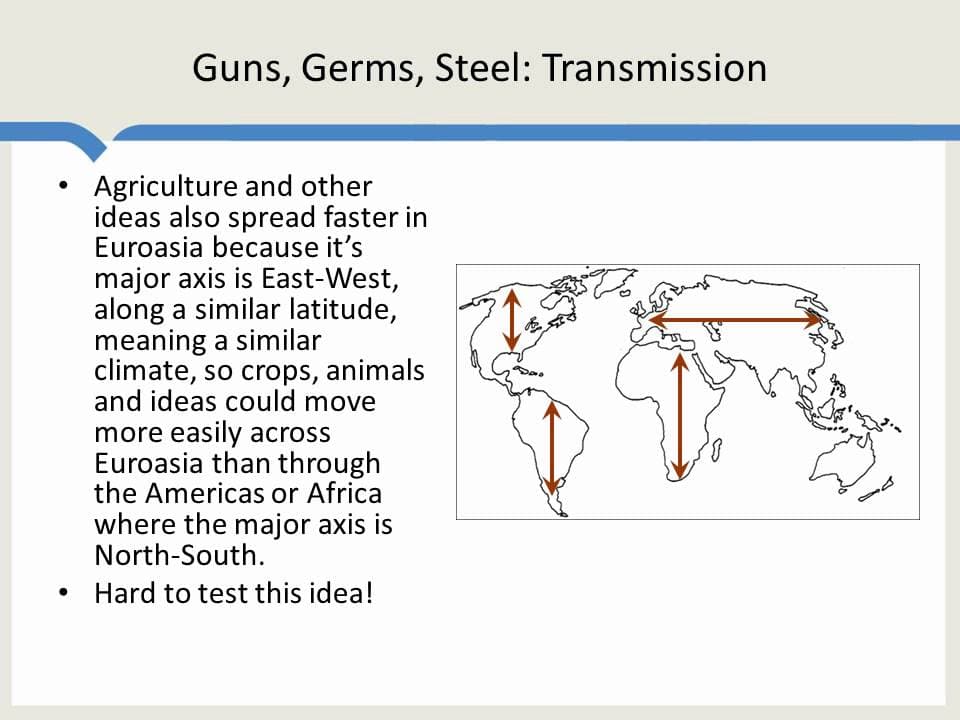
- The east-west axis of Eurasia facilitated the spread of crops and ideas due to similar climates, enhancing agricultural and technological progress.
- Germs, originating from domesticated animals, played a significant role in European conquests by decimating indigenous populations in the Americas.
- Despite early advantages, geography alone cannot explain modern economic disparities, as institutions play a crucial role.
- The conquest of the Americas was aided by diseases like smallpox, which decimated native populations lacking immunity.
- Diamond's theory explains historical development until around 1500, but modern disparities require analysis of institutions and governance.
Install to Summarize YouTube Videos and Get Transcripts
Explore YouTube Video Summarizer or Get YouTube Transcript Extractor
Questions & Answers
Q: Why did Eurasia develop before other continents?
Eurasia developed before other continents primarily due to its access to a large number of domesticable animals and crops. These facilitated the development of agriculture, leading to the rise of cities and civilizations. Additionally, Eurasia's east-west axis allowed for the easy spread of ideas and technologies across similar climates, further accelerating development.
Q: What role did domesticable animals play in Eurasia's development?
Domesticable animals played a crucial role in Eurasia's development by providing food, clothing, and power for agriculture. They also served as military assets and contributed to the spread of germs that would later decimate indigenous populations in other continents, aiding in European conquests. The presence of these animals was a significant advantage for Eurasia.
Q: How did the east-west axis of Eurasia benefit its development?
The east-west axis of Eurasia benefited its development by facilitating the spread of crops, animals, and ideas across similar climates. This geographical orientation allowed for the rapid transmission of agricultural and technological innovations, enabling large-scale development. In contrast, continents with north-south axes faced diverse climates that hindered such exchanges.
Q: What impact did germs have on the conquest of the Americas?
Germs had a profound impact on the conquest of the Americas by European powers. Diseases like smallpox, which evolved from domesticated animals in Eurasia, decimated indigenous populations who lacked immunity. This biological advantage allowed relatively small European forces to conquer large civilizations, such as the Incan Empire, with minimal resistance.
Q: Why can't geography alone explain modern economic disparities?
Geography alone cannot explain modern economic disparities because institutional factors play a crucial role in economic development. While geographical advantages facilitated early development, the presence of good institutions, such as property rights, rule of law, and limited government, are essential for sustained economic prosperity. These factors have become more significant in explaining current economic differences.
Q: What does Diamond's theory explain about historical development?
Diamond's theory explains historical development up to around 1500 by highlighting the role of geographical advantages, such as domesticable animals and crops, in the early rise of civilizations in Eurasia. It provides a framework for understanding why certain regions developed first, focusing on environmental and geographical factors that facilitated agriculture and technological progress.
Q: How did European conquests benefit from germs?
European conquests benefited from germs as diseases like smallpox, which originated from domesticated animals, devastated indigenous populations in the Americas. These populations lacked immunity to such diseases, leading to massive mortality rates. This biological advantage allowed European conquerors to subdue large civilizations with relatively small military forces, playing a pivotal role in their colonial success.
Q: What are the limitations of Diamond's geographical explanation?
The limitations of Diamond's geographical explanation lie in its inability to account for modern economic disparities. While geography played a significant role in early development, it does not fully explain why some countries are rich today while others are poor. Institutional factors, such as governance, economic policies, and social structures, have become crucial in understanding contemporary economic differences.
Summary & Key Takeaways
-
Jared Diamond's book 'Guns, Germs, and Steel' explores why Eurasia developed before other continents due to domesticable animals and crops. This led to agriculture, cities, and civilizations. The geographical advantage of Eurasia, with its east-west axis, facilitated the spread of ideas and technologies.
-
The presence of domesticable animals in Eurasia provided numerous advantages, including food, clothing, and power, crucial for agricultural development. Germs from these animals played a significant role in European conquests by decimating indigenous populations in the Americas, aiding in their colonization efforts.
-
While Diamond's theory explains historical development until around 1500, modern economic disparities require analysis of institutions and governance. Good institutions, such as property rights and the rule of law, are essential for economic prosperity, beyond the geographical advantages discussed by Diamond.
Read in Other Languages (beta)
Share This Summary 📚
Summarize YouTube Videos and Get Video Transcripts with 1-Click
Try YouTube Summary with ChatGPT & Claude or YouTube Transcript Generator
Explore More Summaries from Marginal Revolution University 📚

Summarize YouTube Videos and Get Video Transcripts with 1-Click
Try YouTube Summary with ChatGPT & Claude or YouTube Transcript Generator