How to Train Brain-Computer Interface Models with Python?
TL;DR
To train brain-computer interface (BCI) models effectively, use separate validation data from a different day to avoid overfitting and obtain accurate performance metrics. This approach addresses inconsistencies caused by sequential data and muscle artifacts, allowing for improved model validation and experimentation. Access the provided GitHub repository for code and training data to start your own projects.
Transcript
what's going on everybody and welcome to part 3 of the BCI tutorials to begin we have now a github as so lots of people were asking for code and stuff like that I put that up as well as training data as well as models and their validation and all that so a little bit more on that towards the end but just know it's up there now so anybody can follow... Read More
Key Insights
- 😒 The author has created a GitHub repository with code, training data, and models for others to use in their BCI experiments.
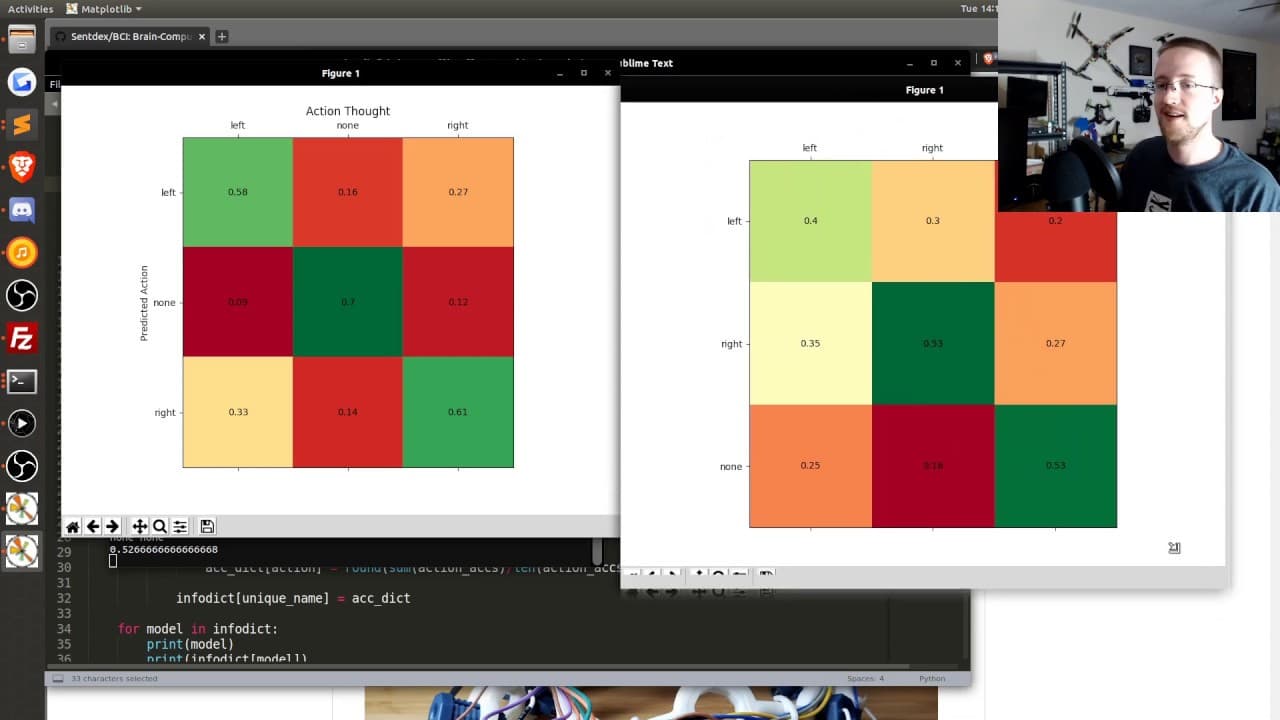
- 💪 Inconsistent accuracy between validation data and practical performance is due to the sequential nature of the data and potential muscle artifacts.
- 🥳 Separate validation data from different days helps to provide a better representation of out-of-sample performance.
- ❓ Overfitting is a challenge in BCI models, and more data and filtering techniques might be necessary to improve accuracy.
Install to Summarize YouTube Videos and Get Transcripts
Explore YouTube Video Summarizer or Get YouTube Transcript Extractor
Questions & Answers
Q: How can others follow along and try their own experiments with BCI systems?
The author has created a GitHub repository with code, training data, and models for others to download and use for their experiments. They can also use the provided code to create their own training data and analyze and validate their models.
Q: Why is the accuracy of the models in practice different from the accuracy of the validation data?
The author explains that the inconsistency is due to the sequential nature of the data, where similar data samples are encountered sequentially. This causes overfitting and the models to perform better in-sample compared to out-of-sample.
Q: How did the author address the issue of inconsistent validation data accuracy?
The author used separate validation data from a different day to ensure a more accurate representation of out-of-sample performance. This helped to identify and analyze the differences between in-sample and out-of-sample accuracy.
Q: Are there limitations to the models and potential challenges in BCI systems?
The author highlights potential challenges such as muscle artifacts and the need to filter out EMG signals. They also mention the importance of collecting more data to overcome the issue of overfitting and improve the models' accuracy.
Summary & Key Takeaways
-
The author has created a GitHub repository with code, training data, and models for BCI systems, allowing others to follow along and try their own experiments.
-
The author has encountered challenges in validating the models, as the accuracy of the models in practice doesn't always match the accuracy of the validation data.
-
The author has discovered that the inconsistency is due to the sequential nature of the data and potential muscle artifacts, and has implemented a fix by using separate validation data from a different day.
-
The author encourages others to try training their own models and shares insights into the potential limitations and areas for improvement.
Read in Other Languages (beta)
Share This Summary 📚
Summarize YouTube Videos and Get Video Transcripts with 1-Click
Try YouTube Summary with ChatGPT & Claude or YouTube Transcript Generator
Explore More Summaries from sentdex 📚





Summarize YouTube Videos and Get Video Transcripts with 1-Click
Try YouTube Summary with ChatGPT & Claude or YouTube Transcript Generator