Transformer Vs Induction motor | Equivalent circuit | Induction Motor | Lec-43
TL;DR
The session explores the equivalent circuit analysis of induction motors, comparing them to transformers.
Transcript
hello everyone in this session we will discuss equivalent circuit of equivalent circuit analysis of induction motor up to now we discussed some important topics regarding the three-phase induction motor now we will entering into the equivalent circuit analysis so before entering into the equivalent circuit analysis just we should compare with the t... Read More
Key Insights
- 🧑🦼 Induction motors require higher no load currents than transformers because of the air gap, influencing efficiency.
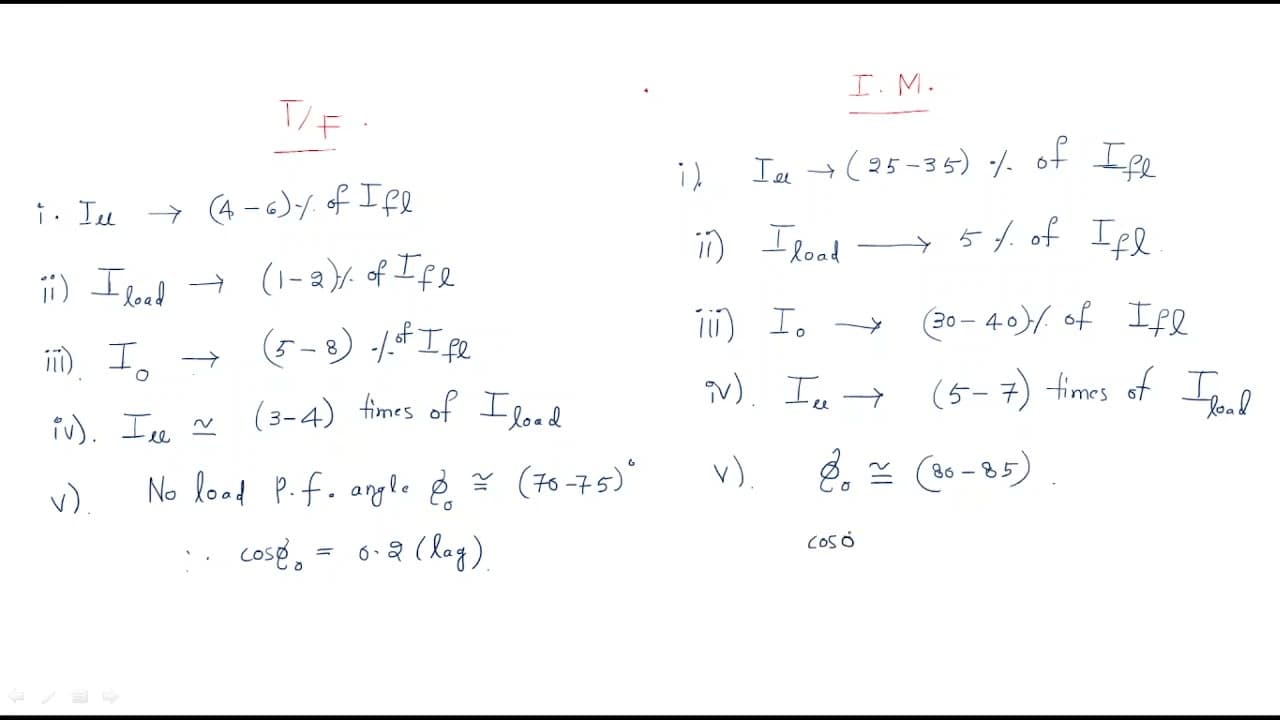
- ✋ The magnetizing current in induction motors is considerably higher, at 25-35% of full load compared to 4-6% in transformers.
- ✋ Load currents also behave differently, with induction motors generally having higher percentages of full load current in comparison.
- ✊ The power factor under no load conditions is worse for induction motors, which affects their performance stability.
- 🧑🦼 Understanding the equivalent circuit of the stator is crucial for analyzing operational characteristics and overall effectiveness of the motor.
- 🧑🦼 The inductive and resistive properties of the stator windings can significantly alter motor performance under various load conditions.
- 🧑🦼 Analyzing the differences in magnetic flux dynamics between transformers and induction motors is vital for electrical engineering applications.
Install to Summarize YouTube Videos and Get Transcripts
Explore YouTube Video Summarizer or Get YouTube Transcript Extractor
Questions & Answers
Q: How does the presence of an air gap affect the no load current in induction motors compared to transformers?
The air gap in induction motors necessitates higher no load current compared to transformers. In induction motors, the no load current can reach 30-40% of full load current, while transformers operate at only 5-8%. This difference arises because the air gap reduces the efficiency of magnetic flux transfer, requiring greater magnetizing current to maintain the magnetic field.
Q: What are the main components in the equivalent circuit of the stator for an induction motor?
The equivalent circuit of the stator includes stator resistance (R1), leakage reactance (X1), and a no load branch represented by resistance (R0) and magnetizing reactance (X0). Additionally, it features induced EMF (E1) and supply current (I1). These components are crucial for understanding how the motor operates under various conditions.
Q: What is the typical no load power factor for transformers and induction motors, and why is it significant?
For transformers operating under no load conditions, the power factor is approximately 0.2 lagging (around 70-75 degrees). In contrast, induction motors have a no load power factor of approximately 0.1 lagging (80-85 degrees). These values are significant as they influence efficiency and stability during operation, affecting overall performance in electrical systems.
Q: How does the magnetizing current of induction motors compare to that of transformers?
The magnetizing current in induction motors ranges from 25-35% of full load current, which is significantly higher than that in transformers, where it is only 4-6%. This large disparity highlights the increased energy requirements for induction motors to establish the necessary magnetic field due to the air gap present.
Summary & Key Takeaways
-
The session discusses the differences in no load and magnetizing currents between induction motors and transformers due to the presence of an air gap in motors.
-
Key statistics highlight that induction motors require significantly higher no load and magnetizing currents (30-40% and 25-35% of full load current respectively) compared to transformers.
-
The equivalent circuit of the stator is introduced, detailing components like stator resistance and reactance, and describing how voltage and currents are represented within the circuit.
Read in Other Languages (beta)
Share This Summary 📚
Summarize YouTube Videos and Get Video Transcripts with 1-Click
Try YouTube Summary with ChatGPT & Claude or YouTube Transcript Generator