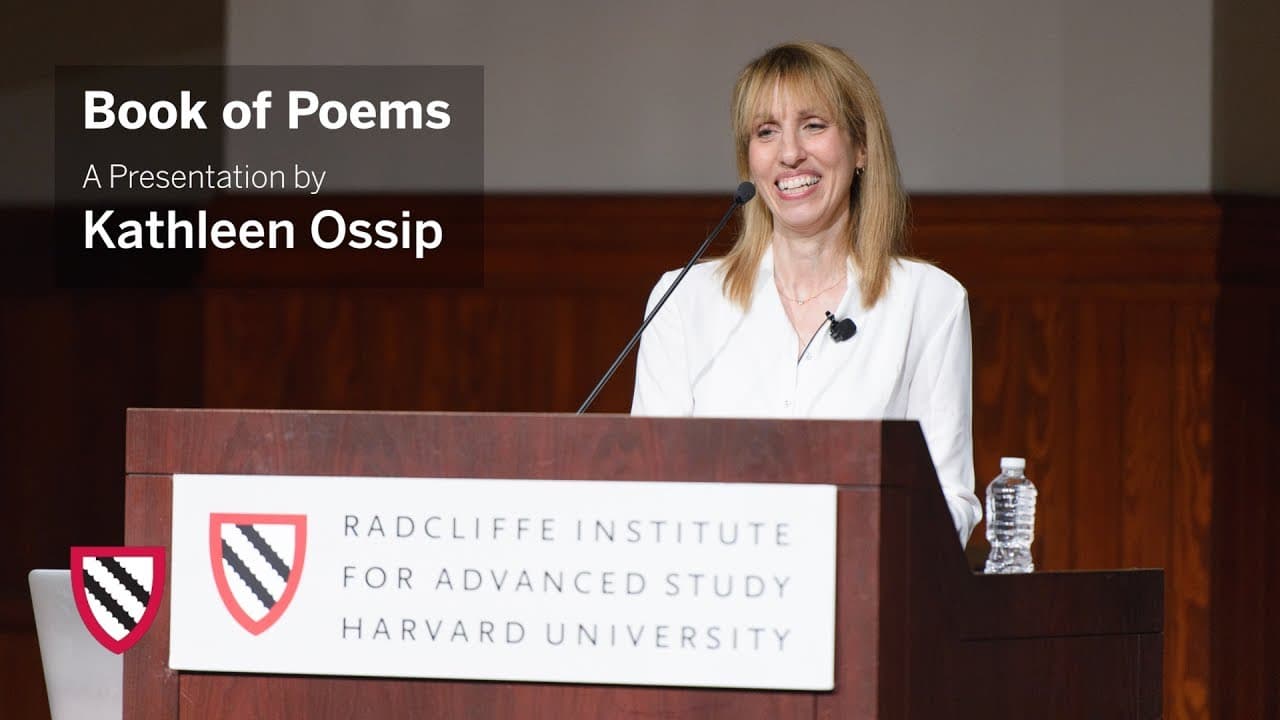
Kathleen Ossip | Book of Poems || Radcliffe Institute
TL;DR
Poetry is an utterly free space for language, inviting readers to participate in making meaning, and serving as a political act that awakens awareness of the essential and subtle joy and suffering of being alive.
Transcript
[MUSIC PLAYING] - Hello. First, I'm going to talk briefly before I read my poems. And my talk is inspired by my Radcliffe Fellow Fellows, many of whom have expressed to me over the past nine months or so-- me, the lone poet in the cohort-- that they wish that they understood poetry better, its meaning and its purpose. I remember being out on the la... Read More
Key Insights
- 🥶 Poetry is an utterly free space for language, allowing for ambiguity, complexity, and subtle emotions.
- 💄 Poetry's unique qualities prompt readers to actively participate in making meaning, making it a political act.
- 🥋 Mainstream culture often undervalues poetry, which diminishes its worth as an art form.
- 🤔 Poetry challenges passivity and invites readers to think critically and engage with complex emotions.
- 👾 Poetry shares similarities with music, relies on the power of language, and offers a space for difficulty and pleasure.
- 🧑🏭 Poetry can give pleasure, which can be an act of resistance against the degradation of language.
- 🥰 Society's valuation of poetry reflects its perception of art and language, raising questions about the overall state of society.
Install to Summarize YouTube Videos and Get Transcripts
Explore YouTube Video Summarizer or Get YouTube Transcript Extractor
Questions & Answers
Q: How does poetry differ from other forms of text?
Poetry is an utterly free space for language, allowing for ambiguity, complexity, and uncertainty, unlike other forms that may aim for clear informational exchange.
Q: Why is poetry undervalued in mainstream culture?
Poetry often garners attention only in articles that question its relevance or in times of public trauma. This mainstream diminishment of poetry's value is a point of contention.
Q: How does reading or writing poetry become a political action?
Poetry invites readers to actively participate in making meaning, which challenges passive consumption and supports critical thinking. This act of engagement and introspection can be seen as a political action.
Q: Can poetry awaken awareness of joy and suffering without explicitly telling readers how?
Yes, poetry can evoke emotions and provoke introspection without explicitly providing answers. It creates spaces for the essential and infinitely subtle experiences of being alive.
Summary & Key Takeaways
-
Poetry is an utterly free space for language, making it indispensable and political.
-
Poetry invites readers to lean in and participate in making meaning, making it a political act.
-
Poetry is often undervalued in mainstream culture, with articles questioning its relevance, but its unique qualities make it an essential art form.
Read in Other Languages (beta)
Share This Summary 📚
Summarize YouTube Videos and Get Video Transcripts with 1-Click
Try YouTube Summary with ChatGPT & Claude or YouTube Transcript Generator
Explore More Summaries from Harvard University 📚


Summarize YouTube Videos and Get Video Transcripts with 1-Click
Try YouTube Summary with ChatGPT & Claude or YouTube Transcript Generator