FPGA families | XILINX XC4000 | XLINX SPARTAN II | Part-2/3 | VLSI | Lec-81
TL;DR
This video discusses various FPGA logic families, focusing on the XC4000 series.
Transcript
yeah hi everyone in this video you are going to see the continuation of fpga logic families so fpga families we have seen there are different types of families like our text families Altera Spartan and vertex in the previous video you have seen Altera Flex 8000 Flex fpga family where it consists of clb's hclv consisting of eight logic elements unde... Read More
Key Insights
- 💦 The XC4000 family of FPGAs includes significant components such as configurable logic blocks, interconnects, and input/output buffers, which work in tandem for efficient data handling.
- 🎨 Function generators within the CLBs are designed for flexibly implementing logic functions, with some capable of processing up to four inputs to generate arbitrary logic functions.
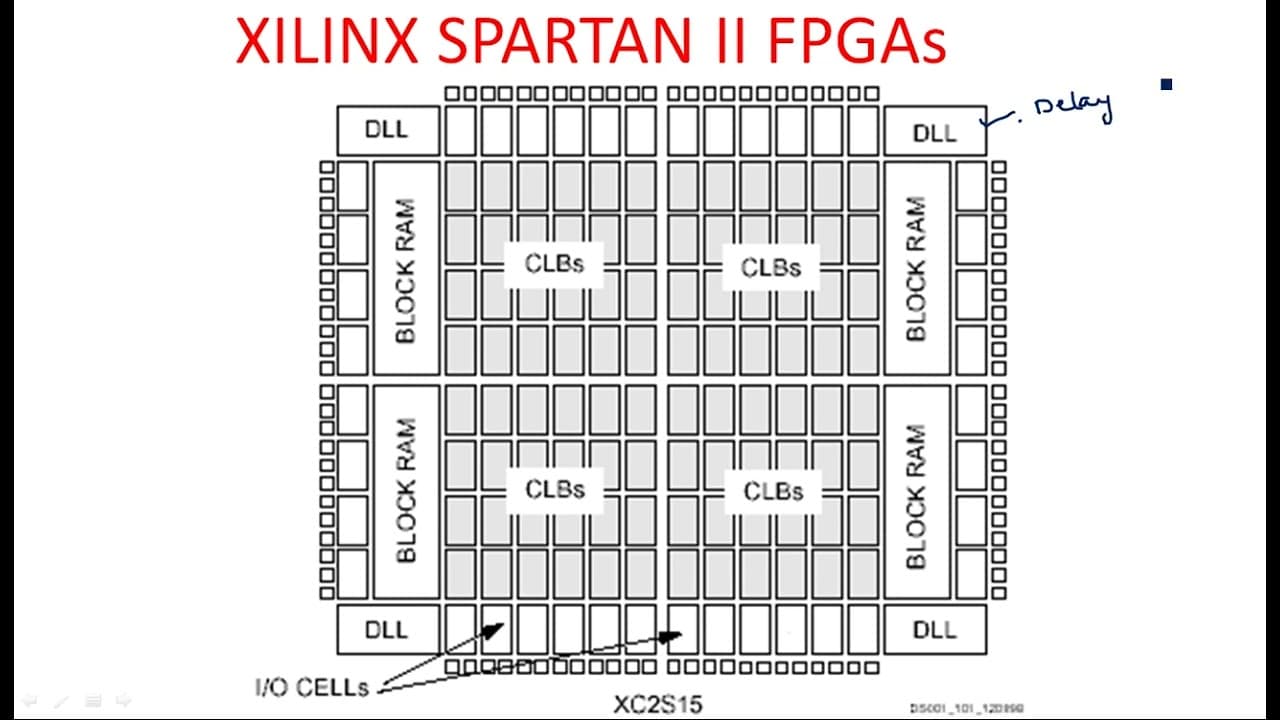
- 😒 Modular architecture in the Spartan 2 family allows each logic cell to be configured for various RAM uses, adapting to the needs of specific applications while optimizing memory usage.
- ⚡ Input/output buffers are versatile, enabling them to be programmed for different voltages and output determinations, enhancing interoperability with external systems.
- 🐬 Each CLB in the XC4000 features multiplexers and D flip-flops, allowing for intricate logic designs and state retention in digital circuits.
- 👪 Different FPGA families offer varying performance capabilities; the Spartan family is aimed at educational and budget-sensitive applications, while the Vertex family targets high-performance needs.
- 🎨 The programmable nature of both logic blocks and IOBs fosters customization for diverse circuit requirements and accelerates the design process.
Install to Summarize YouTube Videos and Get Transcripts
Explore YouTube Video Summarizer or Get YouTube Transcript Extractor
Questions & Answers
Q: What is the role of configurable logic blocks (CLBs) in the XC4000 FPGA family?
Configurable Logic Blocks (CLBs) are essential components of the XC4000 FPGA, serving as the core structure where logic functions are implemented. Each CLB contains multiple logic elements, function generators, and multiplexers which allow for the configuration of complex logical operations. The interconnections between CLBs facilitate data transfer, enhancing the FPGA's computational capabilities.
Q: How do input/output buffers (IOBs) function in the XC4000 architecture?
Input/Output Buffers (IOBs) are critical for communication between the FPGA and external devices. They serve to manage data transfer by buffering signals and ensuring correct voltage levels. IOBs can be programmed for various functions and can operate with different clock signals, which allows for flexibility in data handling and integration with diverse electronic systems.
Q: What distinguishes the Spartan 2 family from other FPGA families?
The Spartan 2 family is considered a lower-level, lab-oriented FPGA family, designed to provide cost-effective solutions without compromising on performance. It supports several logical memory resources and is suitable for applications requiring moderate system gate counts, ranging from 15K to 200K gates. This flexibility makes it ideal for educational and prototyping environments.
Q: Can you elaborate on the delay lock loop (DLL) feature mentioned in relation to Spartan 2?
The Delay Lock Loop (DLL) feature in Spartan 2 FPGAs is used to manage timing and synchronization issues within the architecture. Placed at the corners of the design, DLLs help maintain signal integrity by aligning clock signals, thereby reducing jitter. This ensures that all components function cohesively, which is vital in high-speed applications and data transfer.
Summary & Key Takeaways
-
The video continues the exploration of FPGA logic families, specifically the Xilinx XC4000, which features configurable logic blocks, IO buffers, and a switch matrix for data communication.
-
It highlights the architecture of the XC4000, detailing its components like CLBs, multiplexers, D flip-flops, and SRAM-based memory configuration, emphasizing how each part functions within the FPGA.
-
The content also compares Xilinx families like Spartan 2 and Vertex, mentioning their capabilities, including logic gates and memory storage options, catering to different application needs.
Read in Other Languages (beta)
Share This Summary 📚
Summarize YouTube Videos and Get Video Transcripts with 1-Click
Try YouTube Summary with ChatGPT & Claude or YouTube Transcript Generator