How To Simplify Cube Roots
TL;DR
Learn how to simplify cube roots by finding perfect cubes and applying basic operations.
Transcript
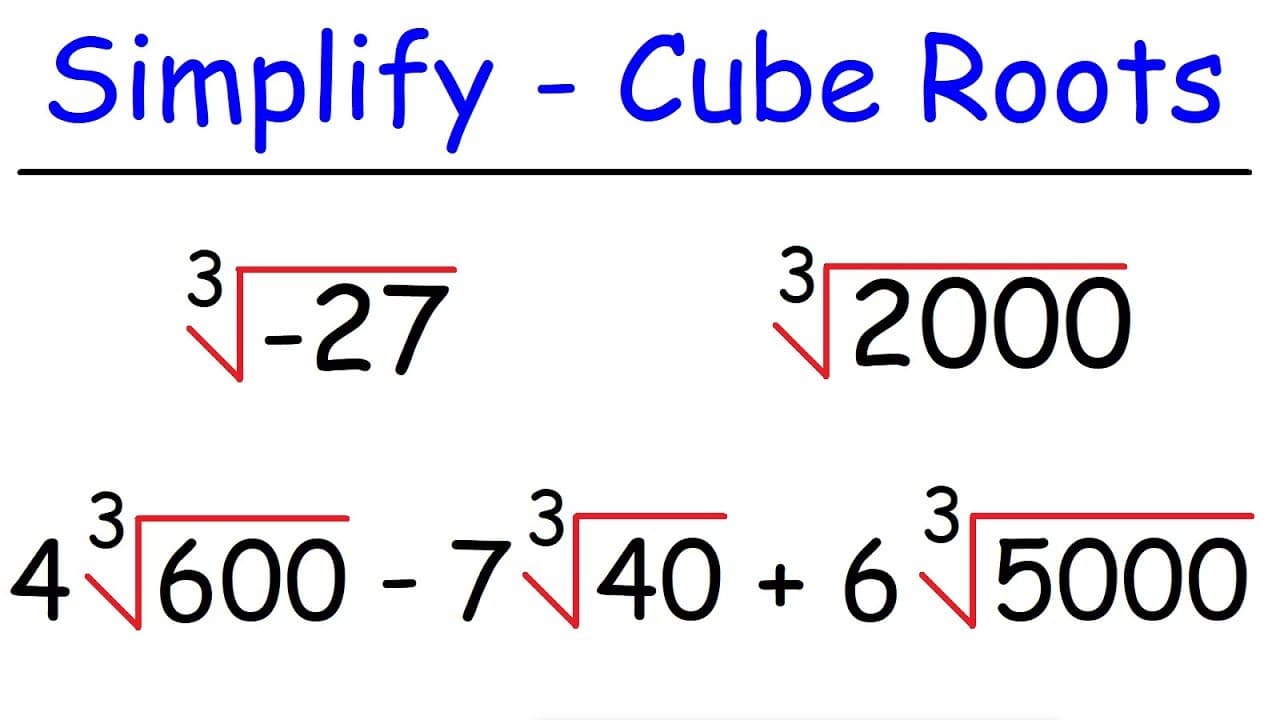
in this video we're going to talk about how to simplify cube roots so we're going to work on a few example problems let's try these the cube root of 8 the cube root of negative 27 and then negative cube root 125 and then negative cube root negative 64. so let's start with the first one what is the cube root of eight so what number let's call that n... Read More
Key Insights
- 🧊 Simplifying cube roots involves finding perfect cubes and using basic arithmetic operations.
- 🫚 The cube root of a negative number is found by finding the cube root of the positive value and adding a negative sign.
- #️⃣ Exponents can be used to represent cube roots, with the exponent indicating the number of times a number is multiplied by itself.
Install to Summarize YouTube Videos and Get Transcripts
Explore YouTube Video Summarizer or Get YouTube Transcript Extractor
Questions & Answers
Q: How do you simplify the cube root of negative numbers?
To simplify the cube root of a negative number, find the cube root of the positive value and add a negative sign to the solution. For example, the cube root of -27 is -3, as the cube root of 27 is 3.
Q: What is the cube root of a perfect cube?
The cube root of a perfect cube is the whole number that, when multiplied by itself three times, gives the perfect cube. For example, the cube root of 8 is 2, as 2 x 2 x 2 equals 8.
Q: How can exponents be used to represent cube roots?
Exponents indicate how many times a number is multiplied by itself. For example, 5 to the third power (5^3) is equal to 125, so the cube root of 125 is 5.
Q: How can you simplify expressions involving cube roots?
To simplify expressions with cube roots, find the perfect cube factors of the numbers under the cube roots and simplify them separately. Then, combine like terms and perform any necessary arithmetic operations.
Summary & Key Takeaways
-
The video demonstrates how to simplify cube roots using various examples, such as finding the cube root of 8, -27, 125, and -64.
-
Perfect cubes (1, 8, 27, 64, 125, etc.) are used to simplify cube roots, and exponents can also represent cube roots.
-
The video also shows how to simplify expressions involving cube roots by combining like terms and performing arithmetic operations.
Read in Other Languages (beta)
Share This Summary 📚
Summarize YouTube Videos and Get Video Transcripts with 1-Click
Try YouTube Summary with ChatGPT & Claude or YouTube Transcript Generator
Explore More Summaries from The Organic Chemistry Tutor 📚

Summarize YouTube Videos and Get Video Transcripts with 1-Click
Try YouTube Summary with ChatGPT & Claude or YouTube Transcript Generator