Capacitance and Inductance | Comparison Bridges | Electrical Instruments ( EIM ) | Lec - 44
TL;DR
This video explains capacitance and inductance comparison bridges, including their formulas and applications.
Transcript
hi everyone in this video i am going to explain capacitance comparison bridge and inductance comparison range so in the previous video i have explained ac bridges ac bridges are nothing but which are used to measure either capacitance inductance or frequency measurement values now is a part of as a part of ac bridge you know we are going to see the... Read More
Key Insights
- 🌉 Capacitance and inductance comparison bridges are essential for precise electrical measurements, particularly for unknown elements.
- 🌉 The balance condition is critical for these bridges, as it ensures accurate calculations based on the known values.
- ❓ Mathematical representation of components, using impedance concepts, enhances understanding of circuit behavior.
- 😒 Capacitance measurements use formulas derived from the relationship between known and unknown values while taking into account the circuit's reactance.
- 〽️ The impact of frequency is crucial, as it alters reactance and subsequently affects measured values.
- 🥳 Equating real and imaginary parts of impedance helps clarify relationships between resistance and reactance in calculations.
- 🌉 Accurate measurements hinge on meticulous setup and maintenance of balanced state within the bridge circuit.
Install to Summarize YouTube Videos and Get Transcripts
Explore YouTube Video Summarizer or Get YouTube Transcript Extractor
Questions & Answers
Q: What is the main purpose of a capacitance comparison bridge?
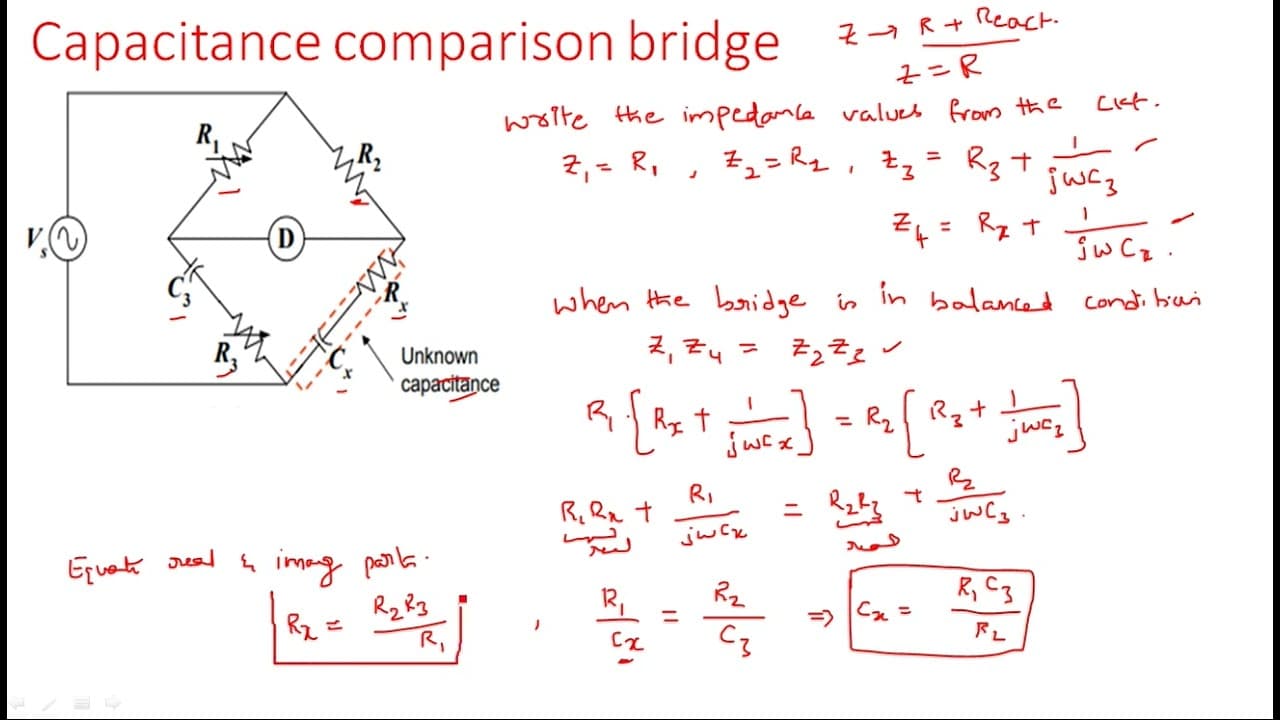
The capacitance comparison bridge is designed to measure an unknown capacitance by comparing it to a known capacitance. The bridge works on the principle of equal impedance in a balanced state, allowing the user to calculate the unknown value accurately using specific formulas.
Q: How are the components of the bridge circuit represented mathematically?
In the bridge circuit, components are represented as complex impedance (Z), which consists of resistance (R) and reactance (X). For example, Z1 = R1, Z2 = R2, Z3 = R3 + 1/jωC3, and Z4 = Rx + 1/jωCx, where these help in setting up the balance condition for measurement.
Q: What conditions must be met for accurate measurements using these bridges?
Accurate measurements can only be obtained when the bridge is in a balanced condition, which is when the ratios of the impedances in the arms of the bridge satisfy the established relationships. If the bridge is not balanced, the condition will not yield correct values for the unknown components.
Q: Can you explain the process of finding unknown capacitance using the capacitance comparison bridge?
To find unknown capacitance using the bridge, start by writing down the formulas for the impedances in balance. Using the equation Z1Z4 = Z2Z3, substitute the values for known resistances and capacitors, and then equate the real and imaginary components of the equation to solve for the unknown capacitance.
Q: What role does frequency play in this context?
Frequency plays a significant role because it affects the reactance of capacitors and inductors in the circuit. In the formulas, reactance is expressed as 1/jωC for capacitors and jωL for inductors, revealing how frequency impacts the overall impedance and ultimately the measurements being taken.
Q: What is the significance of equating real and imaginary parts in the calculations?
Equating real and imaginary parts allows us to separate the resistive and reactive components of the impedance, leading to clear formulas for calculating unknown values. This separation is crucial for understanding how each component contributes to the overall behavior of the bridge circuit.
Q: How does the inductance comparison bridge differ from the capacitance bridge?
The inductance comparison bridge functions similarly to the capacitance bridge but focuses on measuring unknown inductance instead. The formulas and impedance notations differ slightly, as they incorporate inductive reactance instead of capacitive reactance in their calculations.
Q: What are the limitations of using these bridges for measurements?
The primary limitation is that the measurements are only accurate in a balanced condition, meaning any disturbance due to external factors or improper setup could lead to incorrect results. Additionally, it requires precise component values and stable frequency sources to maintain accuracy in measurements.
Summary & Key Takeaways
-
The video focuses on capacitance and inductance comparison bridges, which are used to measure unknown capacitance or inductance by comparing them with known values.
-
An explanation of the bridge components, including impedance and reactance, is provided, illustrating how to write notations for each component in the circuits.
-
Key formulas for calculating unknown capacitance and inductance in a balanced bridge condition are discussed, emphasizing that the accuracy of these calculations depends on the bridge being in a balanced state.
Read in Other Languages (beta)
Share This Summary 📚
Summarize YouTube Videos and Get Video Transcripts with 1-Click
Try YouTube Summary with ChatGPT & Claude or YouTube Transcript Generator