Astable multivibrator | Emitter coupled | Period calculation | PDC | Lec-70
TL;DR
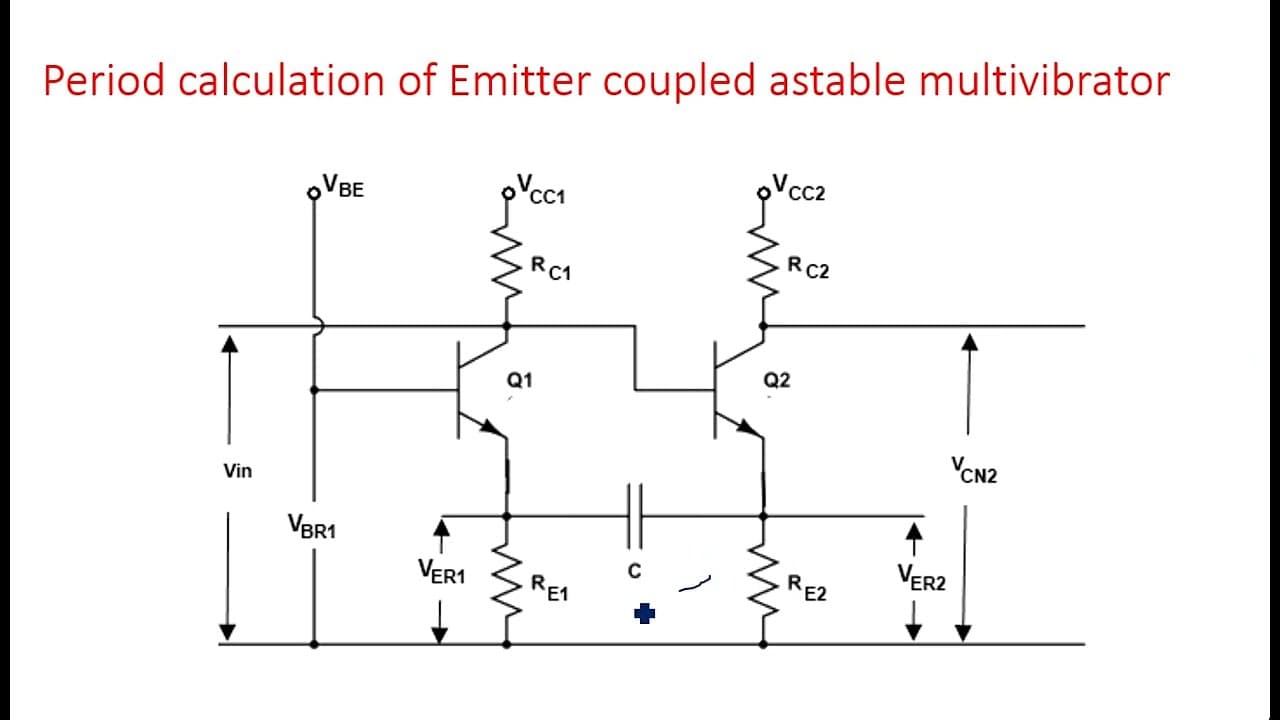
This video explains time period calculations for an emitter coupled stable multivibrator circuit.
Transcript
hi everyone in this video I am going to explain about the calculation of time period for the emitter coupled stable multivibrator so in the previous video I have explained about you the calculation of different voltages at different data in different points of this circuit emitter couple H stable multivibrator like a v e one va2 VB and VB N1 VB N2 ... Read More
Key Insights
- ⌛ Understanding the time period calculations T1 and T2 is essential for effective circuit design in multivibrator applications.
- 🧑🤝🧑 The behavior of transistors Q1 and Q2 significantly influences the overall performance of the emitter coupled stable multivibrator.
- ⚡ Frequency independence from supply voltages occurs when VCC and VBB are arranged proportionately, enhancing stability in the operation.
- 🤳 The circuit exhibits self-starting characteristics, making it suitable for various applications without requiring external triggers.
- 👻 Capacitor coupling between emitters allows for rapid signal transitions, crucial for maintaining consistent performance in multivibrator circuits.
- ❓ Careful biasing of transistors is necessary to ensure proper switching and operating conditions, affecting both performance and reliability.
- 🎨 Despite its advantages, the multivibrator circuit is more complex and requires careful adjustments compared to simpler designs.
Install to Summarize YouTube Videos and Get Transcripts
Explore YouTube Video Summarizer or Get YouTube Transcript Extractor
Questions & Answers
Q: What is the significance of T1 and T2 in the emitter coupled stable multivibrator?
T1 and T2 represent the time periods during which the output states of transistors Q1 and Q2 change. T1 occurs when Q2 conducts, while Q1 is off, and T2 is the transition point when their states reverse. Understanding these time intervals is crucial for predicting circuit behavior and optimizing performance in multivibrator configurations.
Q: How does the capacitor influence the operation of the multivibrator?
The capacitor in an emitter coupled stable multivibrator is essential for coupling signals between the transistors. It allows capacitor charging and discharging, which influences the timing of state changes in the circuit. The dynamics of this process significantly affect the time periods T1 and T2, ultimately determining the frequency of oscillation.
Q: Why is it important to maintain certain voltage conditions for VBB and VCC in this circuit?
Maintaining specific voltage conditions for VBB and VCC is critical to ensure the operational stability of the emitter coupled multivibrator. The relationship involves keeping VBB less than VCC to manage transistor operation and prevent saturation. This condition is vital for achieving desired oscillation frequencies and circuit performance.
Q: What are the advantages of using an emitter coupled stable multivibrator over other configurations?
An emitter coupled stable multivibrator is inherently self-starting and allows for easier frequency adjustment due to its single-capacitor design. Additionally, its output is free from recovery transients because of isolated input at the base of Q1, leading to more reliable operation in certain applications compared to other multivibrator configurations.
Summary & Key Takeaways
-
The video covers the calculation of time periods T1 and T2 in an emitter coupled stable multivibrator, focusing on the behavior of transistors Q1 and Q2 during these time intervals.
-
It discusses the role of collector resistors, base biasing conditions, and how to determine the parameters affecting the capacitor's charge and discharge cycle.
-
The advantages and disadvantages of the emitter coupled stable multivibrator are highlighted, emphasizing its self-starting nature and frequency adjustment challenges.
Read in Other Languages (beta)
Share This Summary 📚
Summarize YouTube Videos and Get Video Transcripts with 1-Click
Try YouTube Summary with ChatGPT & Claude or YouTube Transcript Generator