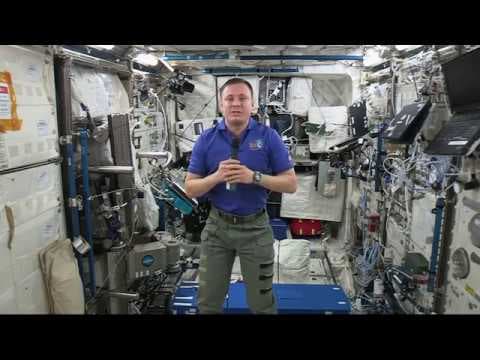
Live Q&A with NASA Planetary Defender

TL;DR
NASA aims to protect Earth from asteroids through the DART mission, which will test a deflection technique by impacting the moon of an asteroid. Finding asteroids ahead of time is crucial to prevent potential impacts.
Transcript
just a spacecraft that is going to go and smack an asteroid it is fantastic to see it in real life dart will only be changing the period of the orbit of dimorphose by a tiny amount and really that's all that's needed in the event that an asteroid is discovered well ahead of time before it might impact earth you can't have emission like dart without... Read More
Key Insights
- 🙂 The primary goal of the DART mission is to test a deflection technique by impacting the moon of an asteroid to alter its orbit slightly.
- 👻 Finding asteroids early is crucial for planetary defense efforts, allowing time to track and calculate their orbits to assess potential impact threats.
- 🛝 Ground-based telescopes and observations play a significant role in measuring the impact and monitoring any changes in the moon's orbit.
- 🛰️ The DART mission presents a unique opportunity to test deflection techniques in a binary asteroid system, where the satellite interactions are easier to measure.
- 🚜 Different deflection techniques, such as kinetic impactors, gravity tractors, and nuclear deflection, may be employed depending on the size and threat of an asteroid.
- ✋ The goal is not to stop an asteroid's motion entirely but to deflect it enough to prevent a potential impact with Earth.
- ❓ The DART spacecraft utilizes rollout solar arrays, a technology previously used on the International Space Station.
- 🛰️ The impact of the DART mission will not pose a threat to Earth, and the orbital debris is not a concern for satellites.
- 🛟 While the chances of a life-threatening asteroid strike are rare, continuous asteroid surveys and cataloging are essential to identify potential threats and be prepared with deflection techniques.
Install to Summarize YouTube Videos and Get Transcripts
Explore YouTube Video Summarizer or Get YouTube Transcript Extractor
Questions & Answers
Q: Why is it important to find asteroids before they find us?
By locating asteroids early, we have time to track, calculate their orbits, and assess potential impact threats. This knowledge allows us to develop appropriate deflection techniques like the DART mission.
Q: How will the DART mission impact the trajectory of the asteroid?
The impact will change the speed of the moon's orbit slightly, affecting its period around the asteroid. The goal is not to significantly alter its course but to test the deflection technique.
Q: Will the DART spacecraft have cameras to record the impact?
The DART spacecraft has a camera to guide its trajectory but does not have cameras specifically for recording the impact. However, the Italian space agency's contributed LICIACube will capture images of the impact.
Q: Can the DART mission accidentally redirect the asteroid towards Earth?
No, the mission will only change the moon's orbit slightly without posing any threat to Earth. The DART spacecraft cannot redirect the asteroid towards Earth due to its small size and the nature of the mission.
Q: Can the DART mission completely stop an asteroid's motion?
Stopping an asteroid's motion completely is not feasible due to the massive amount of energy required. The goal is to deflect it enough to prevent a potential impact with Earth, not to stop its motion altogether.
Q: How will scientists know if the DART impact significantly alters the asteroid's trajectory?
Ground-based telescopes and observations will track the asteroid's light curve, which changes as the moon passes in front or behind the asteroid. This data, combined with modeling, will help determine the impact's effect on the moon's orbit.
Q: What experiments have been conducted on Earth to simulate the DART impact?
Researchers conduct impact experiments using laboratory settings and simulate impacts with boulders and meteorite materials. These experiments help understand the dynamics and behavior of impacts on asteroids.
Q: What is the largest asteroid that could be redirected using techniques like the DART mission?
The largest asteroid that could be redirected using the kinetic impactor technique, like the DART mission, is not specified. However, the technique is more effective for smaller asteroids, typically in the range of 160 meters and larger.
Summary & Key Takeaways
-
The DART mission involves the use of a spacecraft to impact the moon of an asteroid, changing its orbit slightly as a test of a deflection technique.
-
Finding asteroids ahead of time is essential for planetary defense efforts.
-
Telescopes on Earth and ground-based observations will be used to measure the impact and assess any changes in the moon's orbit.
Read in Other Languages (beta)
Share This Summary 📚
Summarize YouTube Videos and Get Video Transcripts with 1-Click
Try YouTube Summary with ChatGPT & Claude or YouTube Transcript Generator
Explore More Summaries from NASA 📚

Summarize YouTube Videos and Get Video Transcripts with 1-Click
Try YouTube Summary with ChatGPT & Claude or YouTube Transcript Generator