Products
Features
YouTube Video Summarizer
Summarize YouTube videos
Web & PDF Highlighter
Highlight web pages & PDFs
Chat with PDF
Ask any PDF questions with AI
Ask AI Clone
Chat with your highlights & memories
Audio Transcriber
Transcribe audio files to text
Glasp Reader
Read and highlight articles
Kindle Highlight Export
Export your Kindle highlights
Idea Hatch
Hatch ideas from your highlights
Integrations
Obsidian Plugin
Notion Integration
Pocket Integration
Instapaper Integration
Medium Integration
Readwise Integration
Snipd Integration
Hypothesis Integration
Apps & Extensions
Chrome Extension
Safari Extension
Edge Add-ons
Firefox Add-ons
iOS App
Android App
Discover
Discover
Ideas
Discover new ideas and insights
Articles
Curated articles and insights
Books
Book recommendations by great minds
Posts
Essays and notes from readers
Quotes
Inspiring quotes collection
Videos
Curated videos and summaries
Explore Glasp
Glasp Newsletter
Weekly insights and updates
Glasp Talk
Interview series with great minds
Glasp Blog
Latest news and articles
Glasp Use Cases
Learn how others use Glasp
Build & Support
Glasp API
Access Glasp's API for developers
MCP Connector
Connect Glasp to Claude & ChatGPT
Community
Glasp Reddit Community
Students
Student discount and benefits
FAQs
Frequently Asked Questions
AboutPricing
DashboardLog inSign up

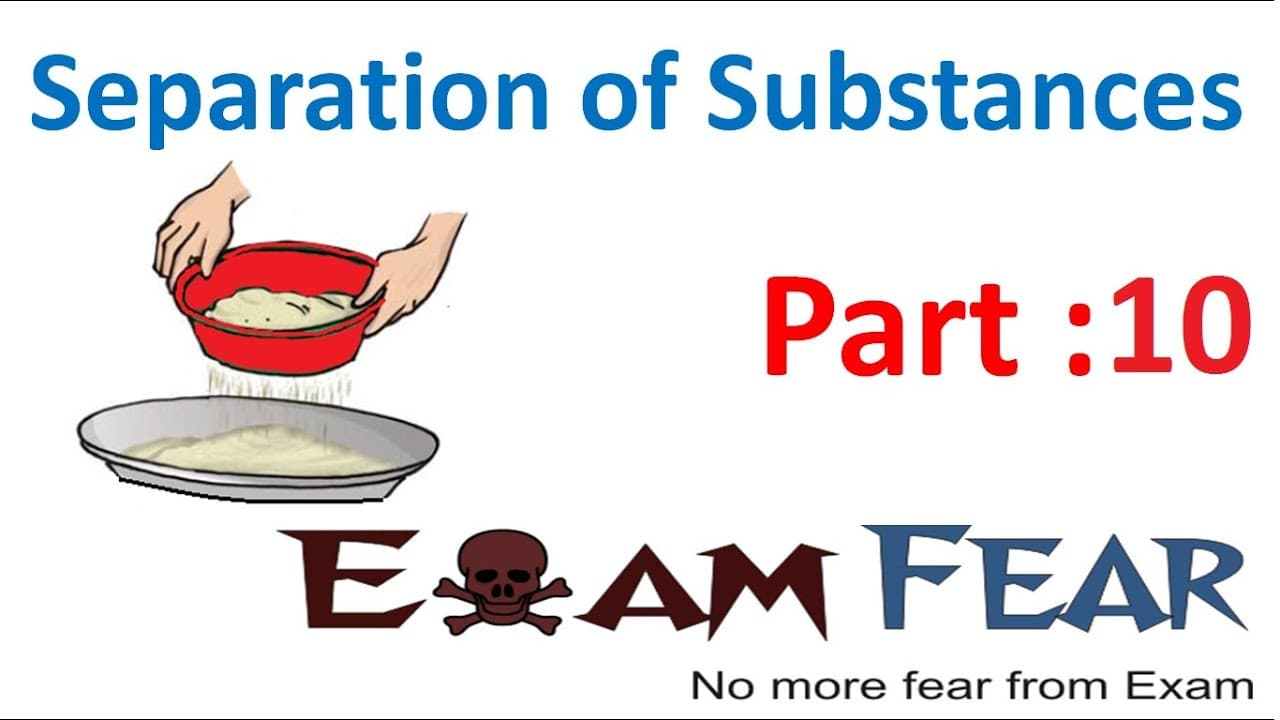
Chemistry Separation of Substances Part 10 (Separate Sand Salt Mixture) Class 6 VI
April 3, 2016
by
LearnoHub - Class 11, 12
YouTube video player
Chemistry Separation of Substances Part 10 (Separate Sand Salt Mixture) Class 6 VI

TL;DR

Learn how to separate a mixture of sand and salt using sedimentation, decantation, and evaporation.

Transcript

hello friends this video on separation of substances part 10 is brought to you by exam for calm no more fear from exam ok so then now we have learnt about a lot of processes we learnt about sedimentation you can mention condensation evaporation filtration a lot of them now let us look at some example so let us say you are given a mixture of sand an... Read More

Key Insights

  • ❓ Multiple separation processes, such as sedimentation, decantation, and evaporation, are often used together to separate mixtures.
  • 🧑‍🏭 Particle size and solubility are important factors to consider when choosing a method for separation.
  • ❣️ Sedimentation involves the settling of heavier particles at the bottom, while decantation is the removal of the upper layer of liquid.
  • 🫗 Evaporation is used to separate a dissolved substance from a solution by converting the liquid into vapor.

Install to Summarize YouTube Videos and Get Transcripts

Explore YouTube Video Summarizer or Get YouTube Transcript Extractor

Questions & Answers

Q: Why is hand picking not a suitable method for separating sand and salt?

Hand picking is not effective because the particles of sand and salt are too small and numerous to be individually picked out.

Q: How does sieving work in the separation process?

Sieving is not ideal for separating sand and salt since both particles are small. However, if the sieve allows only the sand particles to pass through, it can be used.

Q: What is the main property difference between sand and salt that allows them to be separated?

The main difference is that sand is insoluble in water, whereas salt is water-soluble. This property is used to separate them by dissolving the salt in water.

Q: Why is evaporation used in the separation process?

Evaporation is used to separate the salt from the saltwater solution. By heating the saltwater, the liquid water evaporates, leaving behind the salt.

Summary & Key Takeaways

  • The video discusses different methods for separating substances, such as sedimentation, decantation, and evaporation.

  • Hand picking and winnowing are not suitable for separating sand and salt due to their particle sizes.

  • The process of separating sand and salt involves pouring the mixture into water, allowing the sand to settle, decanting the water, and evaporating it to obtain the salt.


Read in Other Languages (beta)

English

Share This Summary 📚

Summarize YouTube Videos and Get Video Transcripts with 1-Click

Download browser extensions on:

Try YouTube Summary with ChatGPT & Claude or YouTube Transcript Generator

Explore More Summaries from LearnoHub - Class 11, 12 📚
Biology Ecosystem part 5 (Components : Decomposers) class 12 XII thumbnail
Biology Ecosystem part 5 (Components : Decomposers) class 12 XII
LearnoHub - Class 11, 12
Biology Getting to Know Plants Part 3 (Creepers, Climbers, Plant parts) Class 6 VI thumbnail
Biology Getting to Know Plants Part 3 (Creepers, Climbers, Plant parts) Class 6 VI
LearnoHub - Class 11, 12
Maths Mensuration part 2 (Perimeter of Rectangle and Square) CBSE Class 6 Mathematics VI thumbnail
Maths Mensuration part 2 (Perimeter of Rectangle and Square) CBSE Class 6 Mathematics VI
LearnoHub - Class 11, 12
Maths Fraction part 12 (Numericals) CBSE Class 6 Mathematics VI thumbnail
Maths Fraction part 12 (Numericals) CBSE Class 6 Mathematics VI
LearnoHub - Class 11, 12
NEET Biology Ecology : Multiple Choice Previous Years Questions MCQs 2 thumbnail
NEET Biology Ecology : Multiple Choice Previous Years Questions MCQs 2
LearnoHub - Class 11, 12

Summarize YouTube Videos and Get Video Transcripts with 1-Click

Download browser extensions on:

Try YouTube Summary with ChatGPT & Claude or YouTube Transcript Generator

Apps & Extensions

  • Chrome Extension
  • Safari Extension
  • Edge Add-ons
  • Firefox Add-ons
  • iOS App
  • Android App

Key Features

  • YouTube Video Summarizer
  • Web & PDF Summarizer
  • Web & PDF Highlighter
  • Chat with PDF
  • Ask AI Clone
  • Audio Transcriber
  • Glasp Reader
  • Kindle Highlight Export
  • Idea Hatch

Integrations

  • Obsidian Plugin
  • Notion Integration
  • Pocket Integration
  • Instapaper Integration
  • Medium Integration
  • Readwise Integration
  • Snipd Integration
  • Hypothesis Integration

More Features

  • APIs
  • MCP Connector
  • Blog & Post
  • Embed Links
  • Image Highlight
  • Personality Test
  • Quote Shots

Company

  • About us
  • Blog
  • Community
  • FAQs
  • Job Board
  • Newsletter
  • Pricing
Terms

•

Privacy

•

Guidelines

© 2026 Glasp Inc. All rights reserved.