Products
Features
YouTube Video Summarizer
Summarize YouTube videos
Web & PDF Highlighter
Highlight web pages & PDFs
Chat with PDF
Ask any PDF questions with AI
Ask AI Clone
Chat with your highlights & memories
Audio Transcriber
Transcribe audio files to text
Glasp Reader
Read and highlight articles
Kindle Highlight Export
Export your Kindle highlights
Idea Hatch
Hatch ideas from your highlights
Integrations
Obsidian Plugin
Notion Integration
Pocket Integration
Instapaper Integration
Medium Integration
Readwise Integration
Snipd Integration
Hypothesis Integration
Apps & Extensions
Chrome Extension
Safari Extension
Edge Add-ons
Firefox Add-ons
iOS App
Android App
Discover
Discover
Ideas
Discover new ideas and insights
Articles
Curated articles and insights
Books
Book recommendations by great minds
Posts
Essays and notes from readers
Quotes
Inspiring quotes collection
Videos
Curated videos and summaries
Explore Glasp
Glasp Newsletter
Weekly insights and updates
Glasp Talk
Interview series with great minds
Glasp Blog
Latest news and articles
Glasp Use Cases
Learn how others use Glasp
Build & Support
Glasp API
Access Glasp's API for developers
MCP Connector
Connect Glasp to Claude & ChatGPT
Community
Glasp Reddit Community
Students
Student discount and benefits
FAQs
Frequently Asked Questions
AboutPricing
DashboardLog inSign up

Effects of resonance on phase shifts, wave amplitude and time delay
July 5, 2017
by
MIT OpenCourseWare
YouTube video player
Effects of resonance on phase shifts, wave amplitude and time delay

TL;DR

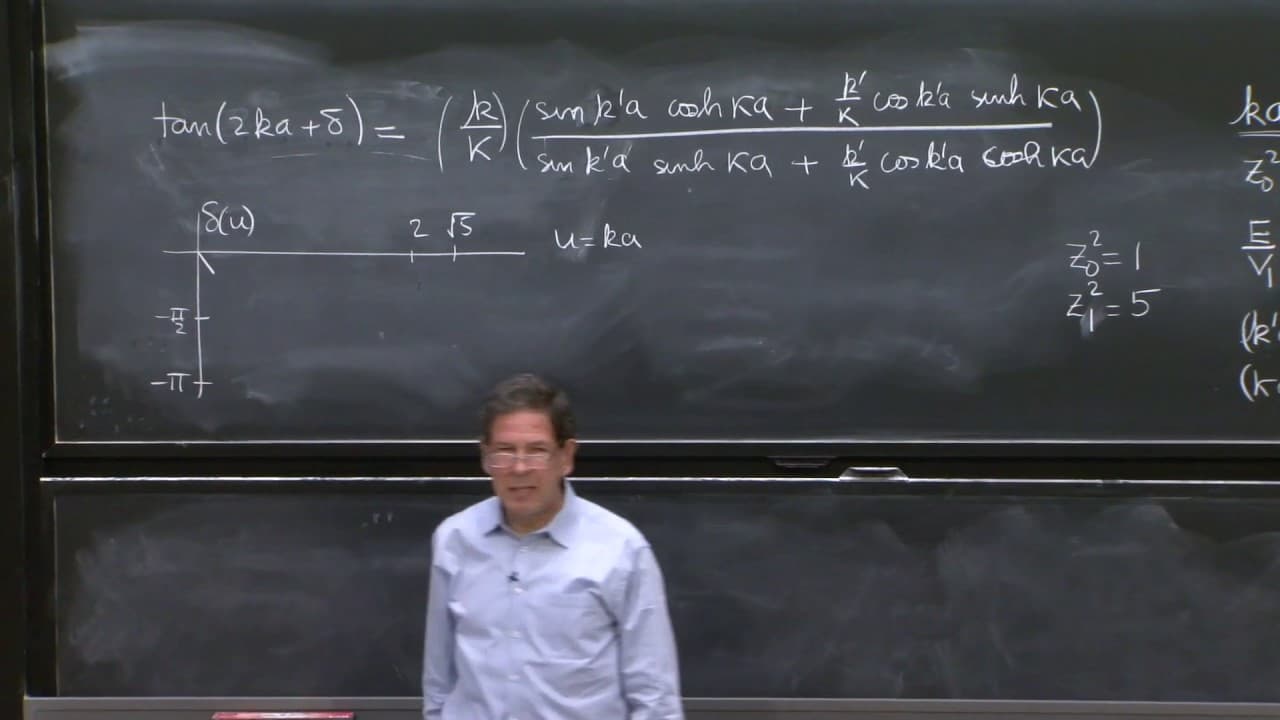
The professor solves a physics problem involving trigonometric and hyperbolic functions, explaining key equations and variables.

Transcript

PROFESSOR: This is the answer. Tan of 2 k a plus delta. It's a little messy, no wonder. Just plotted this functions. [INAUDIBLE] Sin k plus a cosh kappa a [INAUDIBLE] plus a prime over kappa cosh a prime a sinh kappa a. You have sin a prime a sinh. The sinh causes outer [INAUDIBLE] the same but this one changes. Centered here, k prime over kappa co... Read More

Key Insights

  • 👋 The solving of the physics problem involves determining the phase shift and wave behavior in a square well potential.
  • 😑 Trigonometric and hyperbolic functions are used to express the wave functions and calculate various parameters.
  • 👋 The phase shift shows a linear time advance initially, followed by a rapid change and a jump in wave behavior.

Install to Summarize YouTube Videos and Get Transcripts

Explore YouTube Video Summarizer or Get YouTube Transcript Extractor

Questions & Answers

Q: What functions are involved in the mathematical expression?

The mathematical expression involves trigonometric functions such as sine and cosine, as well as hyperbolic functions like hyperbolic sine and hyperbolic cosine.

Q: What variables are introduced in the problem?

The variables introduced are ka, u, v0, v1, z0, z1, k, kappa, k_prime, delta, and e. These variables represent energy, potential parameters, and wave behavior.

Q: How does the phase shift vary with energy?

The phase shift begins linearly with a negative slope, representing a time advance. Then it jumps rapidly and crosses pi/2, indicating a change in wave behavior.

Q: What is the significance of the resonance and time delay peak?

The resonance occurs at a specific energy value, leading to a sharp increase in scattering amplitude. The time delay peak represents a significant delay in the time spent traveling inside the well.

Summary & Key Takeaways

  • The professor solves a mathematical expression involving sine, cosine, hyperbolic sine, and hyperbolic cosine functions.

  • He introduces variables and formulas related to energy, potential, and wave functions in a square well.

  • The professor discusses the behavior of the phase shift and scattering amplitude, highlighting the presence of a resonance and a peak in time delay.


Read in Other Languages (beta)

English

Share This Summary 📚

Summarize YouTube Videos and Get Video Transcripts with 1-Click

Download browser extensions on:

Try YouTube Summary with ChatGPT & Claude or YouTube Transcript Generator

Explore More Summaries from MIT OpenCourseWare 📚
19. Roth's theorem II: Fourier analytic proof in the integers thumbnail
19. Roth's theorem II: Fourier analytic proof in the integers
MIT OpenCourseWare
29.2 Moment of Inertia of a Rod thumbnail
29.2 Moment of Inertia of a Rod
MIT OpenCourseWare
L19.2 Energy eigenstates: incident and outgoing waves. Scattering amplitude thumbnail
L19.2 Energy eigenstates: incident and outgoing waves. Scattering amplitude
MIT OpenCourseWare
19.2.6 Worked Examples: Semaphores thumbnail
19.2.6 Worked Examples: Semaphores
MIT OpenCourseWare
Student Video: Particle in a Tube thumbnail
Student Video: Particle in a Tube
MIT OpenCourseWare
Lec 2 | MIT 18.085 Computational Science and Engineering I, Fall 2008 thumbnail
Lec 2 | MIT 18.085 Computational Science and Engineering I, Fall 2008
MIT OpenCourseWare

Summarize YouTube Videos and Get Video Transcripts with 1-Click

Download browser extensions on:

Try YouTube Summary with ChatGPT & Claude or YouTube Transcript Generator

Apps & Extensions

  • Chrome Extension
  • Safari Extension
  • Edge Add-ons
  • Firefox Add-ons
  • iOS App
  • Android App

Key Features

  • YouTube Video Summarizer
  • Web & PDF Summarizer
  • Web & PDF Highlighter
  • Chat with PDF
  • Ask AI Clone
  • Audio Transcriber
  • Glasp Reader
  • Kindle Highlight Export
  • Idea Hatch

Integrations

  • Obsidian Plugin
  • Notion Integration
  • Pocket Integration
  • Instapaper Integration
  • Medium Integration
  • Readwise Integration
  • Snipd Integration
  • Hypothesis Integration

More Features

  • APIs
  • MCP Connector
  • Blog & Post
  • Embed Links
  • Image Highlight
  • Personality Test
  • Quote Shots

Company

  • About us
  • Blog
  • Community
  • FAQs
  • Job Board
  • Newsletter
  • Pricing
Terms

•

Privacy

•

Guidelines

© 2026 Glasp Inc. All rights reserved.