Class Takeaways — How to Lead Through Workplace Culture
TL;DR
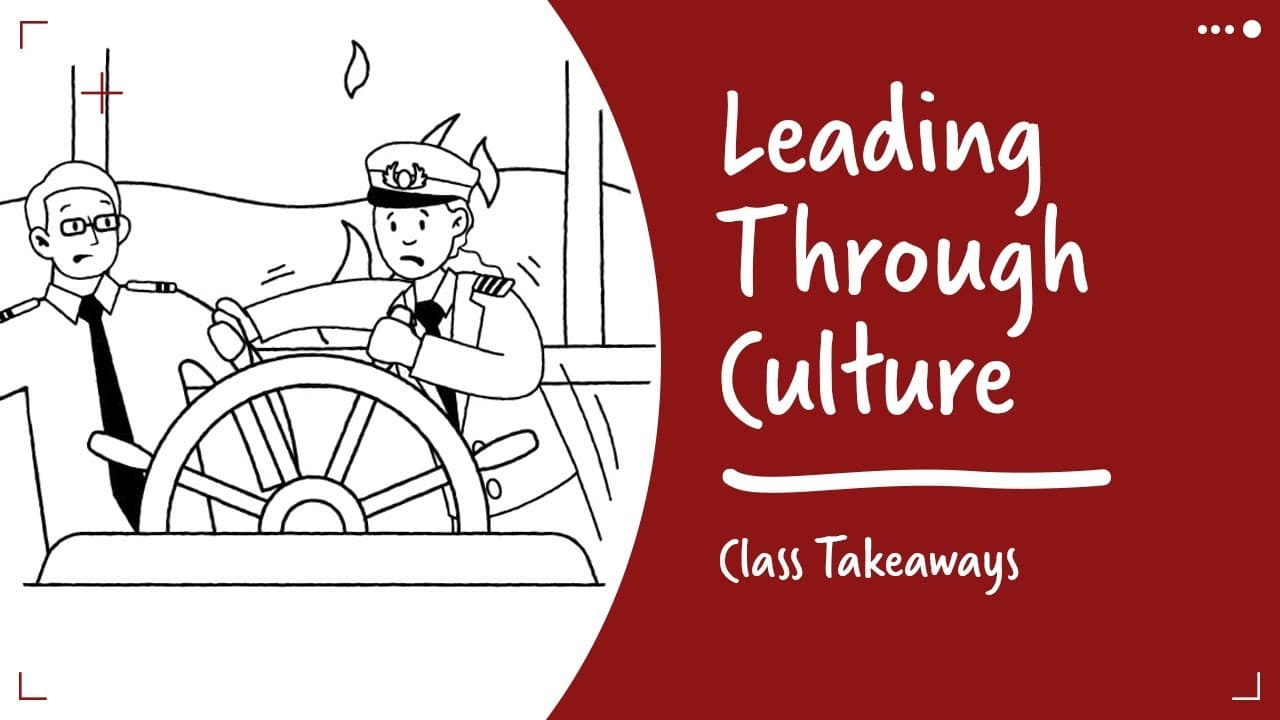
Traditional management focuses on observation, measurement, coaching, and feedback, while cultural management emphasizes building and trusting the system.
Transcript
[MUSIC] All right, I'm Glenn Carroll. I teach a class at the Stanford Graduate School of Business titled Leading Through Culture. I'd like to talk to you about five key takeaways from this class. [MUSIC] In traditional management, the manager observes the worker, measures his output, coaches him gives him feedback and tells him how to do it better.... Read More
Key Insights
- 🎮 Traditional management focuses on direct control and intervention, while cultural management emphasizes trust in the system.
- 💪 A strong culture can be established in any organization, regardless of the industry or organizational type.
- 😫 Managers have various levers at their disposal to shape culture, and it is important to consider and utilize the full set of available levers.
- 💪 Culturally selective hiring is often the most impactful lever in building a strong culture quickly and effectively.
- 💪 Building a strong culture requires time and effort, and culturally selective hiring needs to be done carefully to avoid bias and discrimination.
- 💪 Trusting the system is crucial during times of crisis in a strong culture.
- 💪 The content of a culture is irrelevant to its strength; strong cultures can be found in various sectors.
Install to Summarize YouTube Videos and Get Transcripts
Explore YouTube Video Summarizer or Get YouTube Transcript Extractor
Questions & Answers
Q: What is the difference between traditional management and cultural management?
Traditional management involves the manager observing, measuring, coaching, and giving feedback to workers. Cultural management, on the other hand, focuses on building a system, trusting the system, and allowing it to operate without constant manager intervention.
Q: How can a strong culture benefit an organization during times of crisis?
During times of crisis, the instinct for a manager might be to take control and direct things. However, in a strong culture, it is crucial to trust the system that has been built, as it is designed to handle challenging situations. Trusting the culture allows for smoother navigation through crises.
Q: Can a strong culture be established in any type of organization?
Yes, a strong culture can be built around any set of beliefs, values, or practices. It is not limited to specific industries or organization types. Examples of strong cultures can be found in various sectors, including business, education, military, and even extremist groups.
Q: What are some levers that managers can use to shape culture?
While many managers focus on defining culture, setting up incentives, and launching training programs, there are numerous other levers available. These levers include making the organization transparent, homogenizing groupings, broadening job definitions, and implementing job rotation, among others.
Summary & Key Takeaways
-
Traditional management involves observing, measuring, coaching, and giving feedback, while cultural management emphasizes building and trusting the system.
-
Strong cultures can thrive during times of crisis when managers trust the system they have built.
-
A strong culture can be built around any set of beliefs, values, or practices regardless of the industry or organization type.
-
There are various levers available for managers to use in shaping culture, and culturally selective hiring is the most impactful lever to build a strong culture quickly and effectively.
Read in Other Languages (beta)
Share This Summary 📚
Summarize YouTube Videos and Get Video Transcripts with 1-Click
Try YouTube Summary with ChatGPT & Claude or YouTube Transcript Generator
Explore More Summaries from Stanford Graduate School of Business 📚





Summarize YouTube Videos and Get Video Transcripts with 1-Click
Try YouTube Summary with ChatGPT & Claude or YouTube Transcript Generator