Life Beyond Earth, Part 1: Linda Spilker | Nat Geo Live
TL;DR
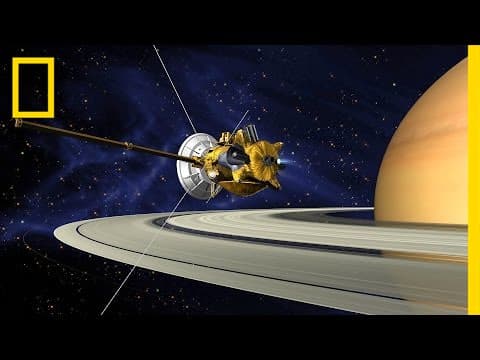
Cassini spacecraft's ten-year journey around Saturn revealed fascinating discoveries about the planet, its rings, moons, and potential for life.
Transcript
( intro music ) ( radio signal ) ( ethereal music ) ( audience applause ) Linda: Ten years ago today, the Cassini spacecraft flawlessly executed a nail-biting 96 minute burn to become the first man-made object to go into orbit around Saturn. And Cassini carried with it ESA's Huygens Probe, which we later sent down to the surface of Titan. And so we... Read More
Key Insights
- 🙂 Saturn's unique features, like the north polar hexagon and giant hurricane, shed light on planetary weather systems.
- 🥮 Moons like Titan and Enceladus offer potential habitats for life with their liquid oceans and organic material.
- 😋 Cassini's observations of Saturn's rings revealed intricate patterns and varying particle sizes, providing insights into ring formation.
- 🛰️ The Grand Finale orbits of the Cassini mission offered unprecedented data on Saturn's magnetic field and seasonal variations.
- 🥮 Discoveries by the Cassini spacecraft have expanded our understanding of Saturn's moons and potential for extraterrestrial life.
- 💁 Enceladus' geysers and Titan's methane-filled lakes present intriguing possibilities for unique forms of life beyond Earth.
- 🌗 Cassini's mission has left a lasting legacy of groundbreaking discoveries and insights into the mysteries of Saturn and its moons.
Install to Summarize YouTube Videos and Get Transcripts
Explore YouTube Video Summarizer or Get YouTube Transcript Extractor
Questions & Answers
Q: What are some of the key discoveries made by the Cassini spacecraft during its mission around Saturn?
The Cassini spacecraft discovered Saturn's hexagon and giant hurricane, potential for life on moons like Titan and Enceladus, and intricate structures within Saturn's rings.
Q: How did Cassini observe and analyze the rings of Saturn, and what did it reveal about the composition and formation of the rings?
Cassini's observations of Saturn's rings revealed billions of icy particles in intricate patterns, with the outer B ring showing variations in particle size, casting shadows that provided insights into ring formation and planetary evolution.
Q: What unique characteristics do moons like Titan and Enceladus possess that make them potential candidates for life outside of Earth?
Moons like Titan and Enceladus have liquid water oceans, organic materials, methane clouds, and geysers, indicating the possibility of microbial life forms that could exist in these environments.
Q: How did Cassini's mission end, and what were the goals and significance of the Grand Finale orbits?
Cassini's mission concluded with the Grand Finale orbits diving between Saturn's rings and atmosphere, providing unprecedented data on the planet's magnetic field, mass of the rings, and seasonal variations, marking a unique and irreplaceable opportunity in space exploration.
Summary & Key Takeaways
-
Cassini spacecraft's ten-year orbit around Saturn delivered groundbreaking findings about the planet, rings, and moons.
-
Saturn's north polar hexagon and giant hurricane offer insights into planetary weather systems.
-
Moons like Titan and Enceladus show potential for life with liquid oceans and organic material.
Read in Other Languages (beta)
Share This Summary 📚
Summarize YouTube Videos and Get Video Transcripts with 1-Click
Try YouTube Summary with ChatGPT & Claude or YouTube Transcript Generator
Explore More Summaries from National Geographic 📚



Summarize YouTube Videos and Get Video Transcripts with 1-Click
Try YouTube Summary with ChatGPT & Claude or YouTube Transcript Generator