Laminar Flow - Problem 4 - Real Fluid Flows - Fluid Mechanics 1
TL;DR
Water flows with a steady rate in an inclined pipe, and we need to calculate the average shear stress at the walls and at a specific radius.
Transcript
so we have studied various equations of laminar flow for shear stress velocity gradient average velocity and the flow rate of that entire fluid so now we are going to apply those formulas to solve real life situation problems on laminar flow so let us solve a problem on laminar flow now the problem says which is over here now problem says that wate... Read More
Key Insights
- 💐 Laminar flow equations can be applied to solve real-life problems involving flow rate, velocity gradients, and shear stress.
- 😥 The average shear stress at the walls of a pipe can be calculated using the formula tau = - (dp/dx) * (r/2).
- 🤕 Bernoulli's equation can be used to determine the head loss and pressure difference between two sections of an inclined pipe.
- 😥 The viscosity of the fluid is not provided, but by analyzing the problem and using Bernoulli's equation, the value of dp/dx can be calculated.
Install to Summarize YouTube Videos and Get Transcripts
Explore YouTube Video Summarizer or Get YouTube Transcript Extractor
Questions & Answers
Q: What is the velocity of water flowing through the pipe?
The mean velocity of water flowing through the pipe is given as 1.5 meters per second (u bar).
Q: What is the diameter of the pipe in meters?
The diameter of the pipe is given as 50mm, which is equal to 50 x 10^-3 meters.
Q: How far apart are the two sections of the pipe?
The two sections of the pipe are located 30 meters apart.
Q: What is the difference in pressure between the inlet and outlet of the pipe?
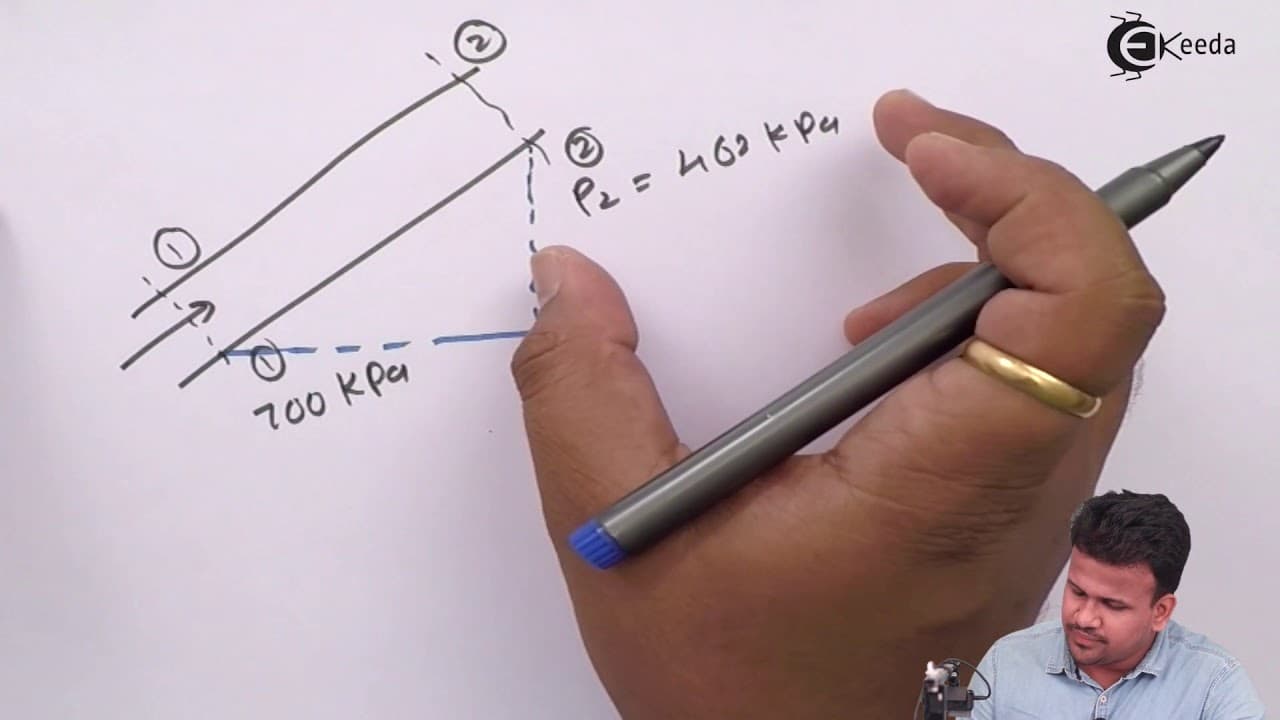
The pressure readings at the inlet and outlet are 700kPa and 462kPa respectively, indicating a pressure difference of 238kPa.
Summary & Key Takeaways
-
Water flows through a 50mm diameter pipe at a velocity of 1.5m/s and at an angle of 45 degrees to the horizontal.
-
Two sections of the pipe are located 30 meters apart, with pressure readings of 700kPa and 462kPa respectively.
-
We need to calculate the average shear stress at the walls and at a radius of 0.01 meters.
Read in Other Languages (beta)
Share This Summary 📚
Summarize YouTube Videos and Get Video Transcripts with 1-Click
Try YouTube Summary with ChatGPT & Claude or YouTube Transcript Generator
Explore More Summaries from Ekeeda 📚






Summarize YouTube Videos and Get Video Transcripts with 1-Click
Try YouTube Summary with ChatGPT & Claude or YouTube Transcript Generator